
follow ft86club on our blog, twitter or facebook.
FT86CLUB
Ft86Club
Speed By Design
Register Garage Community Calendar Today's Posts Search

Go Back   Toyota GR86, 86, FR-S and Subaru BRZ Forum & Owners Community - FT86CLUB > Technical Topics > Suspension | Chassis | Brakes -- Sponsored by 949 Racing

Suspension | Chassis | Brakes -- Sponsored by 949 Racing Relating to suspension, chassis, and brakes. Sponsored by 949 Racing.

Register and become an FT86Club.com member. You will see fewer ads

Reply
 
Thread Tools Search this Thread
Old 10-17-2012, 11:41 PM   #29
Dave-ROR
Site Moderator
 
Dave-ROR's Avatar
 
Join Date: Dec 2010
Drives: Stuff
Location: Florida
Posts: 10,317
Thanks: 955
Thanked 5,965 Times in 2,689 Posts
Mentioned: 262 Post(s)
Quote:
Originally Posted by ModBargains View Post
Actually, slotted rotors are proven to help. The slotted rotors help dissipate heat and creates even wear on the brake pad. Just my .02 cents.

We sell the Stoptech Power Slotted Rotors for both FRS and BRZ and it's been a popular seller:


-Frank
Dissipate heat? Really? You do understand that removing mass from a heatsink just makes it hold less heat and one of the rotors job is to take heat away from the pads and caliper. Removing mass means less heat can be taken away from those and held by the rotor until it's dissipated.

However, removal of heat from the system comes AFTER removing it from the pad and caliper.
__________________
-Dave
Track cars: 2013 Scion FRS, 1998 Acura Integra Type-R, 1993 Honda Civic Hatchback
DD: 2005 Acura TSX
Tow: 2022 F-450
Toys: 2001 Chevrolet Corvette Z06, 1993 Toyota MR2 Turbo, 1994 Toyota MR2 Turbo, 1991 Mitsubishi Galant VR-4
Parts: 2015 Subaru BRZ Limited, 2005 Acura TSX
Projects: 2013 Subaru BRZ Limited track car build
FS: 2004 GMC Sierra 2500 LT CCSB 8.1/Allison with 99k miles
Dave-ROR is offline   Reply With Quote
Old 10-18-2012, 01:33 AM   #30
jamal
Senior Member
 
jamal's Avatar
 
Join Date: Nov 2011
Drives: Legacy GT
Location: compton
Posts: 534
Thanks: 9
Thanked 368 Times in 206 Posts
Mentioned: 11 Post(s)
Quote:
Originally Posted by TAP Auto View Post
Powerslot and Stoptech rotors are both created from the Centric Premium blank. Go with the Powerslot rotor if you want a performance rotor.

The setup you have listed above sounds great, should really improve the pedal feel
This is not always true. The Powerslot rotors use a different alloy than the 120.xxxxx blanks as well as directional vanes. These are becoming available in blank format under the 125.xxxxx part number. Stoptech slotted/drilled rotors used to be made out of the 120.xxxxx material but now they are all becoming the same thing.

So, for some applications it is worth going to the slotted rotor for more than just the slots because you get a better alloy and directional vanes. However, for the FRS/BRZ I am not sure if they are using it yet. For the STi and EVO, the 126 rotor (slots) is very different from the 120 rotor.
jamal is offline   Reply With Quote
Old 10-18-2012, 12:17 PM   #31
ModBargains
 
ModBargains's Avatar
 
Join Date: Sep 2012
Drives: FRS, M3
Location: La Habra, CA
Posts: 296
Thanks: 48
Thanked 135 Times in 103 Posts
Mentioned: 24 Post(s)
Quote:
Originally Posted by Dave-ROR View Post
Dissipate heat? Really? You do understand that removing mass from a heatsink just makes it hold less heat and one of the rotors job is to take heat away from the pads and caliper. Removing mass means less heat can be taken away from those and held by the rotor until it's dissipated.

However, removal of heat from the system comes AFTER removing it from the pad and caliper.
Yes, really. Let me clarify my statement and help educate the people reading this thread as well.

Like you said, a rotor's job is to act as a heatsink because there is heat energy created by means of friction. This heat is then cooled down by the ambient air floating around the rotors. For example, why do people get Big Brake Kits for better stopping power? Because the bigger rotor is able to absorb more heat and there is a larger cooling surface. But along with heat, there are also hot gasses/debris that are emitted from the point of friction. These hot gasses/debris often get trapped between the rotors and brake pads and create "glazing" on the brake, increase temperature, and give a slugglish brake feeling.

So in the past, racing teams thought that cross drilling the rotors would help dissipate the heat better. But like you said as well: Less Mass = Less Energy Absorb = Poor Heatsink. However, with a slotted/vented style rotor, you can keep the same amount of surface area on the rotors while dissipating hot gasses/debris. Ever wonder why the slots are directional and kind of look like a propeller? It's because while the rotors spin, it forces cool air to be sucked in at the center, and hot hair to dissipate out just like any propeller/turbine/hairdryer etc.

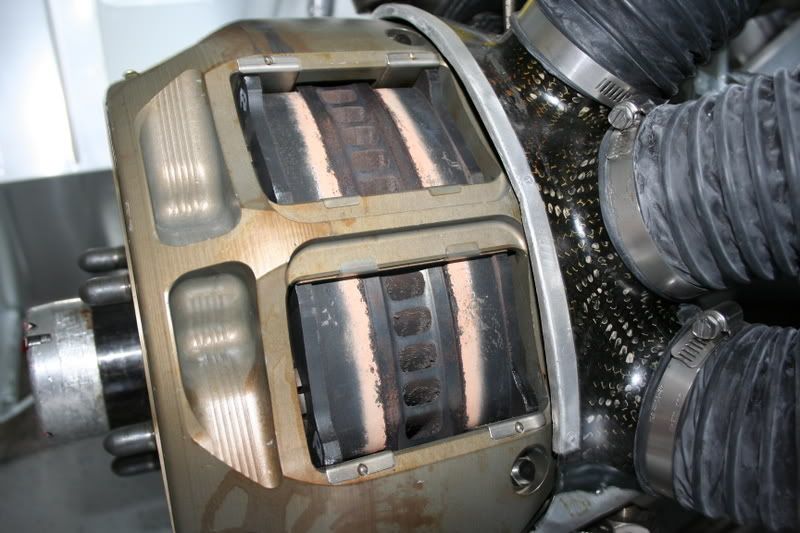
If you look almost all the racecars nowadays, they are mostly running slotted rotors. Take a look at these massive brakes on a NASCAR vehicle:


-Frank

Last edited by ModBargains; 10-18-2012 at 12:46 PM.
ModBargains is offline   Reply With Quote
Old 10-18-2012, 12:27 PM   #32
ModBargains
 
ModBargains's Avatar
 
Join Date: Sep 2012
Drives: FRS, M3
Location: La Habra, CA
Posts: 296
Thanks: 48
Thanked 135 Times in 103 Posts
Mentioned: 24 Post(s)
Quote:
Originally Posted by ABQautoxer View Post
Of course, you sell parts, I don't.
I don't think it comes to that actually at all. I think it comes down to what you want out of your braking system. If you want to prolong the life of your brake pads and are satisfied with the stock braking system, a regular rotor would do just fine. But if you are looking for more of a bite and don't mind replacing brake pads sooner, a slotted rotor is going to give you increased bite, but it will eat away your brake pads sooner.

A slotted rotor is not a "bad idea" if increased braking performance is what someone is looking for.

-Frank

Last edited by ModBargains; 10-18-2012 at 12:49 PM.
ModBargains is offline   Reply With Quote
Old 10-18-2012, 02:09 PM   #33
Dave-ROR
Site Moderator
 
Dave-ROR's Avatar
 
Join Date: Dec 2010
Drives: Stuff
Location: Florida
Posts: 10,317
Thanks: 955
Thanked 5,965 Times in 2,689 Posts
Mentioned: 262 Post(s)
Before reading this reply understand that I'm not against slotted rotors when used correctly.

Quote:
Originally Posted by ModBargains View Post
Like you said, a rotor's job is to act as a heatsink because there is heat energy created by means of friction. This heat is then cooled down by the ambient air floating around the rotors.
Correct, usually assisted by brake cooling on any serious track car or race car if brake temps are a concern.

Quote:
For example, why do people get Big Brake Kits for better stopping power? Because the bigger rotor is able to absorb more heat and there is a larger cooling surface.
Most people? For looks. For others, because it's the only solution left after attempting all others to reduce brake temps to a reasonable level. Increasing rotor diameter IMO should be the last ditch effort, not the first one. Get a pad that works in the heat range you are seeing, fluid that works, and then if the rotor can't take enough heat from the pads/caliper/fluid and/or can't remove the heat, then go either with a wider rotor with directional vanes (not slots necessarily, or j hooks, etc). Still too hot, run ducts to the center of the rotor to increase the cooling the directionally vented rotor is doing. Still not enough, go bigger.

Quote:
But along with heat, there are also hot gasses/debris that are emitted from the point of friction. These hot gasses/debris often get trapped between the rotors and brake pads and create "glazing" on the brake, increase temperature, and give a slugglish brake feeling.
Gasses aren't so much a problem these days. Debris is, but I've never seen a slotted rotor on my cars not get filled up with crap to the point of no longer being slotted after 30 minutes or so of track use anyways

Quote:
So in the past, racing teams thought that cross drilling the rotors would help dissipate the heat better.
Technically they did it to remove gasses from old pad technology knowing the side effect would be less heat capacity and sized rotors appropriately. They were also throw away because both end up with cracks from the stress risers (slots/holes) although casting them into the rotor instead of cutting/drilling helps with that (but does not eliminate it).

Quote:
But like you said as well: Less Mass = Less Energy Absorb = Poor Heatsink. However, with a slotted/vented style rotor, you can keep the same amount of surface area on the rotors while dissipating hot gasses/debris.
Surface area for the pads? If that's what you mean then you're wrong. Surface area for heat removal, you could technically say there is more but the slots fill up with pad material and vented rotors cool more from the center than the face. Rotors don't remove heat from the system until braking is done (until then they are providing a surface for friction, generating heat, and keeping heat from the pad and caliper), so by removing material/mass you are limiting how much heat can be held more than you are doing anything for cooling. Slots are great for bite though, and their negatives are far less than drilled rotors negatives.

Quote:
Ever wonder why the slots are directional and kind of look like a propeller? It's because while the rotors spin, it forces cool air to be sucked in at the center, and hot hair to dissipate out just like any propeller/turbine/hairdryer etc.
They aren't always and the air is so turbulant on the rotor face from the wheels, caliper, etc that I seriously doubt (but have never read a non-reseller or manufacturers study/PR) that the slots are bringing ANY air to the center, and if they did on half the rotor it would hit the wheel, not the center of the rotor to exit the vanes to really cool the rotor. The best way to cool brakes it to direct outside cool air into the center of the rotor to the vanes, so it can be expelled out taking heat with it, not to bring it from the outside of the rotor in, and then back out which seems to be what your text is saying there.

Quote:
If you look almost all the racecars nowadays, they are mostly running slotted rotors. Take a look at these massive brakes on a NASCAR vehicle:

-Frank
And j hooks.

NASCAR also does this:


I haven't seen a BRZ with that level of brake cooling yet (nor do I expect I ever will).

Here's my problem with slotted on this car on the track (again street use doesn't matter, just watch drilled rotors to check for cracks over time, but whatever the heck you want for looks), these cars, much to my surprise, simply don't have enough mass up front IMO to handle tracks that are tougher on brakes. They need more mass or better cooling through brake ducts (ie real cooling). This is one of my rotors after a day at Sebring:
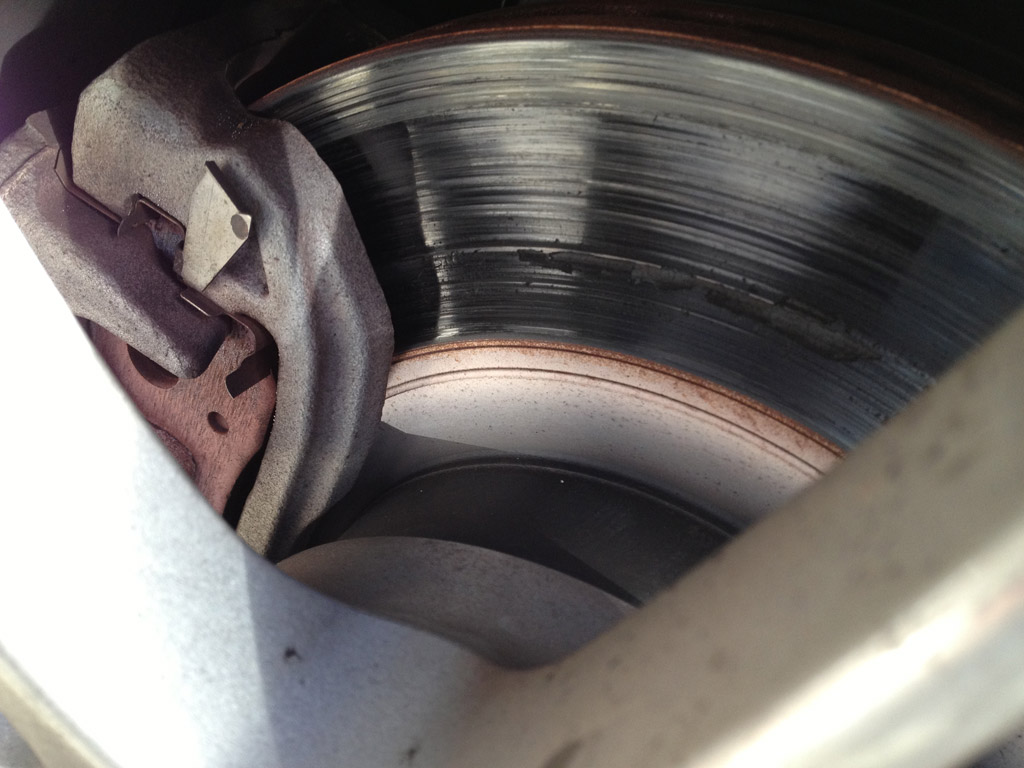

The other side is the same. I have no doubt those rotors were glowing a nice shade of red going into 17 and 6 at least. So with stock size rotors we already don't have enough mass IMO so removing ANY mass is going to reduce that capacity that's already borderline. I'm perfectly fine with slots or j hooks on wider/larger rotors and with cooling, just not as stock replacements for track use.
__________________
-Dave
Track cars: 2013 Scion FRS, 1998 Acura Integra Type-R, 1993 Honda Civic Hatchback
DD: 2005 Acura TSX
Tow: 2022 F-450
Toys: 2001 Chevrolet Corvette Z06, 1993 Toyota MR2 Turbo, 1994 Toyota MR2 Turbo, 1991 Mitsubishi Galant VR-4
Parts: 2015 Subaru BRZ Limited, 2005 Acura TSX
Projects: 2013 Subaru BRZ Limited track car build
FS: 2004 GMC Sierra 2500 LT CCSB 8.1/Allison with 99k miles

Last edited by Dave-ROR; 10-18-2012 at 02:22 PM.
Dave-ROR is offline   Reply With Quote
The Following User Says Thank You to Dave-ROR For This Useful Post:
gmookher (10-22-2012)
Old 10-18-2012, 02:11 PM   #34
Dave-ROR
Site Moderator
 
Dave-ROR's Avatar
 
Join Date: Dec 2010
Drives: Stuff
Location: Florida
Posts: 10,317
Thanks: 955
Thanked 5,965 Times in 2,689 Posts
Mentioned: 262 Post(s)
Quote:
Originally Posted by ModBargains View Post
A slotted rotor is not a "bad idea" if increased braking performance is what someone is looking for.
Additional bite is nice, but can be gained from pads and shorter pad life isn't what I consider "braking performance". If the tires can be locked/ABS activated then the car has MORE than enough brake already so it all comes down to heat management.

Man I can't even remember how many times this topic has been discussed here already.
__________________
-Dave
Track cars: 2013 Scion FRS, 1998 Acura Integra Type-R, 1993 Honda Civic Hatchback
DD: 2005 Acura TSX
Tow: 2022 F-450
Toys: 2001 Chevrolet Corvette Z06, 1993 Toyota MR2 Turbo, 1994 Toyota MR2 Turbo, 1991 Mitsubishi Galant VR-4
Parts: 2015 Subaru BRZ Limited, 2005 Acura TSX
Projects: 2013 Subaru BRZ Limited track car build
FS: 2004 GMC Sierra 2500 LT CCSB 8.1/Allison with 99k miles
Dave-ROR is offline   Reply With Quote
Old 10-18-2012, 03:29 PM   #35
ModBargains
 
ModBargains's Avatar
 
Join Date: Sep 2012
Drives: FRS, M3
Location: La Habra, CA
Posts: 296
Thanks: 48
Thanked 135 Times in 103 Posts
Mentioned: 24 Post(s)
Quote:
Originally Posted by Dave-ROR View Post
Before reading this reply understand that I'm not against slotted rotors when used correctly.


Correct, usually assisted by brake cooling on any serious track car or race car if brake temps are a concern.


Most people? For looks. For others, because it's the only solution left after attempting all others to reduce brake temps to a reasonable level. Increasing rotor diameter IMO should be the last ditch effort, not the first one. Get a pad that works in the heat range you are seeing, fluid that works, and then if the rotor can't take enough heat from the pads/caliper/fluid and/or can't remove the heat, then go either with a wider rotor with directional vanes (not slots necessarily, or j hooks, etc). Still too hot, run ducts to the center of the rotor to increase the cooling the directionally vented rotor is doing. Still not enough, go bigger.

Agreed, most people get it for show. You could run ducts, but realistically how many FRS/BRZ daily drivers are going to invest time fabricating brake cooling ducts, testing, etc.

Gasses aren't so much a problem these days. Debris is, but I've never seen a slotted rotor on my cars not get filled up with crap to the point of no longer being slotted after 30 minutes or so of track use anyways

Gasses/debris still exist though - more evident with certain brake pad combos than others. I've never seen a slotted rotor get filled up with crap as well, but again, over time, little accumulation of micro debris can add up.


Technically they did it to remove gasses from old pad technology knowing the side effect would be less heat capacity and sized rotors appropriately. They were also throw away because both end up with cracks from the stress risers (slots/holes) although casting them into the rotor instead of cutting/drilling helps with that (but does not eliminate it).

I don't think we disagree here. But yes, drilled rotors definitely tend to crack more.

Surface area for the pads? If that's what you mean then you're wrong. Surface area for heat removal, you could technically say there is more but the slots fill up with pad material and vented rotors cool more from the center than the face. Rotors don't remove heat from the system until braking is done (until then they are providing a surface for friction, generating heat, and keeping heat from the pad and caliper), so by removing material/mass you are limiting how much heat can be held more than you are doing anything for cooling. Slots are great for bite though, and their negatives are far less than drilled rotors negatives.

Bigger surface area for more cooling by the ambient air after braking is done. With a cross drilled setup, the surface area literally decreases because it's drilled out, so that's no bueno. Just like how increasing the surface size of a front mount intercooler will allow more air to hit the FMIC and increase cooling. I seriously doubt that the amount of material that is actually removed by going with a slotted setup is going to be ANYTHING significant to decrease cooling. A drilled setup, now that's a different story.

They aren't always and the air is so turbulant on the rotor face from the wheels, caliper, etc that I seriously doubt (but have never read a non-reseller or manufacturers study/PR) that the slots are bringing ANY air to the center, and if they did on half the rotor it would hit the wheel, not the center of the rotor to exit the vanes to really cool the rotor. The best way to cool brakes it to direct outside cool air into the center of the rotor to the vanes, so it can be expelled out taking heat with it, not to bring it from the outside of the rotor in, and then back out which seems to be what your text is saying there.

My point was not to prove that going with slotted rotors was the best way to cool the brakes. Of course, I 100% agree with you that the best way is to draw in outside air. But the only time we see that is on race car applications. I'm merely explaining why brake manufactures designed the slots the way they did. For more bite and to provide route for the excess gasses to escape.

And j hooks.

NASCAR also does this:


I haven't seen a BRZ with that level of brake cooling yet (nor do I expect I ever will).

Here's my problem with slotted on this car on the track (again street use doesn't matter, just watch drilled rotors to check for cracks over time, but whatever the heck you want for looks), these cars, much to my surprise, simply don't have enough mass up front IMO to handle tracks that are tougher on brakes. They need more mass or better cooling through brake ducts (ie real cooling). This is one of my rotors after a day at Sebring:

That's probably very true on the track. But I believe the OP wasn't a dedicated track junky.


The other side is the same. I have no doubt those rotors were glowing a nice shade of red going into 17 and 6 at least. So with stock size rotors we already don't have enough mass IMO so removing ANY mass is going to reduce that capacity that's already borderline. I'm perfectly fine with slots or j hooks on wider/larger rotors and with cooling, just not as stock \
replacements for track use.
If you got some testing data that you could provide to prove your theory, that would be an interesting read. But again, I highly doubt that the amount of material that is taken away on a slotted rotor is going to decrease the cooling ability of that rotor compared to the stock.

Quote:
Originally Posted by Dave-ROR View Post
Additional bite is nice, but can be gained from pads and shorter pad life isn't what I consider "braking performance". If the tires can be locked/ABS activated then the car has MORE than enough brake already so it all comes down to heat management.

True, but you can get a better bite with the right brake pads coupled with slotted rotors. Better bite = braking performance, shorter pad life is flip side to the coin.

Man I can't even remember how many times this topic has been discussed here already.
Probably too many times.

Again, I'm just here to help educate enthusiasts on what brake options are available to their FRS / BRZ and it's up to them to make a decision. I'm not here to argue or force you to accept that slotted rotors are the best for you. But again, I'm here to contribute to the forums and provide value. The Stoptech Power Slotted Rotors not only increase bite and help wipe away debris/gasses between the pad and rotor, but the hats come e-coated so they do not rust which is another advantage over stock rotors. Also, each power slot rotor has center split castings to provide proper heat transfer compared to the stock rotor. So there are other benefits going Stoptech Replacement Powerslot Rotors vs. stock rotors.

-Frank
ModBargains is offline   Reply With Quote
Old 10-18-2012, 03:49 PM   #36
Dave-ROR
Site Moderator
 
Dave-ROR's Avatar
 
Join Date: Dec 2010
Drives: Stuff
Location: Florida
Posts: 10,317
Thanks: 955
Thanked 5,965 Times in 2,689 Posts
Mentioned: 262 Post(s)
Hard to reply to those nested replies..

As for the OP, I already said multiple times for the street run whatever, it's not going to make much difference either way, so this left the street awhile ago I think.

Brake ducts, I will if I have to.. I'd prefer not to because they get annoying and I don't feel like dealing with it, which is why I'm increasing disc mass on my car instead (width, not diameter really). I don't forsee a problem after that point so thankfully I would have to remove my fogs and deal with hose routing/securing, potentially limited steering angles, etc due to ducts.

I also never said slotted decrease cooling, I said they decrease heat capacity because they have less mass unless mass is added somewhere else useful (which would be bad if it was added in the vanes, and it wouldn't serve much purpose in the hat). Capacity and cooling are two different things. On a car where it's borderline not being enough anyways I just don't think the slight benefits (bite, debris removal) offset the potential negatives (less heat capacity which will cause other components to run hotter), stress risers, etc.

I'm sure I'm not the only one here who is upgrading front components due to the limited heat capacity of the stock front brakes, so again, removing mass is something I would *never* consider except for testing.

I'd be more than happy to test it for you and gather data if I intended to keep stock components. If you want to provide the rotors I'm sure we can find someone to test it out. I'll supply temp paint and caliper strips if needed but won't send out the pyrometer...

I like bite for feel reasons, however distances aren't changed in any meaningful way. The driver has way more impact on that so I guess to me braking performance, if tires can be locked, comes down to: heat management, modulation, lifespan and feel in that order. :shrug:

People can buy what they want, I agree there, I just want to make sure people really understand what they are buying. Some brake "upgrades" remind me of all of these chassis braces. People want dynos, videos, first person impressions, etc when buying a $300 intake but will buy brakes and braces without any understanding or proof that what they are buying does anything postive for them.
__________________
-Dave
Track cars: 2013 Scion FRS, 1998 Acura Integra Type-R, 1993 Honda Civic Hatchback
DD: 2005 Acura TSX
Tow: 2022 F-450
Toys: 2001 Chevrolet Corvette Z06, 1993 Toyota MR2 Turbo, 1994 Toyota MR2 Turbo, 1991 Mitsubishi Galant VR-4
Parts: 2015 Subaru BRZ Limited, 2005 Acura TSX
Projects: 2013 Subaru BRZ Limited track car build
FS: 2004 GMC Sierra 2500 LT CCSB 8.1/Allison with 99k miles
Dave-ROR is offline   Reply With Quote
Old 10-18-2012, 03:55 PM   #37
OrbitalEllipses
Banned
 
Join Date: Jan 2012
Drives: Attitude
Location: MD
Posts: 10,046
Thanks: 884
Thanked 4,890 Times in 2,903 Posts
Mentioned: 123 Post(s)
Did someone legitimately bring up pad off-gassing in a modern day pad/rotor argument about whether or not slots are bling bling?
OrbitalEllipses is offline   Reply With Quote
The Following User Says Thank You to OrbitalEllipses For This Useful Post:
chulooz (10-18-2012)
Old 10-18-2012, 05:05 PM   #38
ModBargains
 
ModBargains's Avatar
 
Join Date: Sep 2012
Drives: FRS, M3
Location: La Habra, CA
Posts: 296
Thanks: 48
Thanked 135 Times in 103 Posts
Mentioned: 24 Post(s)
Quote:
Originally Posted by Dave-ROR View Post
Hard to reply to those nested replies..

As for the OP, I already said multiple times for the street run whatever, it's not going to make much difference either way, so this left the street awhile ago I think.

Brake ducts, I will if I have to.. I'd prefer not to because they get annoying and I don't feel like dealing with it, which is why I'm increasing disc mass on my car instead (width, not diameter really). I don't forsee a problem after that point so thankfully I would have to remove my fogs and deal with hose routing/securing, potentially limited steering angles, etc due to ducts.

I also never said slotted decrease cooling, I said they decrease heat capacity because they have less mass unless mass is added somewhere else useful (which would be bad if it was added in the vanes, and it wouldn't serve much purpose in the hat). Capacity and cooling are two different things. On a car where it's borderline not being enough anyways I just don't think the slight benefits (bite, debris removal) offset the potential negatives (less heat capacity which will cause other components to run hotter), stress risers, etc.

I'm sure I'm not the only one here who is upgrading front components due to the limited heat capacity of the stock front brakes, so again, removing mass is something I would *never* consider except for testing.

I'd be more than happy to test it for you and gather data if I intended to keep stock components. If you want to provide the rotors I'm sure we can find someone to test it out. I'll supply temp paint and caliper strips if needed but won't send out the pyrometer...

I like bite for feel reasons, however distances aren't changed in any meaningful way. The driver has way more impact on that so I guess to me braking performance, if tires can be locked, comes down to: heat management, modulation, lifespan and feel in that order. :shrug:

People can buy what they want, I agree there, I just want to make sure people really understand what they are buying. Some brake "upgrades" remind me of all of these chassis braces. People want dynos, videos, first person impressions, etc when buying a $300 intake but will buy brakes and braces without any understanding or proof that what they are buying does anything postive for them.
Definitely, brake ducts would be a hassle, but I would actually be pretty stoked if you started on that. How much wider were you looking to go with rotors?

I understand what you are saying about decreasing the rotor disc mass, but again the amount of material that is actually taken off by going with slotted rotors, I think, is not going to negatively affect the heat capacity by much at all. I guess only test data will show that though.

I think people should always do their research before buying any product whether it's an intake or chassis bracing. As far as chassis bracing, there are ways to test how much benefit it would provide. For example, Cusco explains how there chassis braces works...it's actually pretty information:

http://www.jdm-option.com/eng/pr_CUSCO/towerbar.html

-Frank
ModBargains is offline   Reply With Quote
Old 10-18-2012, 05:13 PM   #39
Dave-ROR
Site Moderator
 
Dave-ROR's Avatar
 
Join Date: Dec 2010
Drives: Stuff
Location: Florida
Posts: 10,317
Thanks: 955
Thanked 5,965 Times in 2,689 Posts
Mentioned: 262 Post(s)
Quote:
Originally Posted by ModBargains View Post
Definitely, brake ducts would be a hassle, but I would actually be pretty stoked if you started on that. How much wider were you looking to go with rotors?
32MM wide vs 24MM stock.

Comparison, assuming I can crosslink Jeff's pics here:


Vent pic - stock:


Replacement AP disc:


Also using AP 4 pots with pads that have 15mm friction pucks vs the OEM 10mm friction puck.
__________________
-Dave
Track cars: 2013 Scion FRS, 1998 Acura Integra Type-R, 1993 Honda Civic Hatchback
DD: 2005 Acura TSX
Tow: 2022 F-450
Toys: 2001 Chevrolet Corvette Z06, 1993 Toyota MR2 Turbo, 1994 Toyota MR2 Turbo, 1991 Mitsubishi Galant VR-4
Parts: 2015 Subaru BRZ Limited, 2005 Acura TSX
Projects: 2013 Subaru BRZ Limited track car build
FS: 2004 GMC Sierra 2500 LT CCSB 8.1/Allison with 99k miles
Dave-ROR is offline   Reply With Quote
Old 10-18-2012, 05:30 PM   #40
ModBargains
 
ModBargains's Avatar
 
Join Date: Sep 2012
Drives: FRS, M3
Location: La Habra, CA
Posts: 296
Thanks: 48
Thanked 135 Times in 103 Posts
Mentioned: 24 Post(s)
Looks promising! Keep us updated!

-Frank
ModBargains is offline   Reply With Quote
Old 10-18-2012, 06:53 PM   #41
JoeBoxer
Senior Member
 
JoeBoxer's Avatar
 
Join Date: Jul 2012
Drives: Whiteout FR-S
Location: Arkansas
Posts: 4,154
Thanks: 1,666
Thanked 1,627 Times in 997 Posts
Mentioned: 72 Post(s)
Thanks for all the info guys, I gained a lot of knowledge from this thread I wasn't expecting. Sorry if it had all been explained before but I feel comfortable with purchasing the centric blanks now, one of the rare cases where cheaper seems to be better for my uses.
JoeBoxer is offline   Reply With Quote
The Following User Says Thank You to JoeBoxer For This Useful Post:
TAP Auto Parts (10-19-2012)
Old 10-19-2012, 12:04 PM   #42
GTM_Challenge
 
GTM_Challenge's Avatar
 
Join Date: Aug 2012
Drives: On track
Location: Chicago
Posts: 527
Thanks: 120
Thanked 285 Times in 166 Posts
Mentioned: 5 Post(s)
As long as you use at least the Centric Premium level rotor, it should be as good as an off the shelf oem rotor in our experiences with S2000 racing, which is not far off from the FRS/BRZ in concept. The right slotted design has its benefits, but from an OEM sized brake setup, we generally stick with OEM or equivlent blanks to keep costs in check as long as they are taking the heat without cracking frequently.
GTM_Challenge is offline   Reply With Quote
 
Reply


Posting Rules
You may not post new threads
You may not post replies
You may not post attachments
You may not edit your posts

BB code is On
Smilies are On
[IMG] code is On
HTML code is Off

Forum Jump

Similar Threads
Thread Thread Starter Forum Replies Last Post
Son of a @#$*&!!! I found out my dealer drilled holes on the front bumper RYU Scion FR-S / Toyota 86 GT86 General Forum 40 09-12-2012 07:23 AM
Front Rotor Specs - Yes i searched. njccmd2002 Suspension | Chassis | Brakes -- Sponsored by 949 Racing 11 09-03-2012 01:58 AM
($10 Discount on 2nd slot) CDC Autox Sat Aug 11th Hylton HS Woodbirdge, Va echan Mid-Atlantic 0 08-09-2012 10:57 PM
License Plate Holes pre-drilled straight from Japan? Motopythons CANADA 3 07-05-2012 10:15 PM


All times are GMT -4. The time now is 12:56 PM.


Powered by vBulletin® Version 3.8.11
Copyright ©2000 - 2026, vBulletin Solutions Inc.
User Alert System provided by Advanced User Tagging v3.3.0 (Lite) - vBulletin Mods & Addons Copyright © 2026 DragonByte Technologies Ltd.

Garage vBulletin Plugins by Drive Thru Online, Inc.