
follow ft86club on our blog, twitter or facebook.
FT86CLUB
Ft86Club
Speed By Design
Register Garage Community Calendar Today's Posts Search

Go Back   Toyota GR86, 86, FR-S and Subaru BRZ Forum & Owners Community - FT86CLUB > Technical Topics > Suspension | Chassis | Brakes -- Sponsored by 949 Racing

Suspension | Chassis | Brakes -- Sponsored by 949 Racing Relating to suspension, chassis, and brakes. Sponsored by 949 Racing.

Register and become an FT86Club.com member. You will see fewer ads

User Tag List

Reply
 
Thread Tools Search this Thread
Old 06-25-2013, 01:00 PM   #71
IMOA
Member
 
Join Date: Jan 2013
Drives: 86 GTS
Location: Sydney
Posts: 40
Thanks: 0
Thanked 22 Times in 12 Posts
Mentioned: 1 Post(s)
Tagged: 0 Thread(s)
Quote:
Originally Posted by qoncept View Post
It's still absolutely wrong. Play with the calculator below. You'll see that when you increase the maximum available force you also increase the maximum static (rolling) friction. In other words, if your brakes are stronger, you can apply more force before you lock them up. It's a chain that starts at the pad and ends at the road.

It's right here, clear as day. Unsubbed.

http://www.ajdesigner.com/phpfrictio...imum_force.php

Example:
We'll make up a coefficient for brake pads on rotors since I reall have no idea.. lets say 0.8.

- Stock brakes apply 20 newtons of force, which gives us a max of 16 newtons of friction on the rotor. Tires on road is a coefficient of .9, and the 16 newtons we're applying gives us stopping force of 14.4 newtons.

- Megabrake applies 25 newtons of force. Same coefficient of .8 means the rotor sees 20 newtons of friction, and then the tire on the road sees 18 newtons of maximum static friction.

Of course, the friction required to stop a car increases exponentially. Same deal with power and acceleration.
That would work great if we were trying to work out how hard we had to push a car with it's handbrake on to get it to slide. Unfortunately thats not what we're talking about.
IMOA is offline   Reply With Quote
Old 06-25-2013, 01:02 PM   #72
Taxi
Junior Member
 
Join Date: Oct 2012
Drives: Too Many Miatas
Location: Chicago
Posts: 1
Thanks: 0
Thanked 1 Time in 1 Post
Mentioned: 0 Post(s)
Tagged: 0 Thread(s)
For someone asking about if its right to swap between pads for autox, track, street, etc, you sure do seem to know a lot about how brakes work.
Taxi is offline   Reply With Quote
The Following User Says Thank You to Taxi For This Useful Post:
orthojoe (06-26-2013)
Old 06-25-2013, 01:02 PM   #73
qoncept
Senior Member
 
qoncept's Avatar
 
Join Date: May 2013
Drives: 2013 BRZ
Location: Iowa
Posts: 928
Thanks: 135
Thanked 298 Times in 202 Posts
Mentioned: 1 Post(s)
Tagged: 0 Thread(s)
Garage
Quote:
Originally Posted by IMOA View Post
That would work great if we were trying to work out how hard we had to push a car with it's handbrake on to get it to slide. Unfortunately thats not what we're talking about.
Sorry, there's a different equation for that. http://www.school-for-champions.com/...ling_start.htm
__________________
qoncept is offline   Reply With Quote
Old 06-25-2013, 01:08 PM   #74
Racecomp Engineering
 
Join Date: Nov 2011
Drives: 2016 BRZ, 2012 Paris Di2 & 2018 STI
Location: Severn, MD
Posts: 5,520
Thanks: 3,542
Thanked 7,415 Times in 3,033 Posts
Mentioned: 311 Post(s)
Tagged: 9 Thread(s)
Send a message via AIM to Racecomp Engineering
Quote:
Originally Posted by qoncept View Post
Since the invention of the wheel I suppose. Static friction isn't just a good idea, it's the law.
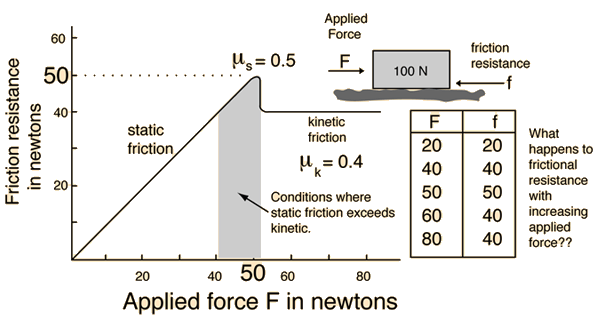
The law also states that if you exceed Fmax, than you have begun sliding. Fmax does not increase just because.


This plot kind of sums it up nicely.

- Andy
Racecomp Engineering is offline   Reply With Quote
Old 06-25-2013, 01:22 PM   #75
qoncept
Senior Member
 
qoncept's Avatar
 
Join Date: May 2013
Drives: 2013 BRZ
Location: Iowa
Posts: 928
Thanks: 135
Thanked 298 Times in 202 Posts
Mentioned: 1 Post(s)
Tagged: 0 Thread(s)
Garage
Quote:
Originally Posted by Racecomp Engineering View Post
The law also states that if you exceed Fmax, than you have begun sliding. Fmax does not increase just because.
Here is the major difficulty. Just because it flies in the fact of everything we think makes sense doesn't make it untrue.

Yes, Fmax does increase. Look at the equation. Seriously, LOOK at it. That's EXACTLY what it says.
__________________
qoncept is offline   Reply With Quote
Old 06-25-2013, 01:44 PM   #76
IMOA
Member
 
Join Date: Jan 2013
Drives: 86 GTS
Location: Sydney
Posts: 40
Thanks: 0
Thanked 22 Times in 12 Posts
Mentioned: 1 Post(s)
Tagged: 0 Thread(s)
No, it says that if the object weighs more you have to push it harder to get it to slide. Now look at how you're trying to use it.
IMOA is offline   Reply With Quote
Old 06-25-2013, 01:48 PM   #77
Racecomp Engineering
 
Join Date: Nov 2011
Drives: 2016 BRZ, 2012 Paris Di2 & 2018 STI
Location: Severn, MD
Posts: 5,520
Thanks: 3,542
Thanked 7,415 Times in 3,033 Posts
Mentioned: 311 Post(s)
Tagged: 9 Thread(s)
Send a message via AIM to Racecomp Engineering
Quote:
Originally Posted by qoncept View Post
Here is the major difficulty. Just because it flies in the fact of everything we think makes sense doesn't make it untrue.

Yes, Fmax does increase. Look at the equation. Seriously, LOOK at it. That's EXACTLY what it says.
It flies in the face of my statics, dynamics, and I can't remember how many physics courses I've had.

Fmax isn't really in the equation. You just know that if the calculated force of friction exceeds Fmax, then you are sliding and must now use kinematic mu. I'm talking wood blocks sliding on a table here.

- Andy
Racecomp Engineering is offline   Reply With Quote
Old 06-25-2013, 01:51 PM   #78
Admiral Ballsy
Shorter of breath
 
Admiral Ballsy's Avatar
 
Join Date: Jul 2012
Drives: a soft bargain
Location: Central IN
Posts: 414
Thanks: 1
Thanked 118 Times in 77 Posts
Mentioned: 1 Post(s)
Tagged: 0 Thread(s)
Garage
Quote:
Originally Posted by qoncept View Post
Yes, Fmax does increase. Look at the equation. Seriously, LOOK at it. That's EXACTLY what it says.
You're mixing up the equation defining the relationship of the pads to the disc with that defining the relationship between the tires and the road.

More force on the pads changes the dynamics of the pad-disc rotation/friction. It has nothing to do with the force defining the friction parameters of tire/road.
Admiral Ballsy is offline   Reply With Quote
Old 06-25-2013, 01:56 PM   #79
qoncept
Senior Member
 
qoncept's Avatar
 
Join Date: May 2013
Drives: 2013 BRZ
Location: Iowa
Posts: 928
Thanks: 135
Thanked 298 Times in 202 Posts
Mentioned: 1 Post(s)
Tagged: 0 Thread(s)
Garage
Quote:
Originally Posted by Racecomp Engineering View Post
Fmax isn't really in the equation.


__________________
qoncept is offline   Reply With Quote
Old 06-25-2013, 01:58 PM   #80
Dave-ROR
Site Moderator
 
Dave-ROR's Avatar
 
Join Date: Dec 2010
Drives: Stuff
Location: Florida
Posts: 10,317
Thanks: 955
Thanked 5,965 Times in 2,689 Posts
Mentioned: 262 Post(s)
Tagged: 8 Thread(s)
Quote:
Originally Posted by qoncept View Post
No, you can't exceed the limits of friction and stop any faster. But you can change the limit by changing the force applied to it.
I never said exceeding the limits of adhesion would stop you any faster.
__________________
-Dave
Track cars: 2013 Scion FRS, 1998 Acura Integra Type-R, 1993 Honda Civic Hatchback
DD: 2005 Acura TSX
Tow: 2022 F-450
Toys: 2001 Chevrolet Corvette Z06, 1993 Toyota MR2 Turbo, 1994 Toyota MR2 Turbo, 1991 Mitsubishi Galant VR-4
Parts: 2015 Subaru BRZ Limited, 2005 Acura TSX
Projects: 2013 Subaru BRZ Limited track car build
FS: 2004 GMC Sierra 2500 LT CCSB 8.1/Allison with 99k miles
Dave-ROR is offline   Reply With Quote
Old 06-25-2013, 01:58 PM   #81
SubieNate
Senior Member
 
SubieNate's Avatar
 
Join Date: Aug 2012
Drives: 2013 FR-S Ultramarine
Location: Temecula, CA
Posts: 959
Thanks: 288
Thanked 560 Times in 269 Posts
Mentioned: 6 Post(s)
Tagged: 0 Thread(s)
Quote:
Originally Posted by qoncept View Post
Here is the major difficulty. Just because it flies in the fact of everything we think makes sense doesn't make it untrue.

Yes, Fmax does increase. Look at the equation. Seriously, LOOK at it. That's EXACTLY what it says.
Dude, you're so wrong it hurts.

Fmaxstatic=mu*fnormal.

For the tires, Fnormal is NOT NOT NOT the braking force. Fnormal is the weight pushing down perpendicular to the sliding/rolling surface.

Trust me. Your understanding is flawed. I went to school for this stuff and CSG_Mike, IMOA, Dave_ROR and Racecomp Engineering area all correct. Without changing the mass on the tire or it's friction coefficient, it's fmax will not change due to the applied force.

Nathan
SubieNate is offline   Reply With Quote
Old 06-25-2013, 02:05 PM   #82
Racecomp Engineering
 
Join Date: Nov 2011
Drives: 2016 BRZ, 2012 Paris Di2 & 2018 STI
Location: Severn, MD
Posts: 5,520
Thanks: 3,542
Thanked 7,415 Times in 3,033 Posts
Mentioned: 311 Post(s)
Tagged: 9 Thread(s)
Send a message via AIM to Racecomp Engineering
Quote:
Originally Posted by qoncept View Post


Yes, that's one way to apply the equation when you're trying to find Fmax. You're still doing it wrong.

I do enjoy the discussion though.

- Andy

Last edited by Racecomp Engineering; 06-25-2013 at 02:25 PM.
Racecomp Engineering is offline   Reply With Quote
Old 06-25-2013, 05:16 PM   #83
wparsons
Senior Member
 
wparsons's Avatar
 
Join Date: Jul 2012
Drives: 2013 Asphalt FR-S Manual
Location: Whitby, ON, Canada
Posts: 6,716
Thanks: 7,875
Thanked 3,353 Times in 2,134 Posts
Mentioned: 99 Post(s)
Tagged: 1 Thread(s)
Garage
Quote:
Originally Posted by qoncept View Post
It's still absolutely wrong. Play with the calculator below. You'll see that when you increase the maximum available force you also increase the maximum static (rolling) friction. In other words, if your brakes are stronger, you can apply more force before you lock them up. It's a chain that starts at the pad and ends at the road.

It's right here, clear as day. Unsubbed.

http://www.ajdesigner.com/phpfrictio...imum_force.php

Example:
We'll make up a coefficient for brake pads on rotors since I reall have no idea.. lets say 0.8.

- Stock brakes apply 20 newtons of force, which gives us a max of 16 newtons of friction on the rotor. Tires on road is a coefficient of .9, and the 16 newtons we're applying gives us stopping force of 14.4 newtons.

- Megabrake applies 25 newtons of force. Same coefficient of .8 means the rotor sees 20 newtons of friction, and then the tire on the road sees 18 newtons of maximum static friction.

Of course, the friction required to stop a car increases exponentially. Same deal with power and acceleration.
No, no, no. You're totally mixing up the equations. You shouldn't be adding the stopping force at the rotor to the stopping force of the tire on the road. That's like saying if you're towing a trailer the amount of force the tow vehicle can apply to the trailer is equal to the amount of force the two vehicle can apply to the road plus the amount of force the attachment point (hitch, chain, whatever) between the tow vehicle and trailer can sustain without braking. The reality is that the total force that can be applied isn't the sum, but the minimum of the two forces.

In this case, force applied to slow down a wheel doesn't change the amount of frictional force between the tire and the road. They're two different frictional forces. The only correlation is that the maximum braking force is the minimum of the two, not the sum.

Quote:
Originally Posted by qoncept View Post
The examples I just posted (see the bold) say that the wheels lock up at 14.4 newtons in the stock example, 18 newtons in the upgraded brake example.

The number you're calculating is maximum static friction. Increase force, increase maximum static friction. Stronger brakes increase the threshold of friction between the road and the tire before locking up.

So no, you don't just lock up the brakes easier.
You're using the equations 100% wrong.

First, if you want to see how much total force is being applied to the wheels from the brake pads you need to look at the amount of force being applied to them, the mu, the rotor speed and the diameter of the brake rotor. Just the mu and pressure isn't nearly enough.

Second, you simply can't apply more force to the rotor than the tires can to the road. Once the wheel locks the amount of braking force between the rotor and brake pad goes way down since the rotor speed is now 0. You can do all the math you want, but I'll give you a hint that the maximum amount of force you can apply through the rotor in a given situation is exactly the same as the maximum amount of force the tires can sustain without locking up.
__________________
Light travels faster than sound, so people may appear to be bright until you hear them speak...
flickr
wparsons is offline   Reply With Quote
The Following User Says Thank You to wparsons For This Useful Post:
SubieNate (06-25-2013)
Old 06-25-2013, 06:40 PM   #84
CSG Mike
 
CSG Mike's Avatar
 
Join Date: Jul 2012
Drives: S2000 CR
Location: Orange County
Posts: 14,562
Thanks: 8,942
Thanked 14,211 Times in 6,854 Posts
Mentioned: 970 Post(s)
Tagged: 14 Thread(s)
Quote:
Originally Posted by qoncept View Post
The examples I just posted (see the bold) say that the wheels lock up at 14.4 newtons in the stock example, 18 newtons in the upgraded brake example.

The number you're calculating is maximum static friction. Increase force, increase maximum static friction. Stronger brakes increase the threshold of friction between the road and the tire before locking up.

So no, you don't just lock up the brakes easier.
Increase maximum static friction on the rotor vs brake pad, not the tire vs the ground.
CSG Mike is offline   Reply With Quote
The Following User Says Thank You to CSG Mike For This Useful Post:
wparsons (06-25-2013)
 
Reply


Posting Rules
You may not post new threads
You may not post replies
You may not post attachments
You may not edit your posts

BB code is On
Smilies are On
[IMG] code is On
HTML code is Off

Forum Jump

Similar Threads
Thread Thread Starter Forum Replies Last Post
Who wants to see Wilwood Brakes vs. AP Racing Brakes ( Sprint Kit ) FT-86 SpeedFactory Suspension | Chassis | Brakes -- Sponsored by 949 Racing 119 12-17-2017 06:53 PM
What's everyone doing on stock brakes, for pads? Nourdmrolnmt1 Suspension | Chassis | Brakes -- Sponsored by 949 Racing 45 05-15-2013 06:08 PM
FS: Stock front FRS Brakes(complete w/ lines) whiteout13FRS Brakes, Suspension, Chassis 0 04-12-2013 05:13 AM
weak paint on bumper 1strwdcar Cosmetic Modification (Interior/Exterior/Lighting) 6 08-15-2012 10:19 PM
Why are most stock wheels weak stance? #87 Other Vehicles & General Automotive Discussions 16 12-17-2011 06:15 AM


All times are GMT -4. The time now is 11:44 AM.


Powered by vBulletin® Version 3.8.11
Copyright ©2000 - 2026, vBulletin Solutions Inc.
User Alert System provided by Advanced User Tagging v3.3.0 (Lite) - vBulletin Mods & Addons Copyright © 2026 DragonByte Technologies Ltd.

Garage vBulletin Plugins by Drive Thru Online, Inc.