


 11-02-2012, 03:18 PM
|
#57 |
|
Senior Member
Join Date: Feb 2012
Drives: 13 GTI
Location: WI
Posts: 416
Thanks: 119
Thanked 204 Times in 97 Posts
Mentioned: 0 Post(s)
|
What are the accordion flex pieces there for? Head expansion/contraction? I've seen some headers without this though.
__________________
 |

|

|
|
11-04-2012, 03:59 AM
|
#58 | |
|
Curious cat.

Join Date: May 2012
Drives: 86 GT base M/T - Red
Location: Dubai
Posts: 775
Thanks: 840
Thanked 383 Times in 191 Posts
Mentioned: 31 Post(s)
|
Quote:
Will the production version of the UEL header be interchangable/compatible with OEM pieces or will it only fit with the rest of the Borla system (overpipe, midpipe etc)?
__________________
2013 Toyota 86 GT M/T
2009 Renault Clio Sport R27 Team F1 Edition (sold) 1991 Mazda MX5 Miata (sold) 2007 Mitsubishi Evo 9 RS (sold) 2006 VW Golf R32 (sold) |
|
|
|
|
|
11-04-2012, 08:38 PM
|
#59 | |
|
Member
Join Date: Jul 2012
Drives: vw mk4 r32
Location: ventura,ca
Posts: 57
Thanks: 13
Thanked 77 Times in 30 Posts
Mentioned: 4 Post(s)
|
Quote:
|
|
|
|
|
| The Following User Says Thank You to AlvinT@Borla For This Useful Post: | ultra (11-05-2012) |
|
11-05-2012, 06:37 PM
|
#60 |

Join Date: Nov 2012
Drives: 2011 Audi S4
Location: Oxnard, California
Posts: 4
Thanks: 0
Thanked 19 Times in 4 Posts
Mentioned: 0 Post(s)
|
Hi,
This is David Borla from Borla Exhaust. Truly appreciate all the interest in the parts we’ve designed for the FR-S . I I can’t stress enough how much we love this platform and how important it is to us that we do the best possible job for you guys. With that said I think it’s important that I address a few things that have been mentioned regarding our parts because we don’t want anyone to be misled. I hope you don’t mind that I’ve chimed in here and please understand that my intention is only to clear a few things up, or at least provide an explanation as to why we did what we did with these parts. I’m not here to soapbox and I hope it doesn’t come off that way. First of all let me address the whole issue of aftermarket or “high flow” cats and why we didn’t incorporate them into our header design. The fact of the matter is that removing or changing your original catalytic convertors with performance or high flow catalytic converters renders your vehicle illegal for street use everywhere in The United States per federal law. Please allow me to repeat that I am referring to federal law, not state law. This is per The Environmental Protection agency (The EPA). In other words, the federal government of The United States is very clear about the fact that regardless of which state you reside in you are not allowed to remove or replace your catalytic convertors and drive on public roads. This includes replacing them with aftermarket cats. So, every performance or high flow catalytic converter on the market is illegal for use on public roads in The United States per The EPA. It’s really that simple. I’ll get into enforcement after you get a chance to read the EPA laws below. I copied and pasted the exact verbiage from the EPA below. You can find the link here - http://www.epa.gov/oms/cert/factshts/catcvrts.pdf (6) When can I install an aftermarket converter? Generally, there are only 3 situations when you can install an aftermarket converter. They are: (1) if the converter is missing from the vehicle when brought in for exhaust system repair; or (2) if a State or local inspection program has determined the existing converter has been lead poisoned, damaged, or otherwise needs replacement; or (3) if the vehicle is more than 5 years old or has more than 50,000 miles* (8 years/80,000 miles for 1995 and newer vehicles) and a legitimate need for replacement has been established and appropriately documented (e.g., a plugged converter or unrepairable exhaust leaks). Any other converter replacement must be with a 'certified' or new original equipment (OE) or equivalent converter. Aftermarket converters subject to the enforcement policy requirements cannot be used for replacement if: (1) the existing converter is present and functioning properly; or (2) the replacement is under recall or warranty; or (3) the vehicle is returning from overseas use. (7) In general, what are the requirements for manufacturers? Manufacturers of new converters are required to run two worst-case vehicles with their converters installed for 25,000 miles each and then conduct testing. The testing must show that the converters will meet certain performance levels for reduction of emissions. Re-manufacturers of used converters may only use OE converters and must test each converter on a bench test to show that it is still performing satisfactorily. Both new and used converter manufacturers must comply with certain record keeping and reporting requirements. They must also have a system to notify installers of the requirements and * (Vehicles with less age or mileage may be entitled to free repairs by the vehicle manufacturer under the emissions warranty if the original converter was defective.) restrictions which apply. Manufacturers of new converters are also required to provide a warranty on the converter shell and end pipes for 5 years or 50,000 miles, whichever comes first, and for 25,000 miles on converter emission performance. All converters are required to be labeled as previously outlined. (8) What are the requirements for installers? Besides installing aftermarket converters only in the 3 situations outlined in response to question (6), other requirements and restrictions also apply. These include completely documenting the need for converter replacement, properly installing the correct one on the vehicle, and informing the customer of his rights and certain restrictions. Specifically, these requirements are as follows: (1) If the replacement is not required by a State or local program, both customer and installer must sign a statement concerning why the converter was replaced. (Manufacturers either provide such a statement with the converter or have an example in their catalogs.) (2) If the replacement is required by a State or local program, the installer must keep a copy of the statement or order by the program representative. (3) The invoice for replacement must include the customer's name and complete address, and the vehicle's make, model year, and mileage, as well as the reason for replacement. (4) Retain copies of the above invoices and statements for 6 months and the replaced converters for 15 days (converters must be identified or marked as to which customer's car they came from). (5) Install the converter in the same location as the original. (6) Install the same type of converter as the original (oxidation, 3-way, or 3-way-plusoxidation (dual-bed)). This information is sometimes available on the emission tuneup label or from the manufacturer's application catalog. (7) Install the proper converter for the vehicle as determined and specified by the converter manufacturer. There are engine size and vehicle weight limitations which make it inappropriate to install certain converters on certain vehicles. Newer vehicles with On-Board Diagnostic (OBD) systems may not always operate properly with certain aftermarket products. Therefore, the catalog should always be consulted for the correct application. (8) The converter must always be properly connected to any existing air injection components. (9) Install all the other required converters the vehicle would have originally come with unless the converter manufacturer has stated in writing that the aftermarket converter is designed to replace more than one converter. (10) For new aftermarket converters, the installer must fill out the warranty information card supplied by the manufacturer and give it to the vehicle owner or operator. (9) What should customers know about buying converters for their cars? First and most importantly, the original converter on a car or truck was designed to last the life of the vehicle if it is properly used and maintained, and is warranted by the vehicle manufacturer to last for at least 5 years or 50,000 miles (8 years or 80,000 miles on 1995 and newer cars and trucks), whichever comes first. See the vehicle warranty booklet for more information. An original equipment converter is designed as an integral part of the vehicle's emission and engine system to achieve the lowest possible emissions and optimal performance. New aftermarket converters are generally designed to be installed on a wide range of vehicles so that the backpressure changes created by the converters may, in some cases, adversely affect vehicle and engine performance. Used converters are not required to have a warranty, and their performance and remaining life is dependent on their prior use history. In general, aftermarket converters are not designed to perform as well as the converter(s) originally on the vehicle. Aftermarket converters, however, will usually provide acceptable performance at a lower cost. Because of the effects of backpressure and heat created during operation and the effectiveness and compatibility of some emission systems with certain converters, it is important to make sure that the converter installed is the proper one for a customer's car or truck. Every installer should have access to and check the application catalog which describes the vehicles each converter can be installed on. Next to installing the proper converter, probably the best way to keep the converter operating properly and under warranty is to make sure the vehicle is properly tuned. A properly tuned and operated vehicle is critical for a long converter life. Otherwise, you may ruin the converter, void your warranty, and possibly cause engine damage along with higher emissions. (10) How do I determine the correct converter for a car or truck? Remember, as discussed above, that converters can be one of three general types. The applications catalog from the converter manufacturer should be checked to determine the proper converter for the vehicle. Keep in mind that particularly large vehicles and engines may not be covered by most manufacturers. Newer vehicles may not work properly with some aftermarket converters. After you have determined the correct type of converter for the vehicle, the engine size and vehicle weight limitations must be considered. If the converter was not designed to cover a large enough vehicle or engine, the converter may be destroyed or cause vehicle engine problems along with voiding the converter warranty and violating Federal law. (11) What may happen if I don't use the correct converter? First, it is a violation of Federal law because it is likely to increase the amount of pollution coming out of the vehicle. Penalties for violations by individuals, service or repair shops or fleet operators are up to $2,500 per violation. (Each improper installation is considered a violation.) New car dealers can be penalized up to $25,000 per violation. Any person who causes a violation could be subject to the same penalty as the installer. Vehicle performance can also be affected by the use of the wrong converter and, in some severe cases, converter or engine overheating could occur, resulting in unsafe operation and possibly engine damage. The conditions or even simply the use of the wrong part on a vehicle may allow the converter manufacturer to not honor the 25,000 mile of the 5 year/50,000 mile warranty, Okay, now it’s also a fact that The EPA doesn’t currently enforce this to any great degree and most of it is regulated at the state level. Many states don’t incorporate the same laws and even the states that do may not have a mechanism for detecting high flow or performance cats. So, as many have said, you might pass the sniff test. With all that said, it’s still 100% illegal and as a company designing, manufacturing and operating in The United States we have to play by the rules by clearly stating that every header made for the FR-S that isn’t a stock header with stock cats is illegal for use on public roads anywhere in The United States. So, why use cats at all in that case? Why go through the expense of incorporating cats and why limit flow just to have a header that is just as illegal as one with no cats at all? If you look at the section above that addresses fines and penalties you will see that individuals who use performance catalytic convertors and installers who install them can be fined $2,500 per violation (not to mention the expense of returning your configuration to stock). Car dealers can be fined $25,000 per violation. Do you notice who is missing? The manufacturer is missing. The manufacturer of the catalytic convertor or header is not liable. Very easy for a manufacturer to mislead enthusiasts into believing their aftermarket cats keep a vehicle street legal, there’s hardly any risk. To make a long story short, every performance or “aftermarket” header for the FR-S is federally illegal for use on all public roads in The United States. Regardless of whether it has cats or not. So, since it’s a “race only” part, we decided to give it the most performance potential possible and to keep the cost as low as possible by not using any cats at all. Now let’s address the whole equal length versus unequal length headers thing. First of all, those of you who have noticed that neither of our headers are truly equal length are correct. It was not our intention to make the primaries equal length and we apologize if we mislead anyone. The reason we have two different designs are for differences in sound for an otherwise mostly stock set-up and to give enthusiasts who make other modifications options that may or may not show a performance increase and or durability advantage depending on their setup. Please note that these headers both perform the same on the dyno. I hate to get too deeply into this because it gets into theory of fluid dynamics, engine management, engine dynamics, physics etc. and I have spent hours and hours debating this with enthusiasts but please understand that “equal length” does not automatically result in “maximum performance”. In fact, even “equal flow” may not give you the most power available. You can easily decrease performance by making header primary lengths equal. When designing headers for street cars, in most cases you are at the mercy of packaging and you have to make compromises to keep primary lengths equal. Unlike on a race car, we don’t have the option of moving other critical components on The FR-S to maximize the flow of every primary. We only have a certain amount of space to work in. What winds up happening is that you take a primary/cylinder which is flowing better than the others and decreasing flow on that primary/cylinder to make it equal to others which aren’t flowing as well or in many cases the worst performing one. You don’t want to decrease the flow of any primary and that’s what you wind up doing in the quest for an equal length or even an equal flow header on a street car in most cases (not every case but most). What you really want is maximum flow, the most you can get from every cylinder. I can’t say it enough, maximum flow is where it’s at. You don’t want to decrease the flow of any primary. Another important aspect of this is that maximum flow does not mean the largest primary size available, primaries that are too large in diameter will also decrease flow. It depends on the engine characteristics and essentially how much air is being pushed by each cylinder. Bigger is not necessarily better, neither is equal length or even equal flow. Sure, in a perfect world, where every primary’s flow is maximized to its full potential, there are possible benefits to equal flow, again only if every single primary is flowing as much as it possibly can. If the flow of one or more primaries is limited by packaging, the only way to get equal flow is to limit the flow of the other primaries which will only hinder performance. Our intention was to design and manufacture bolt on headers that add as much performance as possible while sounding awesome and remaining highly durable. We are confident we have achieved this combination and back it with our million mile warranty. I hope you find this post useful. Please keep in mind that we have to make products that people can use in the real world. There are many limiting factors which create parameters we have to work within. We understand that there are always “ifs” and that very few things are absolute in this world. However, regarding both aftermarket catalytic convertors and header primary lengths we feel we have achieved the right solutions for the needs of the aftermarket based on the given parameters. Enthusiasts are very knowledgeable and we wouldn’t be in business for as long as we have without consistently making the right decisions in product design. Our unequal length header for the WRX and STI is one of the most popular and successful products we’ve had in 35+ years. We’re also not so arrogant as to believe that we can’t improve and are always striving to do so. |
|
|
|
| The Following 14 Users Say Thank You to david borla For This Useful Post: | ABQautoxer (11-05-2012), Chupacabra (11-13-2012), Dimman (11-05-2012), Eau Rouge (11-16-2012), GoSharks (11-05-2012), JTM (11-07-2012), kask2_6.0 (11-05-2012), Lawnik (11-13-2012), number1Tango (11-06-2012), seven (11-16-2012), TheRipler (11-05-2012), ultra (11-06-2012), xclusive_brett (11-06-2012), zoomzoomers (11-05-2012) |
|
11-05-2012, 06:54 PM
|
#61 |
|
Kuruma Otaku
Join Date: Dec 2009
Drives: Mk3 Supra with Semi-built 7MGTE
Location: Greater Vancouver (New West)
Posts: 6,854
Thanks: 2,398
Thanked 2,265 Times in 1,234 Posts
Mentioned: 78 Post(s)
|
The eyeball, a highly developed optical comparison piece of technology...
__________________
 Because titanium. |
|
|
|
|
11-05-2012, 07:06 PM
|
#62 |
|
Kuruma Otaku
Join Date: Dec 2009
Drives: Mk3 Supra with Semi-built 7MGTE
Location: Greater Vancouver (New West)
Posts: 6,854
Thanks: 2,398
Thanked 2,265 Times in 1,234 Posts
Mentioned: 78 Post(s)
|
@david borla
With regards to equal length/flow and performance, we're dealing with an ECU that is referencing average inlet flow and average combustion efficiency. Keeping things as equal as possible looks to be the best solution to tuning so long as we don't have individual cylinder trim.
__________________
Because titanium. |
|
|
|
|
11-05-2012, 07:46 PM
|
#63 |
|
Proud of FR Layout

Join Date: Jan 2012
Drives: 2013 Scion FR-S 6MT
Location: Puget Sound, WA
Posts: 984
Thanks: 101
Thanked 381 Times in 228 Posts
Mentioned: 8 Post(s)
|
Theoretically:
Since our ECU averages flow, decreasing the flow of any one cylinder (in this case to match others) would decrease the average flow anyways and still net less power anyways. |
|
|
|
|
11-05-2012, 08:14 PM
|
#64 | |
|
Kuruma Otaku
Join Date: Dec 2009
Drives: Mk3 Supra with Semi-built 7MGTE
Location: Greater Vancouver (New West)
Posts: 6,854
Thanks: 2,398
Thanked 2,265 Times in 1,234 Posts
Mentioned: 78 Post(s)
|
Quote:
(This is more of a theoretical question and bolt-on wise I can't imagine huge differences.)
__________________
Because titanium. |
|
|
|
|
|
11-06-2012, 07:50 AM
|
#66 |
|
Senior Member
Join Date: Aug 2012
Drives: FR-S
Location: SC
Posts: 101
Thanks: 2
Thanked 43 Times in 13 Posts
Mentioned: 2 Post(s)
|
GB for the catback and diffuser would tits
|
|
|
|
|
11-06-2012, 04:50 PM
|
#67 | |
|
the tuna, no crust.

Join Date: Oct 2012
Drives: 2014 Hachiroku of the year
Location: jersey
Posts: 2,299
Thanks: 874
Thanked 1,770 Times in 761 Posts
Mentioned: 78 Post(s)
|
Quote:

|
|
|
|
|
|
11-13-2012, 07:02 PM
|
#68 |
|
Member
Join Date: Jul 2012
Drives: vw mk4 r32
Location: ventura,ca
Posts: 57
Thanks: 13
Thanked 77 Times in 30 Posts
Mentioned: 4 Post(s)
|
|
|
|
|
| The Following 4 Users Say Thank You to AlvinT@Borla For This Useful Post: |
|
11-13-2012, 09:02 PM
|
#69 |
|
Senior Member
Join Date: Jul 2012
Drives: FRS
Location: Cali
Posts: 1,558
Thanks: 188
Thanked 462 Times in 264 Posts
Mentioned: 9 Post(s)
|
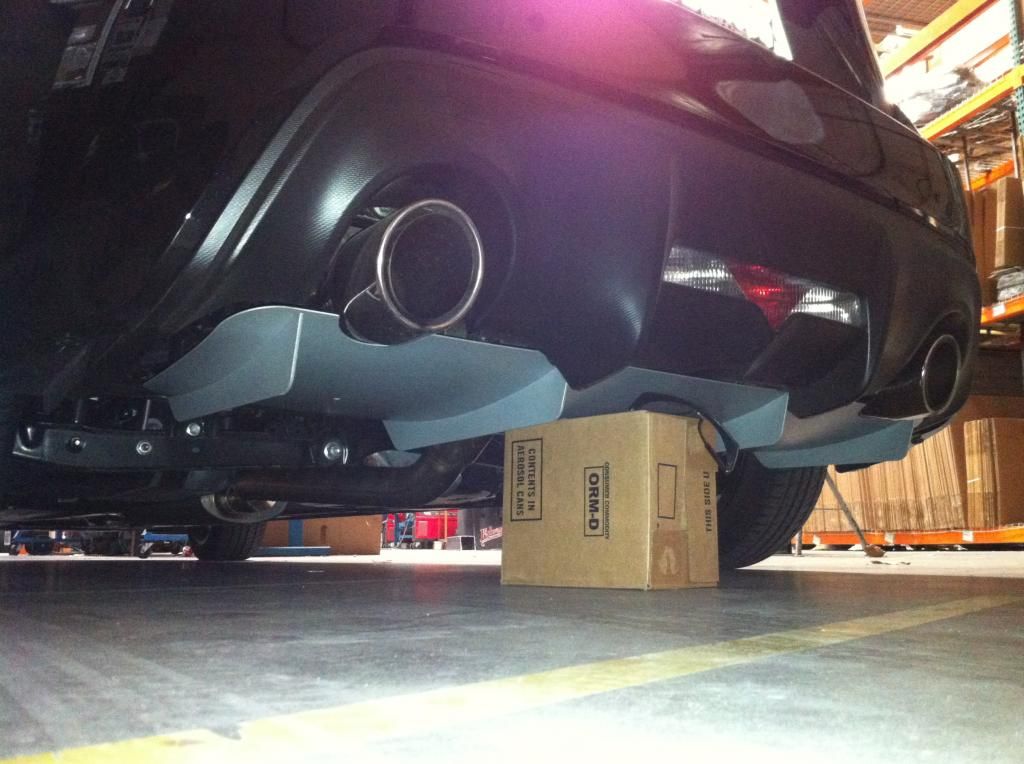
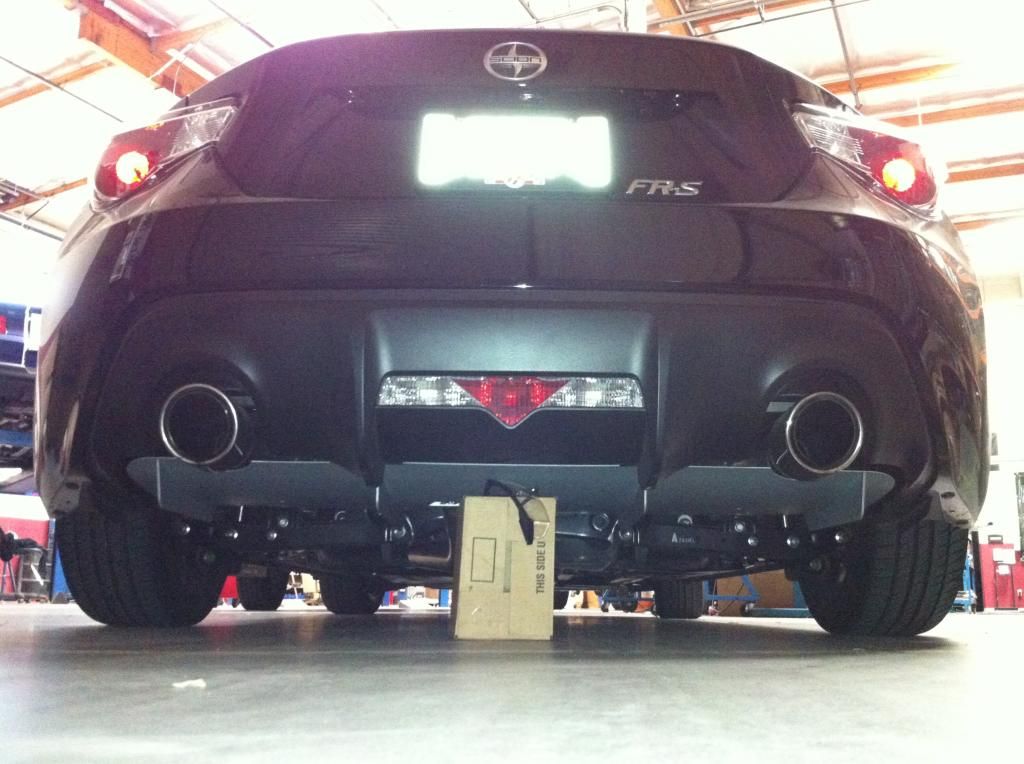
I love the diffuser...
|
|
|
|
|
11-14-2012, 01:21 AM
|
#70 |
|
Member

Join Date: Jul 2012
Drives: 2013 hot lava FR-S
Location: Desoto, MO
Posts: 12
Thanks: 0
Thanked 3 Times in 2 Posts
Mentioned: 2 Post(s)
|
Awesome. Any word on how much the the cat back is?
__________________
-Daniel-
Love, peace and chicken grease |
|
|
|
|
|
|
|
|
|
 Similar Threads
|
||||
| Thread | Thread Starter | Forum | Replies | Last Post |
| Borla Exhaust Installed!!! | microcarmag | Engine, Exhaust, Transmission | 54 | 08-20-2016 05:15 AM |
| ***Borla Exhaust Sale*** | Titanmotorsports | Engine, Exhaust, Bolt-Ons | 36 | 11-26-2012 05:42 PM |
| DC Sport FRS SEMA Booth Car | Pekingduck | FR-S & 86 Photos, Videos, Wallpapers, Gallery Forum | 16 | 10-28-2012 08:06 PM |
| In Stock: Borla FR-S/BRZ Lightweight Cat Back Exhaust! | 10k Redline | Engine, Exhaust, Bolt-Ons | 8 | 10-23-2012 03:11 AM |
| Borla Exhaust in the works | DAZE752 | Engine, Exhaust, Transmission | 14 | 06-13-2012 02:27 AM |





 FR-S
FR-S