


|
||||||
| Other Vehicles & General Automotive Discussions Discuss all other cars and automotive news here. |
 |
|
|
Thread Tools | Search this Thread |
 02-19-2016, 11:43 PM
|
#1 |
|
not a twin owner

Join Date: Jan 2016
Drives: 2016 Veloster Turbo DCT
Location: Northern Virginia, USA
Posts: 734
Thanks: 992
Thanked 463 Times in 267 Posts
Mentioned: 7 Post(s)
|
turbo - why improving LOW-end torque
OK, so it may be a stupid question, but I just don't understand it.
So people say that turbo helps in particular with low-end torque. And if you look at car spec sheets, it seems to be the case, NA cars tend to have max torque between 4.5 and 6 k rpm, and turbocharged have max torque from 1.7 - 2 k. But turbo is driven by exhaust, so it should be particularly effective at high rpm, because high rpm equals a lot of exhaust to spin the turbo to high speed. What am I missing here? |

|

|
|
02-19-2016, 11:47 PM
|
#2 |
|
Senior Member
Join Date: Sep 2014
Drives: BRZ
Location: Los Angeles
Posts: 3,052
Thanks: 1,773
Thanked 2,451 Times in 1,271 Posts
Mentioned: 79 Post(s)
|
What is your question?
Small turbo responds faster but peaks faster also. Larger turbo opposite. Look at the shape of the curve. For this car, most of the turbos are small because most people use them on stock motors. No point in putting a huge turbo when it is just going to blowup. |
|
|
|
|
02-19-2016, 11:51 PM
|
#3 | |
|
not a twin owner
Join Date: Jan 2016
Drives: 2016 Veloster Turbo DCT
Location: Northern Virginia, USA
Posts: 734
Thanks: 992
Thanked 463 Times in 267 Posts
Mentioned: 7 Post(s)
|
Quote:
Sorry if I wasn't clear. My question is: why turbos seem to improve torque in particular at low rpm, while they seem to be driven most effectively (so they should also have the largest effect) at high rpm |
|
|
|
|
|
02-19-2016, 11:59 PM
|
#4 |
|
Senior Member
Join Date: Sep 2014
Drives: BRZ
Location: Los Angeles
Posts: 3,052
Thanks: 1,773
Thanked 2,451 Times in 1,271 Posts
Mentioned: 79 Post(s)
|
Efficiency vs max power. Curves are different, not everything is linear.
You need to word your question better. It is hard to understand. |
|
|
|
|
02-20-2016, 12:24 AM
|
#5 | |
|
Senior Member
Join Date: Nov 2014
Drives: 2013 FR-S
Location: HI
Posts: 236
Thanks: 150
Thanked 157 Times in 90 Posts
Mentioned: 3 Post(s)
|
Quote:
Unfortunately, I have no idea. |
|
|
|
|
|
02-20-2016, 12:28 AM
|
#6 |
|
Senior Member

Join Date: Jun 2015
Drives: 2015 CWP BRZ Limited
Location: NOVA
Posts: 2,800
Thanks: 1,801
Thanked 3,946 Times in 1,757 Posts
Mentioned: 105 Post(s)
|
The size and the efficiency of the turbo determines how well it does at higher RPMs. The long and short of it is that turbos get less efficient the faster they're spinning. You're compressing air violently with exhaust gasses, so things get hot. Hot air = bad.
You can choose larger turbos which tend to be more efficient at a higher RPM range than smaller turbos (I'm oversimplifying, but the general principle applies) and make more peak power. The trade off is that these turbos will take longer to spool. |
|
|
|
| The Following User Says Thank You to jawn For This Useful Post: | mdm (02-20-2016) |
|
02-20-2016, 12:31 AM
|
#7 |
|
not a twin owner
Join Date: Jan 2016
Drives: 2016 Veloster Turbo DCT
Location: Northern Virginia, USA
Posts: 734
Thanks: 992
Thanked 463 Times in 267 Posts
Mentioned: 7 Post(s)
|
I kept thinking about it and a theory came to my mind.
Here it is: While at high rpm the turbo receives more power (because high rpm means more exhaust, which drives the turbo), at the same time the demand for the turbo output increases as well (because high rpm means more intake strokes per unit of time so the turbo must deliver more air). So the two effects would basically cancel out, and the benefit of an ideal turbo would be independent of rpm. But in a real turbo energy losses from friction, turbulent flows and such would be higher at high rpm, so IRL the net benefit would be higher at low rpm. I am not sure though if my thinking is correct. |
|
|
|
|
02-20-2016, 12:32 AM
|
#8 | |
|
not a twin owner
Join Date: Jan 2016
Drives: 2016 Veloster Turbo DCT
Location: Northern Virginia, USA
Posts: 734
Thanks: 992
Thanked 463 Times in 267 Posts
Mentioned: 7 Post(s)
|
Quote:
Thanks, I typed my previous response without seeing yours. |
|
|
|
|
|
02-20-2016, 01:15 AM
|
#9 |
|
Senior Member
Join Date: Jan 2014
Drives: 2013 FR-S 10 Series
Location: Columbus, OH
Posts: 349
Thanks: 41
Thanked 175 Times in 109 Posts
Mentioned: 10 Post(s)
|
MDM here you go.
A turbocharger is an air pump. So down lower in the RPM when the turbo gets spooled up you see a spike in the torque because the compressor is within its most efficient CFM zone. If you look at a compressor map it will show you the efficiency curves across the range of the compressor wheel on the turbo your using. Here is a TD04-15G compressor map for example. 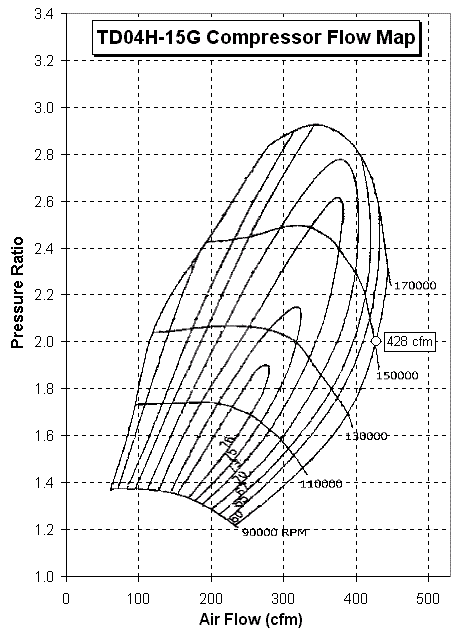 As the turbine spins faster from increase exhaust flow you'll get pushed up higher into less efficient curves which is why you see boost taper off and power start to trail off because the air mass required to generate the power begins to diminish for all sorts of volumetric efficiency and thermodynamic properties. To your other question about why is it that on a NA car that the torque maxes out in the 4.5 to 6k range. It is because of the formula for calculating horsepower partly. There is a standard constant in the denominator of 5,252 and the numerator is (LbFt * RPM). So you will generally always see the inflection point where HP and Torque curves cross within an acceptable deviation of the 5,252 RPMs. Torque begins to fall off after this because as the piston speed increases there is less time per combustion event for the force to act on the crankshaft. So to recap. A turbo/supercharger increases the torque curve and broadens it increasing the amount of work done over the revband (area under the torque curve) and helps push air mass needed for generating horsepower beyond the inflection point. |
|
|
|
| The Following User Says Thank You to NahumCC For This Useful Post: | mdm (02-20-2016) |
|
02-20-2016, 01:25 AM
|
#10 |
|
Senior Member

Join Date: Jul 2014
Drives: 2020 Hakone
Location: London, Ont
Posts: 69,838
Thanks: 61,656
Thanked 108,295 Times in 46,456 Posts
Mentioned: 2499 Post(s)
|
Another thing to take into consideration is that turbos are designed to take advantage of the lower speed exhaust gases. Once they start really spinning and creating boost some of that pressure will be drained off through the blowoff valve. So technically the high rev pressure creates more boost then you really want or need.
__________________
Racecar spelled backwards is Racecar, because Racecar.
|
|
|
|
| The Following User Says Thank You to Tcoat For This Useful Post: | mdm (02-20-2016) |
|
02-20-2016, 01:40 AM
|
#11 | |
|
Senior Member
Join Date: Jan 2014
Drives: 2013 FR-S 10 Series
Location: Columbus, OH
Posts: 349
Thanks: 41
Thanked 175 Times in 109 Posts
Mentioned: 10 Post(s)
|
Quote:
Thank you Tcoat, can't believe I forgot to talk about that. So everything Tcoat said about the wastegate control is spot on. So going back to the compressor map we'll use the 150,000 rpm curve for the turbo. If you let it run at its max speed at a pressure ratio of 2.4 (20.5 PSI gauge) you'll be getting 200 CFM where if you keep the pressure ratio down to 2.0 (14.7 PSI gauge) you'll get 428 CFM which will make you more horsepower the higher you push the motor. The wastegate helps you maintain that by ensuring the turbine isn't over speeding. The BPV, if electronically controlled, can then also be used by the ECU to help maintain the pressure ratio making the control even more efficient. Last edited by NahumCC; 02-20-2016 at 02:14 AM. |
|
|
|
|
| The Following 3 Users Say Thank You to NahumCC For This Useful Post: |
|
02-20-2016, 01:49 AM
|
#12 |
|
Because compromise ®
Join Date: Jan 2012
Drives: Red Herring
Location: australia
Posts: 7,823
Thanks: 4,053
Thanked 9,565 Times in 4,199 Posts
Mentioned: 60 Post(s)
|
Because compromise.
__________________
My car is completely stock except for all the mods.
|
|
|
|
| The Following User Says Thank You to Captain Snooze For This Useful Post: | Tcoat (02-20-2016) |
|
02-20-2016, 01:53 AM
|
#13 |
|
The Fail Boat

Join Date: Aug 2011
Drives: CWP S.B.
Location: LasVegas
Posts: 3,027
Thanks: 4,720
Thanked 1,294 Times in 874 Posts
Mentioned: 19 Post(s)
|
small turbo = boost comes in fast & early, big turbo = boost comes in slow & late. O.O
|
|
|
|
|
02-20-2016, 02:09 AM
|
#14 |
|
Senior Member
Join Date: Mar 2011
Drives: '06 AM V8V Coupe
Location: United States of America
Posts: 5,279
Thanks: 285
Thanked 1,075 Times in 759 Posts
Mentioned: 13 Post(s)
|
It's a manufacturer choice. When you're driving on the street, you're usually not revving the engine that high so low end torque is more useful. You use a small turbo to do this, because at low rpm you have a relatively smaller flow rate of exhaust, so you want to use a small turbine to restrict the flow a bit to produce more pressure to drive the turbine.
What happens with the small turbos used to achieve this is that at high rpm, the turbine becomes a major restriction, and the compressor is maxed out in terms of airflow, so the torque drops early. Adding a bigger compressor doesn't really help, because the turbine isn't big enough to produce the extra power to drive it, no matter how much power the engine is attempting to transfer to the turbine. The small turbo at high rpm is like trying to power a pinwheel sized turbine with a leaf blower. Most of the leaf blower's power is going to be wasted. Another way to think about it is that power is proportional to airflow. A bigger turbo allows more airflow, but it needs more power to run. Thus it allows you to produce more torque at high rpm. A smaller turbo allows less airflow, but it also requires less power to run. It will hit its airflow (and thus power) limit at a lower rpm. The high power Supras and GTRs and whatever all use big fat turbines and compressors to optimize for high rpm torque, or maximum power. |
|
|
|
| The Following 2 Users Say Thank You to serialk11r For This Useful Post: | daiheadjai (02-20-2016), mdm (02-20-2016) |
|
|
|
|
|
|
 Similar Threads
|
||||
| Thread | Thread Starter | Forum | Replies | Last Post |
| AVO turbo kit - 401whp, 314ft/lbs of torque | AVOturboworld | Forced Induction | 38 | 10-29-2018 06:46 PM |
| Improving at Buttonwillow with 86 Cup - shaving a second off my personal best | mav1178 | Tracking / Autocross / HPDE / Drifting | 0 | 06-30-2015 12:03 PM |
| A discussion on improving ride quality | RYU | Suspension | Chassis | Brakes -- Sponsored by 949 Racing | 305 | 06-10-2015 06:55 AM |
| Improving Steering Feel | sittinSideways | Suspension | Chassis | Brakes -- Sponsored by 949 Racing | 9 | 08-18-2014 06:52 PM |
| FBM Premium Turbo w/SSP High Stall Torque Converter and Racing Valve Body | DeOppressorLiber | Forced Induction | 11 | 04-14-2014 11:59 PM |


 spyda
spyda