


|
||||||
| Forced Induction Turbo, Supercharger, Methanol, Nitrous |
 |
|
|
Thread Tools | Search this Thread |
 07-08-2015, 11:47 AM
|
#15 | |
|
Senior Member
Join Date: Mar 2015
Drives: '13 BRZ
Location: Texas
Posts: 362
Thanks: 179
Thanked 235 Times in 149 Posts
Mentioned: 4 Post(s)
Tagged: 0 Thread(s)
|
Quote:
The best two filter locations for these cars are behind the front bumper in the OEM snorkel location, or deleting the washer reservoir as shown in the pics above. An alternate method I was going to try before changing plans, was deleting the washer reservoir, cutting out the OEM driver size DRL bezel, then making a "funnel" to shoot cold air up towards the filter (think the brake cooling kit, but one side only, and only a smaller tube to direct air up). This prevents changes to the intake itself and gets the desired cold air, along with no risk of water induction since you have nothing directly connected to the intake. @IBill4You The cost to have a shop bend piping to attach with a new coupler will be completely worth it. Decide where you want it, then go to any local exhaust shop. As long as you use the same sized piping as your intake piping you will be fine. |
|

|

|
| The Following User Says Thank You to BRZoomTX For This Useful Post: | IBill4You (07-08-2015) |
|
07-08-2015, 01:19 PM
|
#16 | |
|
Señor Member

Join Date: May 2013
Drives: 2013 Scion FR-S
Location: Rockland County NY
Posts: 1,607
Thanks: 1,103
Thanked 1,322 Times in 645 Posts
Mentioned: 17 Post(s)
Tagged: 4 Thread(s)
|
Quote:
If you are chasing down every last bit of HP or trying to cut another tenth off your 1/4 mile time, then sure it may be worth it. But for the average person I wouldn't over complicate things. I would just make sure to put the best flowing/biggest filter you can get on there. Also I've owned a turbo charged car for about 11 years now and have had a CAI, Short ram, and straight filter on the turbo and it never made any difference on the butt dyno. Only difference you will notice is the sound. |
|
|
|
|
| The Following User Says Thank You to STV3 For This Useful Post: | IBill4You (07-08-2015) |
|
07-08-2015, 01:37 PM
|
#17 | |
|
Senior Member
Join Date: Mar 2015
Drives: '13 BRZ
Location: Texas
Posts: 362
Thanks: 179
Thanked 235 Times in 149 Posts
Mentioned: 4 Post(s)
Tagged: 0 Thread(s)
|
Quote:
http://stratifiedauto.com/blog/the-e...rged-vehicles/ tl;dr: 20 degree drop in IAT showed large gains throughout the powerband and a 30whp peak gain on this particular car (MazdaSpeed6). Drive a N/A 86 before and after an e85 tune to see how much of a difference 30whp is in these lightweight cars.  Same dyno, same car, same tune, same day: 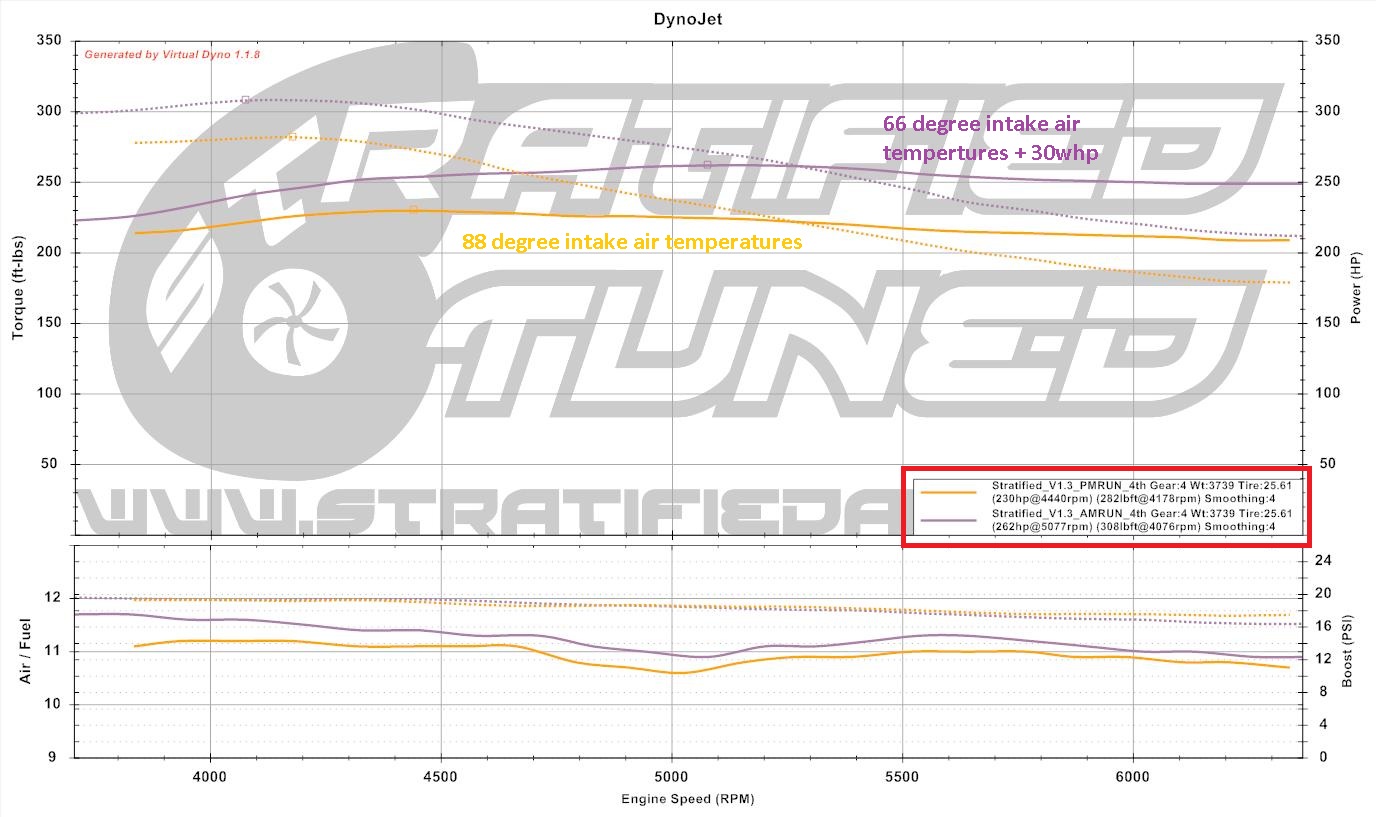
|
|
|
|
|
| The Following User Says Thank You to BRZoomTX For This Useful Post: | IBill4You (07-08-2015) |
|
07-08-2015, 03:05 PM
|
#19 | |
|
NASA SpecE30 Racer

Join Date: May 2012
Drives: 2006 Honda S2000
Location: Gulf Breeze, FL
Posts: 7,279
Thanks: 607
Thanked 5,759 Times in 3,055 Posts
Mentioned: 274 Post(s)
Tagged: 10 Thread(s)
 |
Quote:
__________________
- King Tut
Street/Track Car: 2006 Honda S2000 TT3 || Race Car: 1987 BMW 325is SpecE30 || Tow Vehicle: 2014 RAM 1500 EcoDiesel Sold Cars: 2012 BMW M3 || 2013 Subaru BRZ || 2012 Porsche Cayman R || 2009 Chevrolet Z06 || 2009 BMW M3 || 2004 BMW M3 || 2004 Nissan 350Z |
|
|
|
|
|
07-08-2015, 03:21 PM
|
#20 | |
|
Senior Member
Join Date: Mar 2015
Drives: '13 BRZ
Location: Texas
Posts: 362
Thanks: 179
Thanked 235 Times in 149 Posts
Mentioned: 4 Post(s)
Tagged: 0 Thread(s)
|
Quote:
But very good point anyway. IAT would be affected even further once on the road. Any gains shown on an actual dyno by moving the inlet out of the high ambient temp engine bay would just be further increased on the street. The best goal is to position the intake inlet or filter in an area where it will mostly (if not completely) take in air from outside of the car. Any position were a significant amount of air is being taken from the bay is poor placement. Taking in hot air from the bay is leaving free power on the table. |
|
|
|
|
|
07-08-2015, 03:28 PM
|
#21 | |
|
Señor Member
Join Date: May 2013
Drives: 2013 Scion FR-S
Location: Rockland County NY
Posts: 1,607
Thanks: 1,103
Thanked 1,322 Times in 645 Posts
Mentioned: 17 Post(s)
Tagged: 4 Thread(s)
|
Quote:
Why are you bringing up N/A 86's when we are talking about turbo charged cars. Two different worlds.\ Also, that dyno chart is only showing the difference in power between the higher and lower IAT's. Don't see anything about them achieving that via CAI. Also the AFR seems to be leaned out a bit more on the higher HP run. Last edited by STV3; 07-08-2015 at 03:40 PM. |
|
|
|
|
| The Following User Says Thank You to STV3 For This Useful Post: | Sportsguy83 (07-08-2015) |
|
07-08-2015, 05:21 PM
|
#22 |
|
Banned
Join Date: Mar 2015
Drives: 2015 Subaru BRZ
Location: Maryland
Posts: 197
Thanks: 463
Thanked 65 Times in 49 Posts
Mentioned: 1 Post(s)
Tagged: 0 Thread(s)
|
Aside from the AFR discrepancy and removing the intercooler from this equation just temporarily (because optimizing an intercooler specific to an application is a whole different topic) I assume your main point is that a lower pre turbo IAT will have either no or negligible affect on the IAT post compression (which causes heat as a byproduct).
I am not a physics major and would never remember the chem calculations. Can anyone conclusively say that the air post turbo compression will contain the same number of oxygen molecules regardless of pre compression temperatures? If my memory serves me correctly all equations will have a starting O2 density based on starting temps. Does anyone know what happens on a molecular level when the air is compressed that would make pre turbo IAT irrelevant or is this still a balance between reducing pre turbo restrictions vs pre turbo air temp variance? |
|
|
|
|
07-08-2015, 05:26 PM
|
#23 | ||
|
Senior Member
Join Date: Mar 2015
Drives: '13 BRZ
Location: Texas
Posts: 362
Thanks: 179
Thanked 235 Times in 149 Posts
Mentioned: 4 Post(s)
Tagged: 0 Thread(s)
|
Quote:
2) I mention N/A simply as an example. 30whp gains in this car are worth the additional effort due to the lighter weight than most cars. 30 free WHEEL horsepower is just a stupid amount to potentially leave on the table. I'm assuming you've never ridden in a N/A e85 BRZ/FRS because otherwise you wouldn't be arguing with the clear data here. The difference from 150hp to 180hp is night and day. Even a tuned car making 160whp on 93 switching over to e85 is a very noticeable gain. Not to say you would always gain 30hp for a 20 degree drop in IAT, but there will always be noticeable gains. You claim you've owned turbo cars for over 10 years. Surely you would notice how much better the car feels during the winter months, no? 3) Moving the intake out from the engine bay to a direct shot of cold air directly lowers IAT. It doesn't matter how the example attained lower IAT. Any mod that lowers IAT supports the data. 4) Not sure what your point is with AFR either. The small .2 to .3 change in AFR doesn't equal 30whp. The clear answer to intake placement is determined with a very easy task. Let your car run for 10 minutes, then lift your hood up slightly and hold your hand under the hood. Now, drive down the road with your windows down and hold your hand out the window. Where do you think the colder, denser air is? If you answered "the engine bay", well I don't really have a response to that. Quote:
In hotter climates like the Southwest heat, it is even more critical to have a direct cold air source for the intake. That, or at least make sure you're running some sort of heat extraction out of the engine bay like functional side vents or a vented hood. In my case, I am doing both. Every little bit helps and is freeing up more power regardless of how little the gains are. |
||
|
|
|
| The Following User Says Thank You to BRZoomTX For This Useful Post: | IBill4You (07-08-2015) |
|
07-08-2015, 07:41 PM
|
#24 |
|
Senior Member
Join Date: Oct 2013
Drives: 2015 Series.Blue
Location: Fort Worth, TX
Posts: 1,781
Thanks: 88
Thanked 781 Times in 481 Posts
Mentioned: 16 Post(s)
Tagged: 0 Thread(s)
|
If the car was supercharged, going to a CAI isn't going to help much because a SC doesn't heat the air as much. A turbo heats the air quite a lot, and while a good intercooler setup will do wonders, it can still heat soak.
If you really want to know the truth of the matter, put temp probes on either side of the intercooler and use a hot air intake and a CAI and see the difference on your own setup. I've seen this done enough times to know the CAI setup is superior. |
|
|
|
|
07-09-2015, 01:55 AM
|
#25 |
|
Junior

Join Date: Aug 2013
Drives: a car
Location: Probably at school
Posts: 4,341
Thanks: 3,184
Thanked 2,512 Times in 1,502 Posts
Mentioned: 20 Post(s)
Tagged: 0 Thread(s)
|
@King Tut, theres your mention, lol
__________________
"Ah! What music! They could have never imagined, those pioneers who invented the automobile, that it would posses us like this, our imaginations, our dreams. Men love women, but even more than that, men love CARS!"-Lord Hesketh
|
|
|
|
|
07-09-2015, 10:24 AM
|
#26 | |
|
NASA SpecE30 Racer
Join Date: May 2012
Drives: 2006 Honda S2000
Location: Gulf Breeze, FL
Posts: 7,279
Thanks: 607
Thanked 5,759 Times in 3,055 Posts
Mentioned: 274 Post(s)
Tagged: 10 Thread(s)
|
Quote:

__________________
- King Tut
Street/Track Car: 2006 Honda S2000 TT3 || Race Car: 1987 BMW 325is SpecE30 || Tow Vehicle: 2014 RAM 1500 EcoDiesel Sold Cars: 2012 BMW M3 || 2013 Subaru BRZ || 2012 Porsche Cayman R || 2009 Chevrolet Z06 || 2009 BMW M3 || 2004 BMW M3 || 2004 Nissan 350Z |
|
|
|
|
|
07-09-2015, 11:10 AM
|
#27 | |
|
Banned
Join Date: Mar 2015
Drives: 2015 Subaru BRZ
Location: Maryland
Posts: 197
Thanks: 463
Thanked 65 Times in 49 Posts
Mentioned: 1 Post(s)
Tagged: 0 Thread(s)
|
Quote:
 I specifically tagged @Sportsguy83 because I knew he had a filter mounted directly to the compressor housing and tracks his car (although he is kind of cheating with that vented hood I specifically tagged @Sportsguy83 because I knew he had a filter mounted directly to the compressor housing and tracks his car (although he is kind of cheating with that vented hood  ). ).
|
|
|
|
|
|
07-09-2015, 06:14 PM
|
#28 | |
|
Join Date: Jan 2012
Drives: 2013 "AVO Orange" FR-S
Location: Seattle, WA
Posts: 1,067
Thanks: 69
Thanked 2,277 Times in 636 Posts
Mentioned: 108 Post(s)
Tagged: 2 Thread(s)
|
Quote:
"Keep in mind that higher temperature air isn’t a good thing, but it is a necessary evil shared by both superchargers and turbochargers because “when you compress a gas, its temperature will increase…” (Turbocharging, 2002, p. 1). Many people think that only turbochargers increase the intake temperature, because they are connected to the exhaust manifold. That is not true. Both systems increase the intake air temperature. " Quoting somebody else to save some typing. Bottom line, it's the compression of the air that heats it up, not the heat of the turbocharger or supercharger. Keeping the air as cool as possible pre-compression and post-compression is thus important. |
|
|
|
|
| The Following User Says Thank You to AVOturboworld For This Useful Post: | IBill4You (07-10-2015) |
|
|
|
|
|
|
 Similar Threads
|
||||
| Thread | Thread Starter | Forum | Replies | Last Post |
| Ideal Suspension Setup for DD and Mild Track Use? | Lust | Suspension | Chassis | Brakes -- Sponsored by 949 Racing | 31 | 11-22-2022 09:37 AM |
| FS: Entire P&L Stage 1 Turbo Setup - Turn key Setup ready to make 400+whp | PrimeMotoring | NY / NJ / CT / PA | 0 | 10-20-2014 10:48 AM |
| Ideal Exhaust setup | cjcoupe | AUSTRALIA | 4 | 02-07-2014 07:40 AM |
| New Rumor: Subaru Developing Turbo 4 2.0T for BRZ | Hachiroku | BRZ First-Gen (2012+) — General Topics | 350 | 02-02-2013 01:52 PM |


