
follow ft86club on our blog, twitter or facebook.
FT86CLUB
Ft86Club
Delicious Tuning
Register Garage Community Calendar Today's Posts Search

Go Back   Toyota GR86, 86, FR-S and Subaru BRZ Forum & Owners Community - FT86CLUB > Technical Topics > Forced Induction

Forced Induction Turbo, Supercharger, Methanol, Nitrous

Register and become an FT86Club.com member. You will see fewer ads

User Tag List
neutron256, Robftss

Reply
 
Thread Tools Search this Thread
Old 08-23-2013, 01:50 AM   #295
neutron256
Senior Member
 
neutron256's Avatar
 
Join Date: Jan 2012
Drives: '13 GBS Subaru BRZ
Location: Minneapolis, MN
Posts: 2,030
Thanks: 680
Thanked 664 Times in 382 Posts
Mentioned: 26 Post(s)
Tagged: 1 Thread(s)
Quote:
Originally Posted by mid_life_crisis View Post
Did you mean SPDT? His layout works with SPDT. Takes more of them obviously, but it pretty clearly does not require DPDT.
Yeah I should have been more clear. What I meant was relays for the required current/voltage only come in SPST, where as his design is using some SPDT relays.

Edit: My dyslexia doesn't help either so I hope I said that right
__________________
-Fortes fortuna adiuvat (Fortune favors the bold)
neutron256 is offline   Reply With Quote
Old 08-23-2013, 02:22 AM   #296
neutron256
Senior Member
 
neutron256's Avatar
 
Join Date: Jan 2012
Drives: '13 GBS Subaru BRZ
Location: Minneapolis, MN
Posts: 2,030
Thanks: 680
Thanked 664 Times in 382 Posts
Mentioned: 26 Post(s)
Tagged: 1 Thread(s)
I've been reading more in the 'B2B Electric Supercharger' e-book tonight.
http://b2belectricsupercharger.com/

In their design which appears to be much of what the Phantom Supercharger is based on (or maybe the other way around) they are using a 12V setup. This made me think that maybe that's what I should be trying for in my first prototype.

This would have one huge advantage in that the charging system becomes extremely simple.

When I checked out 12V motors I was pretty impressed with what I found.

SkyRC Toro SCT 4600Kv
Max Power: 2000w
Voltage limits: 18v; up to 4s lipo
Max current: 180a
Brushless KV: 4600
Resistance: .005ohm
Shaft: 5mm x 15.5mm
Dimensions(L*W): 62.5mm*36mm
Weight:220g

For a 12V nominal volatage that's 55K rpm. I'm sure actual speed it won't be that good, but that might work well with the smaller 20g compressor I currently have.

Another advantage is that my original concept to use Ultracapacitors should work just fine at 12V. Ultra capacitors will charge/discharge much faster, and more efficiently then SLA batteries (about 95% vs 60% efficient).
__________________
-Fortes fortuna adiuvat (Fortune favors the bold)
neutron256 is offline   Reply With Quote
The Following User Says Thank You to neutron256 For This Useful Post:
DAEMANO (08-24-2013)
Old 08-23-2013, 02:27 AM   #297
rusty959
Senior Member
 
Join Date: Jun 2012
Drives: DGM BRZ limited
Location: Indiana
Posts: 366
Thanks: 98
Thanked 147 Times in 95 Posts
Mentioned: 8 Post(s)
Tagged: 0 Thread(s)
Quote:
Originally Posted by mid_life_crisis View Post
It needs one more relay. Lose the connection to 12V on the left. The last relay has the 12/36 as the (I'm blanking on the technical name) common contact that actually moves, the other two are the alternator and the electrocharger so it is either charging or driving the EC. A system like this should have all its batteries isolated from the battery the car runs off. If you want 36 volts, you should have four batteries.
Would it be too much to ask for you to throw it in paint and show me what you mean? Maybe its just because it is late for me, but the only way I am seeing what you are saying means a redundant relay. But I'm probably just reading wrong.

Or, are you saying since you say this should be an isolated system, we will only be charging from 12v or powering the e-charger with 36v? If that is the case, one other possible benefit I was hoping to explore was the possibility of running the e-charger in some partial throttle conditions off of 12v, then have it automatically flip to 36v at a specified threshold. Which is why I had it set up to be either 12v or 36v. Obviously I'm not 100% this would work and would highly depend on the motor controller being used as well as how I programmed the controller, but I don't think it is out of the question.
Now what I do know is the motor controllers usually don't turn on instantly, so you couldn't expect a system that only gets power when you want to make boost to be ready that instant.

Where you are saying to throw this extra relay could obviously make a big difference, but would you mind citing reasons why it should be isolated? I don't disagree that in an optimum world it would be, but from this schematic, it doesn't absolutely have to be. And doesn't have to be means one fewer battery which means less cost and less weight. Could the batteries not have perfectly the same charge in this case? Yes, but for the short amount of time the e-charger is on, it wouldn't be a big deal. Nor is having a different charge really that big of a deal as long as you aren't depleting them too far, which is even less of a problem if you use deep cycle batteries as I am planning.

edit: Is this what you were meaning?:
__________________

rusty959 is offline   Reply With Quote
Old 08-23-2013, 10:18 AM   #298
mid_life_crisis
Senior Member
 
Join Date: May 2013
Drives: FR-S 10 #103 AT
Location: NC
Posts: 1,519
Thanks: 101
Thanked 599 Times in 347 Posts
Mentioned: 5 Post(s)
Tagged: 0 Thread(s)
Quote:
Originally Posted by rusty959 View Post
Would it be too much to ask for you to throw it in paint and show me what you mean? Maybe its just because it is late for me, but the only way I am seeing what you are saying means a redundant relay. But I'm probably just reading wrong.

Or, are you saying since you say this should be an isolated system, we will only be charging from 12v or powering the e-charger with 36v? If that is the case, one other possible benefit I was hoping to explore was the possibility of running the e-charger in some partial throttle conditions off of 12v, then have it automatically flip to 36v at a specified threshold. Which is why I had it set up to be either 12v or 36v. Obviously I'm not 100% this would work and would highly depend on the motor controller being used as well as how I programmed the controller, but I don't think it is out of the question.
Now what I do know is the motor controllers usually don't turn on instantly, so you couldn't expect a system that only gets power when you want to make boost to be ready that instant.

Where you are saying to throw this extra relay could obviously make a big difference, but would you mind citing reasons why it should be isolated? I don't disagree that in an optimum world it would be, but from this schematic, it doesn't absolutely have to be. And doesn't have to be means one fewer battery which means less cost and less weight. Could the batteries not have perfectly the same charge in this case? Yes, but for the short amount of time the e-charger is on, it wouldn't be a big deal. Nor is having a different charge really that big of a deal as long as you aren't depleting them too far, which is even less of a problem if you use deep cycle batteries as I am planning.
You've got it exactly, but that was based off your original design. I had something in my mind that would work off a controller and be able to use 1, 2, or 3 batteries to supply 12, 24, or 36 volts as the situation demanded. I'm not thinking part throttle here, I'm thinking more an rpm based logic only. At very low rpm you could allow only 12 and increase it as the rpm climb to safer levels. The problem I have is that I don't know squat about these controllers other than that the motor speed is directly related to voltage level, so it is hard (okay impossible) for me to account for their behavior.
Past experience with power supplies (long past, admittedly) makes me leery of making one battery be part of an active, constantly fluctuating system (the car) and also share duties with other batteries as part of a different system. It might very well not be as big a deal as I remember, but my memory just tells me it's wrong, even if I don't remember the exact reason. I want to see an isolator on this like they use for car stereos to keep one from affecting the other.

Question: would deep cycle batteries have a rapid enough discharge rate compared to regular battery design to drive the electrocharger satisfactorily?
__________________
Necessity may be the mother of Invention but Desperation is quite often the father.
“Sex is like Bridge. If you don't have a good partner, you'd better have a good hand.” - Mae West
Papa said, "son there's a lot of evil temptations out there. Best to try 'em all so you know which ones to avoid."
mid_life_crisis is offline   Reply With Quote
Old 08-23-2013, 11:34 AM   #299
neutron256
Senior Member
 
neutron256's Avatar
 
Join Date: Jan 2012
Drives: '13 GBS Subaru BRZ
Location: Minneapolis, MN
Posts: 2,030
Thanks: 680
Thanked 664 Times in 382 Posts
Mentioned: 26 Post(s)
Tagged: 1 Thread(s)
Quote:
Originally Posted by mid_life_crisis View Post
You've got it exactly, but that was based off your original design. I had something in my mind that would work off a controller and be able to use 1, 2, or 3 batteries to supply 12, 24, or 36 volts as the situation demanded. I'm not thinking part throttle here, I'm thinking more an rpm based logic only. At very low rpm you could allow only 12 and increase it as the rpm climb to safer levels. The problem I have is that I don't know squat about these controllers other than that the motor speed is directly related to voltage level, so it is hard (okay impossible) for me to account for their behavior.
Past experience with power supplies (long past, admittedly) makes me leery of making one battery be part of an active, constantly fluctuating system (the car) and also share duties with other batteries as part of a different system. It might very well not be as big a deal as I remember, but my memory just tells me it's wrong, even if I don't remember the exact reason. I want to see an isolator on this like they use for car stereos to keep one from affecting the other.

Question: would deep cycle batteries have a rapid enough discharge rate compared to regular battery design to drive the electrocharger satisfactorily?
With RC Brushless Motor speed controllers there would be no need to have the sort of adaptive voltage system you're thinking of. It simply takes the input voltage, and then it regulates the power going to the motor. However it probably would be useful to have it switched to the regular 12V system while charging so the motor could run at an anti-restriction speed.

A deep cycle battery might work fine depending on the size. If you're trying to stick with smaller batteries a standard SLA is probably going to be the best bet since you most likely won't be deep cycling (discharging most of the battery's capacity)
__________________
-Fortes fortuna adiuvat (Fortune favors the bold)
neutron256 is offline   Reply With Quote
The Following User Says Thank You to neutron256 For This Useful Post:
DAEMANO (08-24-2013)
Old 08-23-2013, 01:06 PM   #300
rusty959
Senior Member
 
Join Date: Jun 2012
Drives: DGM BRZ limited
Location: Indiana
Posts: 366
Thanks: 98
Thanked 147 Times in 95 Posts
Mentioned: 8 Post(s)
Tagged: 0 Thread(s)
Quote:
Originally Posted by mid_life_crisis View Post
You've got it exactly, but that was based off your original design. I had something in my mind that would work off a controller and be able to use 1, 2, or 3 batteries to supply 12, 24, or 36 volts as the situation demanded. I'm not thinking part throttle here, I'm thinking more an rpm based logic only. At very low rpm you could allow only 12 and increase it as the rpm climb to safer levels. The problem I have is that I don't know squat about these controllers other than that the motor speed is directly related to voltage level, so it is hard (okay impossible) for me to account for their behavior.
Past experience with power supplies (long past, admittedly) makes me leery of making one battery be part of an active, constantly fluctuating system (the car) and also share duties with other batteries as part of a different system. It might very well not be as big a deal as I remember, but my memory just tells me it's wrong, even if I don't remember the exact reason. I want to see an isolator on this like they use for car stereos to keep one from affecting the other.

Question: would deep cycle batteries have a rapid enough discharge rate compared to regular battery design to drive the electrocharger satisfactorily?
For what I plan to do, accounting for controller behavior won't be my job, it will be the job of the system controller. Unless the whole unichip thing works out satisfactorily Ill be having a beaglebone or arduino based controller which will have a boost map based on tps and rpm which will control the motor controller using PID. This same controller would also be controlling when the batteries switched from 12 to 36v and thus could take any needed steps or precautions. There would likely be some hysteresis involved as well. So in short, it won't really matter what % power you are actually asking from the motor controller, it will be taken care of behind the scenes, and though whether the system is seeing 12/24/36v will matter, it will just be adjusted for.

The good news is batteries like this are a lot more simple than power supplies. While throwing some power supplies in parallel and driving a big load can be risky as you know, these batteries are pretty dumb. When you throw them in parallel to charge, they all see the same charging voltage. In simple terms, if one is more discharged than another, its just going to draw a bit more current than the others and charge faster, or continue to charge after the others have finished. It doesn't really matter, because in theory none will ever be completely discharged so everything happens silently. So in essence, if you have one battery that is also doing main system duties while also being part of the 36v series system, if it happens to get slightly more discharged during the short time the 36v system is engaged, it shouldn't really be a big deal. It will just charge back up later. Who knows, it might even stay more charged part of the time since it will still be hooked up to the alternator while the 36v system is engaged, but of course this will depend on too many factors and it doesn't really matter.

Also, in the real car audio world (which I also frequent) no one actually uses the battery isolators. Some shops might still try to make some extra money by telling customers they need it, but the ones who do it as a hobby never use them.

As far as the deep cycle battery question, here is the battery I will likely use:
http://4xspower.com/shop/d-series/d925/
In the past I used just one of these as the only battery in my 93 Ford Probe (v6) as a temp solution and it started just fine, so current won't be a problem. Now this battery is obviously a bit bigger than absolutely necessary, but as I said they will be doing double duty as powering my stereo.
__________________
rusty959 is offline   Reply With Quote
The Following User Says Thank You to rusty959 For This Useful Post:
DAEMANO (08-24-2013)
Old 08-23-2013, 11:43 PM   #301
PowderfaceTr.
Senior Member
 
PowderfaceTr.'s Avatar
 
Join Date: Sep 2012
Drives: stock
Location: ALBERTA CANADA
Posts: 117
Thanks: 31
Thanked 81 Times in 7 Posts
Mentioned: 1 Post(s)
Tagged: 0 Thread(s)
hey why so complicado?

Just throw a resistor in the fuel injector pulse to the esc input like they do with watermeth injectors Simple as lambda. KISS

http://www.mrtrally.com.au/performance/docs/WRX-V5.pdf

Last edited by PowderfaceTr.; 08-23-2013 at 11:48 PM. Reason: http://www.mrtrally.com.au/performance/docs/WRX-V5.pdf
PowderfaceTr. is offline   Reply With Quote
Old 08-24-2013, 12:25 AM   #302
neutron256
Senior Member
 
neutron256's Avatar
 
Join Date: Jan 2012
Drives: '13 GBS Subaru BRZ
Location: Minneapolis, MN
Posts: 2,030
Thanks: 680
Thanked 664 Times in 382 Posts
Mentioned: 26 Post(s)
Tagged: 1 Thread(s)
Quote:
Originally Posted by PowderfaceTr. View Post
hey why so complicado?

Just throw a resistor in the fuel injector pulse to the esc input like they do with watermeth injectors Simple as lambda. KISS

http://www.mrtrally.com.au/performance/docs/WRX-V5.pdf
Lots of different ways to go about the control aspect. I'm in line with your way of think and that's basically what I'll be doing with the Unichip. Others like programming and the challenge of building their own controller, and after seeing the custom display that @Pug built for the Phantom Supercharger I'm pretty impressed and will be curious to see what others come up with.
__________________
-Fortes fortuna adiuvat (Fortune favors the bold)
neutron256 is offline   Reply With Quote
Old 08-24-2013, 01:46 AM   #303
Raven604
Senior Member
 
Join Date: Dec 2012
Drives: 2013 Scion FR-S
Location: Vancouver
Posts: 328
Thanks: 93
Thanked 113 Times in 65 Posts
Mentioned: 3 Post(s)
Tagged: 0 Thread(s)
o.o
Raven604 is offline   Reply With Quote
Old 08-24-2013, 11:50 AM   #304
rusty959
Senior Member
 
Join Date: Jun 2012
Drives: DGM BRZ limited
Location: Indiana
Posts: 366
Thanks: 98
Thanked 147 Times in 95 Posts
Mentioned: 8 Post(s)
Tagged: 0 Thread(s)
Quote:
Originally Posted by neutron256 View Post
Lots of different ways to go about the control aspect. I'm in line with your way of think and that's basically what I'll be doing with the Unichip. Others like programming and the challenge of building their own controller, and after seeing the custom display that @Pug built for the Phantom Supercharger I'm pretty impressed and will be curious to see what others come up with.
So can you go into more detail on how the unichip will be controlling things for you?
__________________
rusty959 is offline   Reply With Quote
Old 08-24-2013, 12:35 PM   #305
neutron256
Senior Member
 
neutron256's Avatar
 
Join Date: Jan 2012
Drives: '13 GBS Subaru BRZ
Location: Minneapolis, MN
Posts: 2,030
Thanks: 680
Thanked 664 Times in 382 Posts
Mentioned: 26 Post(s)
Tagged: 1 Thread(s)
Quote:
Originally Posted by rusty959 View Post
So can you go into more detail on how the unichip will be controlling things for you?
Sure,

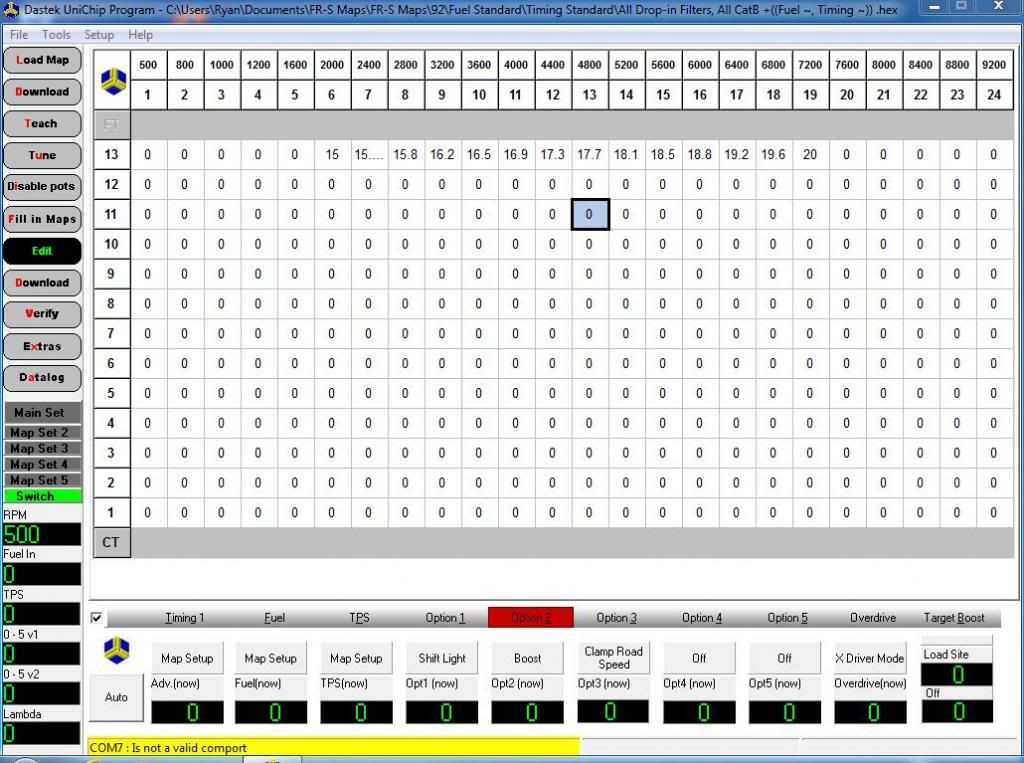
With unichip you can create a boost MAP that normally would be used to control a turbo waste gate. It uses a simple duty cycle signal set at whatever frequency you want. You fill in the various load/RPM sites in the map with a duty cycle % value. This is then sent out on one of the Unichip outputs

For those not familiar with RC brushless motors they use servo signals which are basically a duty cycle signal, but instead of % of the duty cycle they look at the High time in the signal. The high time should be from 1-2 ms/cycle.

Assuming we set the signal for 100 Hz:

10% = 1ms = Full reverse
15% = 1.5ms = Center off
20% = 2ms = Full forward

Doing this of course requires a Unichip tuners license which I got specifically for this, but if you have a local Unichp Tuner it should be pretty simple for them to set up. I can also share my maps with anyone interested and if they have the upload cable they can upload them themselves. Of course with the disclaimer that I'm not a tuner and make no promises to as to the safety of the tune.

Unichip provides tuners with a great manual which is almost a complet how-to-guide on tuning. So if anyone has questions about Unichip I'll be happy to answer as best I can.

Edit: I'm not an expert on servos so if anyone sees anything incorrect with my explanation please say so.
__________________
-Fortes fortuna adiuvat (Fortune favors the bold)

Last edited by neutron256; 08-24-2013 at 12:46 PM.
neutron256 is offline   Reply With Quote
The Following User Says Thank You to neutron256 For This Useful Post:
DAEMANO (08-24-2013)
Old 08-24-2013, 04:33 PM   #306
rusty959
Senior Member
 
Join Date: Jun 2012
Drives: DGM BRZ limited
Location: Indiana
Posts: 366
Thanks: 98
Thanked 147 Times in 95 Posts
Mentioned: 8 Post(s)
Tagged: 0 Thread(s)
Quote:
Originally Posted by neutron256 View Post
Sure,

With unichip you can create a boost MAP that normally would be used to control a turbo waste gate. It uses a simple duty cycle signal set at whatever frequency you want. You fill in the various load/RPM sites in the map with a duty cycle % value. This is then sent out on one of the Unichip outputs

For those not familiar with RC brushless motors they use servo signals which are basically a duty cycle signal, but instead of % of the duty cycle they look at the High time in the signal. The high time should be from 1-2 ms/cycle.

Assuming we set the signal for 100 Hz:

10% = 1ms = Full reverse
15% = 1.5ms = Center off
20% = 2ms = Full forward

Doing this of course requires a Unichip tuners license which I got specifically for this, but if you have a local Unichp Tuner it should be pretty simple for them to set up. I can also share my maps with anyone interested and if they have the upload cable they can upload them themselves. Of course with the disclaimer that I'm not a tuner and make no promises to as to the safety of the tune.

Unichip provides tuners with a great manual which is almost a complet how-to-guide on tuning. So if anyone has questions about Unichip I'll be happy to answer as best I can.

Edit: I'm not an expert on servos so if anyone sees anything incorrect with my explanation please say so.
Ok so there is no way to make a closed loop control, only a duty cycle map? If that is the case, ill definitely continue development of my system.

From what I've seen, you will need to use 50hz for the servo control. Apparently some devices can technically run higher or lower, but 50hz is the standard.

Also, the distinct pulse width that will correspond to reverse/center/forward will change a bit. Depending on your controller, you may not have a reverse, which is pretty typical with controllers intended for use with aircraft. Ground based units will usually have the ability to disable it. Regardless, you probably already know this, so this may just be for the benefit of those who don't, but the controllers usually need set up in regards to what is driving them. They will typically have you do something along the lines of center (or off if there is no reverse) so it can get the base, and then full on, and then reverse if there is one. This is just to take care of the minute differences between r/c controllers or whatever you are driving it with. I only mention this because it may or may not be difficult to do with the unichip if you are planning on running it strait off of it. If you are still going to have another device between the unichip and motor controller then I suppose it depends on that device. Either way faking the signal shouldn't be a problem if needed, just something to consider. My only reservation about running directly off the unichip is 1-2ms at 50hz is a pretty narrow range of duty cycle and I don't know the resolution you are able to use, although for this application you may not really need much resolution.
__________________
rusty959 is offline   Reply With Quote
The Following User Says Thank You to rusty959 For This Useful Post:
DAEMANO (08-31-2013)
Old 08-24-2013, 05:58 PM   #307
neutron256
Senior Member
 
neutron256's Avatar
 
Join Date: Jan 2012
Drives: '13 GBS Subaru BRZ
Location: Minneapolis, MN
Posts: 2,030
Thanks: 680
Thanked 664 Times in 382 Posts
Mentioned: 26 Post(s)
Tagged: 1 Thread(s)
Quote:
Originally Posted by rusty959 View Post
Ok so there is no way to make a closed loop control, only a duty cycle map? If that is the case, ill definitely continue development of my system.

From what I've seen, you will need to use 50hz for the servo control. Apparently some devices can technically run higher or lower, but 50hz is the standard.

Also, the distinct pulse width that will correspond to reverse/center/forward will change a bit. Depending on your controller, you may not have a reverse, which is pretty typical with controllers intended for use with aircraft. Ground based units will usually have the ability to disable it. Regardless, you probably already know this, so this may just be for the benefit of those who don't, but the controllers usually need set up in regards to what is driving them. They will typically have you do something along the lines of center (or off if there is no reverse) so it can get the base, and then full on, and then reverse if there is one. This is just to take care of the minute differences between r/c controllers or whatever you are driving it with. I only mention this because it may or may not be difficult to do with the unichip if you are planning on running it strait off of it. If you are still going to have another device between the unichip and motor controller then I suppose it depends on that device. Either way faking the signal shouldn't be a problem if needed, just something to consider. My only reservation about running directly off the unichip is 1-2ms at 50hz is a pretty narrow range of duty cycle and I don't know the resolution you are able to use, although for this application you may not really need much resolution.
You can create a closed loop boost limit map with unichip as well. It works the same as a boost map except its a 3D map that uses Load/RPM/MAP sensor. It's of course a little more complicated to create the map but the control basics are the same.

From my understanding 30-50 Hz is pretty standard for servos, most will work just fine up to 100 Hz and many will even work up to 250 Hz. I may have to experiment some to find out the limits of my controller.

I plan to run mine at the highest frequency I can get to work consistently with the motor controller. I know unichip will allow at least one decimal place for duty cycle inputs maybe more.

Load sites are also not absolute values for the output. If say the RPM is between two map sites (as will almost always be the case) it will varry the output accordingly.

Example:

4000 RPM duty cycle = 15%
5000 RPM duty cycle = 17%

At 4500 it would output 16%
At 4750 it would output 16.5%

I'm not sure how high the resolution is between map sites but I think it's very high. I need to get an oscilloscope so I can so I can troubleshoot is I have any problems.

Here is a Unichip screenshot just to give you a feel for it.
__________________
-Fortes fortuna adiuvat (Fortune favors the bold)
neutron256 is offline   Reply With Quote
The Following 2 Users Say Thank You to neutron256 For This Useful Post:
DAEMANO (08-31-2013), SloS14 (08-24-2013)
Old 08-24-2013, 10:57 PM   #308
SloS14
Senior Member
 
SloS14's Avatar
 
Join Date: Apr 2013
Drives: 2013 FR-S whiteout
Location: United States
Posts: 726
Thanks: 381
Thanked 652 Times in 256 Posts
Mentioned: 3 Post(s)
Tagged: 0 Thread(s)
Lookin good man!
SloS14 is offline   Reply With Quote
 

Tags
hairdyerperformance, only pulls hard one gear


Posting Rules
You may not post new threads
You may not post replies
You may not post attachments
You may not edit your posts

BB code is On
Smilies are On
[IMG] code is On
HTML code is Off

Forum Jump

Similar Threads
Thread Thread Starter Forum Replies Last Post
Full throttle Electric Supercharger Build Thread fenton Forced Induction 11315 04-07-2025 07:42 PM
DUP THREAD MODZ PLZ DELETE KTHX SloS14 Forced Induction 0 07-09-2013 06:41 PM
Electric Turbocharger Shankenstein Forced Induction 91 06-24-2013 03:47 PM
Electric 86 frosty86 Scion FR-S / Toyota 86 GT86 General Forum 8 11-10-2012 03:16 PM
WRX Electric turbo Neilus Engine, Exhaust, Transmission 42 05-03-2012 10:20 PM


All times are GMT -4. The time now is 08:27 PM.


Powered by vBulletin® Version 3.8.11
Copyright ©2000 - 2026, vBulletin Solutions Inc.
User Alert System provided by Advanced User Tagging v3.3.0 (Lite) - vBulletin Mods & Addons Copyright © 2026 DragonByte Technologies Ltd.

Garage vBulletin Plugins by Drive Thru Online, Inc.