


|
||||||
| Mechanical Maintenance (Oil, Fluids, Break-In, Servicing) Everything related to the mechanical maintenance of the FR-S and BRZ |
 |
|
|
Thread Tools | Search this Thread |
 01-19-2013, 01:51 AM
|
#1 |
|
Senior Member
Join Date: Oct 2012
Drives: WR Blue Pearl 2022 Subaru BRZ
Location: Melbourne
Posts: 818
Thanks: 790
Thanked 518 Times in 275 Posts
Mentioned: 6 Post(s)
|
10W-40
2000kms - Time to replace that oil from the break-in.
Knowing only a little about oils - I.E, that basically the first number relates to the temp range that the oil is at optimum viscosity (it called the winter rating and describes the viscosity at cold temps) , and the second number relates to viscosity at high (operating) temp - also gives you an idea of how thick it is and such, and also how long it might take to come up to temp. I've been told by a mechanic that the 0-20 is being quite readily replaced by a 5-30 at the dealerships (0-20 is very rare for cars in aus). What I'm wondering is if I go a really high quality oil, like a motul 300 that also rates 10-40, will I be pretty much OK considering our climate doesn't really need a super low start temp range (and I always give the car 1 ciggys worth of warm-up) - and that I'm likely to take it to a track in feb for some very high RPM work? Additionally I'm considering using a drift magnetic filter, to catch any left over large particles from the break-in process. Good idea? |

|

|
|
01-19-2013, 04:07 PM
|
#2 |
|
Senior Member

Join Date: Jun 2012
Drives: Nevermorange FRS
Location: Seattle, WA
Posts: 4,175
Thanks: 758
Thanked 4,215 Times in 1,809 Posts
Mentioned: 78 Post(s)
|
There's already several oil threads in here that extensively explain oils and what's recommend in different conditions and why. Take some time and read through those and you'll thank yourself for doing so.
__________________
PRO86 | WTCC | STL
|
|
|
|
|
01-19-2013, 10:49 PM
|
#3 |
|
Senior Member
Join Date: Oct 2012
Drives: WR Blue Pearl 2022 Subaru BRZ
Location: Melbourne
Posts: 818
Thanks: 790
Thanked 518 Times in 275 Posts
Mentioned: 6 Post(s)
|
I actually have read them - I haven't noticed anything on the use of 10w-40, nor magnetic filters for post break in change.
I've also found them quite confusing, I don't claim to know much about oils, but there are quite a few who do in those posts, yet the advise seems to vary significantly. I'll see if I can track down more info. |
|
|
|
|
01-19-2013, 11:51 PM
|
#4 |
|
Senior Member
Join Date: Mar 2011
Drives: '06 AM V8V Coupe
Location: United States of America
Posts: 5,279
Thanks: 285
Thanked 1,075 Times in 759 Posts
Mentioned: 13 Post(s)
|
Yea it is confusing. I spent a bunch of time reading everything I could find about oil, and the feeling I'm getting is that you don't need to overthink oil too much, all the usual grades are fine. 0w-20 is not "too thin, like water!", it'll protect your engine just fine and there's no need to go heavier. Conversely a 40 weight oil is not thick molasses that will never pump around easily, etc. They all work, they all protect the engine, they are all useless and too thick at low temperature, and they are all useless when overheated.
Thicker oil might give a bit more buffer against overheating in track use, thinner oil is more efficient and possibly reduces wear when the engine is not up to operating temperature. It's all hard to say. |
|
|
|
| The Following User Says Thank You to serialk11r For This Useful Post: | Blighty (01-21-2013) |
|
01-19-2013, 11:56 PM
|
#5 |
|
Senior Member
Join Date: Aug 2012
Drives: Raven FR-S 6MT
Location: Garden state
Posts: 181
Thanks: 70
Thanked 54 Times in 22 Posts
Mentioned: 2 Post(s)
|
If you can't find 0-20 oil and you said it's pretty hot where you live then why not go with a 5-20 oil?
|
|
|
|
|
01-21-2013, 05:53 AM
|
#6 |
|
Senior Member
Join Date: Oct 2012
Drives: WR Blue Pearl 2022 Subaru BRZ
Location: Melbourne
Posts: 818
Thanks: 790
Thanked 518 Times in 275 Posts
Mentioned: 6 Post(s)
|
I decided you were right serialk11r, and just find out some stuff, put it against my own needs.
I'm going to get the local shop to order in some 0w-20 motul for me. I'm also going to purchase the perrin oil cooler. I figure that 0w-20 is the spec they designed the engine for - with an allowance for 5-30, i'm guessing for availability - however I do also think that it's good for eco and power, great for engine life with normal driving which probably plays into the considerations a lot for toyota, and a session at the track with high heat loads might cause performance to tail off on a thinner oil - since we have high ambiant temps, may indeed cause extra wear on my baby. With the oil cooler, I can keep the day to day benefits of the 0w-20m, but ensure that my temps don't go so high as to effect performance too much, or add extra wear. It's also one of the only mods I can do and still keep my warranty and not have my car defected by overzealous police in Aus. Plus, it looks cool. Cool adds 25hp every time. If only I could get a price.... |
|
|
|
|
01-21-2013, 01:35 PM
|
#7 |
|
Senior Member
Join Date: Jun 2012
Drives: Nevermorange FRS
Location: Seattle, WA
Posts: 4,175
Thanks: 758
Thanked 4,215 Times in 1,809 Posts
Mentioned: 78 Post(s)
|
Go here:
Lots of good info regarding HTHS, cSt, etc etc by a variety of different users on this forum. That thread should be sticky'd imho. http://www.ft86club.com/forums/showthread.php?t=9084
__________________
PRO86 | WTCC | STL
|
|
|
|
|
01-21-2013, 05:49 PM
|
#8 | |
|
Senior Member

Join Date: May 2010
Drives: Scion FRS Ht Lva(AT)
Location: Alberta
Posts: 409
Thanks: 30
Thanked 81 Times in 54 Posts
Mentioned: 1 Post(s)
|
Quote:
The problem with trying to understand engine oil is the discussion tends to get either over simplified or overly complicated. Folks often confuse the simple explanation with perpheral stuff that is often more complicated than their original question. If you want to keep it simple, here is some info: 1) auto manufacturers make recommendations based on what they believe are the requirements they confront which do include things like: - durability(to satisfy their warranty a ongoing quality goals) - performance(starting, power, etc. in so far as it relates to oil selection) - fuel economy requirements, (which includes emissions requirements such as reduced CO2, and can be either legislated or targeted) - climates where the vehicle is sold or operated - design requirements/limitations The needs of all of these requirements have to be balanced. There are many ways to design an engine oil to meet a set of requirements. There are also many ways to get them to exceed requirements(adding features & benefits) 2) They select from co-operatively developed(between oil producers and vehicle manufacturers) industry standards for oils, such as ILSAC, API, JASO, SAE as the lubricant performance descriptors. Some even include their own or in some cases proprietary specifications. 3) They make recommendations that involve a performance category(such as API, ILSAC,ACEA, etc.) and a viscosity grade( SAE). 4) They tell you how often in their experience and with the criteria of 1)to change the oil to cover both what they categorize as normal and in some cases additionally severe use. They do that so you don't have to spend your time trying to figure it out by testing the oil yourself to determine what might be appropriate for the specific conditions assoicated with you operating your vehicle. So the simplest recommendation is to follow what the manufacturer says! So in this quote, saying all the grades are fine is a simiplification. To say they are all useless and too thick at low temperature, and they are all useless when overheated is a simplification. To consider it over simplification depends on your expectations? As an example it would definitely be an over simplification if you are suggesting that a 20W-50 will start at -35 with no potential short or long term effects. If you want to understand a little bit more I would offer this: Select a performance category(API, ILSAC,ACEA, etc.) based on what the manufacturer recommends. That is the minimum required. To understand the differences between these performance categories and what they mean requires way more time and research than most folks probably care to invest. For those who are willing to understand the details, I commend your enthusiasm, but caution that you have chosen a path that may be more challenging than you wish to undertake. Have fun if you choose to proceed, it can be quite fascinating. Viscosity Grade understanding is usually where people focus their attention, but it is only one part of oil understanding that relates specifically to how the product moves. SAE viscosity grades are a catergorization, that is a "code" supposed to simplify something which is actually quite complex. &&W-?? as in 5W-30 The &&W part represents low temperature performance defined by two critical areas: 1) Startability: Lower CCS(cold cranking simulator) viscosity guarantees starting to a minimum temperature by definition. 2) Pumpability: Lower MRV(Mini rotary viscometer) viscosity guarantees pumping to a minimum temperature by definition. Pumpability(oil will deliver to the pump and be delivered by the pump) for a grade is measured at 5 degrees C less than starting so if an oil is going to guarantee starting at a particular temperature it will be sure to pump. definition of minimums: http://www.infineum.com/Documents/AP...ils%202010.pdf You also have to be careful to consult the latest version of the SAE system as it has changed over ther last 30 years. So you see from a low temperature starting and pumping perspective a 5W-30 is guaranteed to start down to -30 C and pump down to -35 C. It may start and pump below those temperatures, but it is not guaranteed by definition to do so. So if you live in a place where the ambient temperature and engine temperature are -35C it is not within the relm of reason to expect an engine with a 20W-&& to pump or start at that temperature because it is only guaranteed to start down to -15C and pump to -20C? It is possible(but unlikely) it could pump and start but you would be severly stressing things due to the higher viscosity relative to the temperature. These viscosity codes also represent a range, so its possible to design at the high end of the range or alternatively anywhere in the range. You can also design so that you may have 5W starting, but 0W pumping(a case where the SAE grade has to be defined by the higher characteristic even though one part is lower)! The ??: represents high temperature performance. kinematic viscosity at 100 degC relates to flow(under gravitational shear loads) at 100 degC. Think basically about a cup(its actually a very small diameter glass tube) with a very small hole in the bottom and oil at 100C flowing through it. Back in 1911 when the first SAE J300 was issued this was all that was used to categorize oil viscosity grading SAE 10, 20, 30, 40, 50, 60. There was no "&&W" part in those days! HTHS Viscosity: represents viscosity under shear loads and temperature conditions in the connecting rod bearings(where highest hydrodynamic loads and temperatures are experienced. Too thin and you get metal to metal contact, too thick and it impacts power and fuel economy. Oil producers use the SAE system and engine manufacturers use the SAE system and when they make a recommendation for use of a viscosity grade for an operating temperature range they will have aligned their engine design with a clear understanding of how the viscosity grade recommendation will perform. Will other grades work? Probably but only they are likely to know how well for particular circumstances. Now in the FRS/BRZ case they leave the question about more severe applications pretty open by suggesting that something thicker should be considered. Bearing in mind the primary 0W-20 recommendation it kind of begs the question whether there is a grade that might just be inappropriately too thick(keeping in mind the grades and their temperature relationship): A worthy question that no one seems to want to ask, where the only folks that should know are likely the engine manufacturer or the oil producer? Now if you read this on the internet, it must be true????? Everyone has an opinion, everyone knows what they know(both correct and incorrect). I often wonder if there ever was input from an engine oil formulator would anyone be willing to accept it, or would the debate just go on forever? |
|
|
|
|
| The Following 4 Users Say Thank You to smbrm For This Useful Post: |
|
01-21-2013, 07:11 PM
|
#9 | |
|
Senior Member
Join Date: Jun 2012
Drives: Nevermorange FRS
Location: Seattle, WA
Posts: 4,175
Thanks: 758
Thanked 4,215 Times in 1,809 Posts
Mentioned: 78 Post(s)
|
Quote:
 You always make it a habit to ask questions you already know the answer to? 
__________________
PRO86 | WTCC | STL
|
|
|
|
|
|
01-21-2013, 07:17 PM
|
#10 |
|
Senior Member

Join Date: Dec 2009
Drives: '13 FR-S firestorm, 6 mt - '11 CR-V
Location: Tucson
Posts: 2,133
Thanks: 243
Thanked 1,387 Times in 657 Posts
Mentioned: 36 Post(s)
|
Since I missed school that day I find the easiest path is to follow the manuacturers recommendations. I figure they know more about it than I do. It can't get any simpler than that.

|
|
|
|
|
01-21-2013, 08:07 PM
|
#11 | |
|
Senior Member
Join Date: May 2010
Drives: Scion FRS Ht Lva(AT)
Location: Alberta
Posts: 409
Thanks: 30
Thanked 81 Times in 54 Posts
Mentioned: 1 Post(s)
|
Quote:
:happy0180: |
|
|
|
|
|
01-22-2013, 08:06 AM
|
#12 | ||
|
Senior Member
Join Date: Oct 2012
Drives: WR Blue Pearl 2022 Subaru BRZ
Location: Melbourne
Posts: 818
Thanks: 790
Thanked 518 Times in 275 Posts
Mentioned: 6 Post(s)
|
Many thanks smbrm.
Quote:
a) Covering off on the fact that there are not many 0w-20 oils readily available at typical garages in some hotter countries. or b) Perhaps an understanding that although they wanted to meet certain requirements that you stated in your post, for track days it might be more effective of an oil (without actually saying such). From what I've been reading, it seems as though regardless of the mystical science that goes into oils, some things are certainly true - an oil that flows strong and thin at 100c, is going to be thinner when pushed to higher temps. Possibly become less stable too and require changing more often. Actually, I think that it what the shearing stuff is all about, basically a rating for an oil that describes how much it permanently/temporarily breaks down under stress. So the key seems for me to be that if you want to have a happy car on and after a track day, then you either keep the temp down, or use a thicker oil. I'm sure that frequent oil changes are good too, but I would expect that to cover you're bases some kind of temperature control or thicker oil would be best for tracking. Quote:
Chris |
||
|
|
|
|
01-22-2013, 09:53 AM
|
#13 | |
|
Senior Member
Join Date: Jun 2012
Drives: 2013 FR-S Hot Lava, 2007 Tundra
Location: Utah
Posts: 174
Thanks: 283
Thanked 117 Times in 50 Posts
Mentioned: 3 Post(s)
|
Quote:
Wish I could find out which it is. EDIT: I found out. It's the screwy index system SAE chose. What Bilghty says is the case, oil is always thinner when hotter.
__________________
 Last edited by b.e; 01-22-2013 at 02:20 PM. |
|
|
|
|
|
01-22-2013, 12:04 PM
|
#14 | |
|
Senior Member
Join Date: Sep 2012
Drives: 2004 Subaru Forester 2.5XT
Location: Central NJ
Posts: 681
Thanks: 28
Thanked 273 Times in 200 Posts
Mentioned: 9 Post(s)
|
Quote:
 Oil thins as it heats up. Keep a quart of oil outside overnight (and pour it into an oil safe container) and then bring it in your house the next day and notice how easier it pours than the oil kept outside. You can also try storing it in the freezer overnight and then heating it up outside in a safe environment. You can also look up any oil manufacturers product data sheet. Even though the lower oil temp. isn't really that cold at 40C, it will show a higher kinematic viscosity than when hot. Also check the MRV/CCS viscosity in the Infineum chart linked above. If you still want to have more fun, key the 40C and 100C numbers into this chart and look at the difference. http://www.widman.biz/English/Calculators/Graph.html Over at bobistheoilguy.com, several Aussies have posted having a tough time trying to find 0W-20. Does the Subaru/Toyota dealer carry it? I notice that Mobil1 Oz doesn't list a 20 weight. Since the N. American owner's manual does state that thicker viscosities are allowed, I would probably run a light 0W-30 or 5W-30 if I couldn't find a 20 grade. By "light" I mean low HTHS and low kinematic viscosity at 40C/100C. Definitely not one that meets ACEA A3 specs. -Dennis |
|
|
|
|
| The Following User Says Thank You to bluesubie For This Useful Post: | b.e (01-22-2013) |
|
|
|
|
|
|


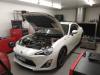 My 86
My 86 spyda
spyda
 My 86
My 86