
follow ft86club on our blog, twitter or facebook.
FT86CLUB
Ft86Club
Speed By Design
Register Garage Community Calendar Today's Posts Search

Go Back   Toyota GR86, 86, FR-S and Subaru BRZ Forum & Owners Community - FT86CLUB > Off-Topic Discussions > Other Vehicles & General Automotive Discussions

Other Vehicles & General Automotive Discussions Discuss all other cars and automotive news here.

Register and become an FT86Club.com member. You will see fewer ads

User Tag List

Reply
 
Thread Tools Search this Thread
Old 11-24-2012, 04:18 PM   #43
ZDan
Senior Member
 
ZDan's Avatar
 
Join Date: May 2011
Drives: '23 BRZ
Location: Providence, RI
Posts: 4,672
Thanks: 1,439
Thanked 4,012 Times in 2,098 Posts
Mentioned: 85 Post(s)
Tagged: 0 Thread(s)
Quote:
Originally Posted by Dimman View Post
I don't think the valvetrain friction is accurate because of rocker arms and pushrod flex. But I'm not 100% certain, so more research will be done.
It's just a brute fact that a high-performance 400+hp 4.0 liter DOHC V8 from BMW gets crap mileage vs. a high performance 400+hp 6.2 liter OHV V8 from GM.

Quote:
Here's a good example of why GM clinging to OHV has a bad rep. Vortec 4.3L V6, 190hp @ 4500 rpm, 260 lb-ft @ 3400 rpm. Compare with Toyota's 5VZ-FE of the same era. 3.4L V6, 190 hp @ 4800 rpm, 220 lb-ft @ 3600 rpm.

There was no need for Toyota to go bigger to meet their requirements. If they matched the displacement it would be an embarrassment for GM.
Nonsense. Two different ways to achieve the same required/desired power levels. Similar fuel economy between those two powerplants in a 2000 awd Bravada vs. 2000 4wd 4Runner.

GM engine almost certainly cost less and I wouldn't be surprised if the 4.3 occupied less space.

Quote:
Now GM can talk about the packaging advantages all they want, but in this example it is complete bullshit. Because GM just showed how cheap and lazy they were, and made that motor by chopping two cylinders off of their small block V8. Which ended up with a 90° V6. Not exactly compact...
You can call giving people the same performance and fuel economy for less money "cheap and lazy". Or you can call it clever engineering.

Two ways of doing the same thing, the DOHC solution isn't inherently "better".

Quote:
So there is a lot more than just OHV = smaller motor to consider.
For a given power level, V-configured engine, the OHV V8 will generally be signficantly dimensionally smaller, and for same/same construction (al/iron), generally lighter as well.

Quote:
Kind of like the solid axle = suck argument.
For me, I find that solid axle does generally suck relative to a good IRS arrangement (not to say that means a Boss 302 can't run with an M3 at Laguna Seca...).

I strongly disagree with the popular notion that OHV = suck.

If you are forced to have limited displacement, DOHC multivalve is the only way to go. If not, for V-engine configurations, OHV can be a better overall solution.
ZDan is offline   Reply With Quote
Old 11-24-2012, 04:31 PM   #44
ZDan
Senior Member
 
ZDan's Avatar
 
Join Date: May 2011
Drives: '23 BRZ
Location: Providence, RI
Posts: 4,672
Thanks: 1,439
Thanked 4,012 Times in 2,098 Posts
Mentioned: 85 Post(s)
Tagged: 0 Thread(s)
Quote:
Originally Posted by serialk11r View Post
I'm not convinced there's less friction. Pushrods add a lot of mass to the valvetrain, and the valvetrain is one of the largest sources of friction power in the engine.
DOHC V-engines have ~4x the cam bearing surfaces vs OHV, and two very long cam chains that have to run along very long guides vs. one very short chain with no guides required on OHV.

4-valve engines have twice the number of valve guides, too, but that's probably more than offset by pushrod guides in the OHV motor.

Quote:
What is the practical rev limit of an OHV motor? I imagine even with titanium pushrods, titanium lifters, titanium valves, the limit is a lot lower because of the mass.
Of course DOHC multivalve engines can rev higher, and breathe better at higher revs. BUT, for same engine size/weight/power output, the smaller-displacement DOHC engine will *have* to rev higher, and frictional losses go up rapidly with increased revs. More efficient to rev slower with greater displacement for a given power output.
ZDan is offline   Reply With Quote
Old 11-24-2012, 04:31 PM   #45
Dimman
Kuruma Otaku
 
Dimman's Avatar
 
Join Date: Dec 2009
Drives: Mk3 Supra with Semi-built 7MGTE
Location: Greater Vancouver (New West)
Posts: 6,854
Thanks: 2,398
Thanked 2,265 Times in 1,234 Posts
Mentioned: 78 Post(s)
Tagged: 2 Thread(s)
Garage
Quote:
Originally Posted by ZDan View Post
It's just a brute fact that a high-performance 400+hp 4.0 liter DOHC V8 from BMW gets crap mileage vs. a high performance 400+hp 6.2 liter OHV V8 from GM.

Nonsense. Two different ways to achieve the same required/desired power levels. Similar fuel economy between those two powerplants in a 2000 awd Bravada vs. 2000 4wd 4Runner.

GM engine almost certainly cost less and I wouldn't be surprised if the 4.3 occupied less space.


You can call giving people the same performance and fuel economy for less money "cheap and lazy". Or you can call it clever engineering.

Two ways of doing the same thing, the DOHC solution isn't inherently "better".

For a given power level, V-configured engine, the OHV V8 will generally be signficantly dimensionally smaller, and for same/same construction (al/iron), generally lighter as well.


For me, I find that solid axle does generally suck relative to a good IRS arrangement (not to say that means a Boss 302 can't run with an M3 at Laguna Seca...).

I strongly disagree with the popular notion that OHV = suck.

If you are forced to have limited displacement, DOHC multivalve is the only way to go. If not, for V-engine configurations, OHV can be a better overall solution.
You see what I did with my cherry-picked example, right?

GM promotes the compact nature of OHV, but made a 90° V6.

As for the mileage example, we need apples to apples. GM's Corvette mileage has a lot to do with the transmission, ridiculously overdriven cruise gears and their skip-shift system.

The solid axle example is to show how excellently applied 'old' tech can be superior to even good 'new' tech (302 v M3). But part of that is how it is integrated into the whole system. OHV is pretty much the same thing. Corvette isn't awesome because of OHV. Corvette is awesome because Corvette. And part of Corvette is the OHV.
__________________


Because titanium.
Dimman is offline   Reply With Quote
Old 11-24-2012, 04:47 PM   #46
ZDan
Senior Member
 
ZDan's Avatar
 
Join Date: May 2011
Drives: '23 BRZ
Location: Providence, RI
Posts: 4,672
Thanks: 1,439
Thanked 4,012 Times in 2,098 Posts
Mentioned: 85 Post(s)
Tagged: 0 Thread(s)
Quote:
Originally Posted by Dimman View Post
You see what I did with my cherry-picked example, right?

GM promotes the compact nature of OHV, but made a 90° V6.
???

I haven't personally heard GM promoting the compact nature of OHV, but it is a fact. Obviously, the 90degree V6 was made to share components with the V8. BFD...

Quote:
As for the mileage example, we need apples to apples. GM's Corvette mileage has a lot to do with the transmission, ridiculously overdriven cruise gears and their skip-shift system.
Never going to get true apples to apples. S65 vs. LS3 is a reasonable comparison, and I think going with the bigger/heavier/less-aerodynamic Camaro SS installation vs. the M3 (which is the comparison I had made) does at least something to offset skip-shift and tall gearing.

Personally, I've found that in a lighter-weight car like my RX-7, I can still pass people easily in the .5:1 6th gear in short order, seldom do I have to downshift.

Quote:
The solid axle example is to show how excellently applied 'old' tech can be superior to even good 'new' tech (302 v M3). But part of that is how it is integrated into the whole system. OHV is pretty much the same thing. Corvette isn't awesome because of OHV. Corvette is awesome because Corvette. And part of Corvette is the OHV.
For me, the driving experience with a live axle is always going to be compromised. But as far as I'm concerned, power is power, whether I get it with smaller-displacement DOHC (S2000) or larger-displacement OHV (LS2 RX-7).

I don't see any major compromise with the larger-displacement OHV solution.

I'm all for diversity, of course! But talk the GM engines being inferior to DOHC engine is, to me, b.s.
ZDan is offline   Reply With Quote
Old 11-24-2012, 05:10 PM   #47
Dimman
Kuruma Otaku
 
Dimman's Avatar
 
Join Date: Dec 2009
Drives: Mk3 Supra with Semi-built 7MGTE
Location: Greater Vancouver (New West)
Posts: 6,854
Thanks: 2,398
Thanked 2,265 Times in 1,234 Posts
Mentioned: 78 Post(s)
Tagged: 2 Thread(s)
Garage
Quote:
Originally Posted by ZDan View Post
???

I haven't personally heard GM promoting the compact nature of OHV, but it is a fact. Obviously, the 90degree V6 was made to share components with the V8. BFD...

Never going to get true apples to apples. S65 vs. LS3 is a reasonable comparison, and I think going with the bigger/heavier/less-aerodynamic Camaro SS installation vs. the M3 (which is the comparison I had made) does at least something to offset skip-shift and tall gearing.

Personally, I've found that in a lighter-weight car like my RX-7, I can still pass people easily in the .5:1 6th gear in short order, seldom do I have to downshift.


For me, the driving experience with a live axle is always going to be compromised. But as far as I'm concerned, power is power, whether I get it with smaller-displacement DOHC (S2000) or larger-displacement OHV (LS2 RX-7).

I don't see any major compromise with the larger-displacement OHV solution.

I'm all for diversity, of course! But talk the GM engines being inferior to DOHC engine is, to me, b.s.
I thought the DOHC ZR1 might have offered the best apples to apples, but the only things I know come from Wiki, and even there it's not apples-apples since Lotus had them recast the block in aluminum to use completely different bore and stroke ...

And it has a TVIS-style dual variable runner intake systems???

But using the example anyways, according to Wiki, the 1993 version made 405 hp and GM didn't match that with OHV tech until 2002 with the uprated Z06.

So I think the balance only comes from DOHC motors not being made to large displacements.

If someone made a modern DOHC ZR1 type engine out of a 7.0L SBC, we would be expecting no LESS than an emissions-friendly 700 hp (what, only 100hp/L? yawn...), with a broader powerband. For a small weight and packaging penalty. Yes it would be more expensive, and too much car for me but whatever...
__________________


Because titanium.
Dimman is offline   Reply With Quote
Old 11-24-2012, 07:23 PM   #48
LSxJunkie
Senior Member
 
LSxJunkie's Avatar
 
Join Date: Dec 2011
Drives: Car
Location: Here
Posts: 326
Thanks: 283
Thanked 403 Times in 214 Posts
Mentioned: 8 Post(s)
Tagged: 0 Thread(s)
Quote:
Originally Posted by serialk11r View Post
Lower frictional losses? If you make a 2 valve OHC engine, you'll have less frictional losses. The extra valves are useful though :P

I'm not convinced there's less friction. Pushrods add a lot of mass to the valvetrain, and the valvetrain is one of the largest sources of friction power in the engine.

What is the practical rev limit of an OHV motor? I imagine even with titanium pushrods, titanium lifters, titanium valves, the limit is a lot lower because of the mass. DOHC motors with normal steel valves can hit 15000rpm on motorbikes, they just have very stiff springs in there. Over 200hp/L might possibly make up for less displacement per unit mass. This is obviously an extreme case, but I bet at the same reliability levels, OHV can tolerate much less revs.
Are we talking cars or bikes again. In the late 60s and early 70s, people were winding out DZ302s to 9k all day long. And adjusting valve lash with every oil change. Solid lifter motors.

Today, people are winding GenIII and Gen IV as high with aftermarket stuff. Factory redlines are 6500 for the LS3 and LS9 and 7000 for the LS7. Aftermarket is a matter of cubic dollars. The Gen V LT1 is supposed to redline to 6600 out of the box. We'll see how high those can rev. The AFM may be a limiting factor there, at least initially.
LSxJunkie is offline   Reply With Quote
Old 11-24-2012, 08:05 PM   #49
serialk11r
Senior Member
 
Join Date: Mar 2011
Drives: '06 AM V8V Coupe
Location: United States of America
Posts: 5,279
Thanks: 285
Thanked 1,075 Times in 759 Posts
Mentioned: 13 Post(s)
Tagged: 1 Thread(s)
Garage
Quote:
Originally Posted by ZDan View Post
DOHC V-engines have ~4x the cam bearing surfaces vs OHV, and two very long cam chains that have to run along very long guides vs. one very short chain with no guides required on OHV.

4-valve engines have twice the number of valve guides, too, but that's probably more than offset by pushrod guides in the OHV motor.
Chains are pretty efficient, I think that's not really a factor.

Sure there's more bearing surface, but there's also less load on those bearings since you have less lobes actuating. Of course this does increase friction, but the cam lobes themselves are where most of the friction happens, and the higher mass that OHV cams need to control almost certainly loses out here, especially at higher revs. The higher spring pressure needed to control the pushrods is detrimental at low rpm too, although the lower valve acceleration at low rpm makes it pretty inconsequential.

Quote:
Originally Posted by LSxJunkie
Are we talking cars or bikes again. In the late 60s and early 70s, people were winding out DZ302s to 9k all day long. And adjusting valve lash with every oil change. Solid lifter motors.

Today, people are winding GenIII and Gen IV as high with aftermarket stuff. Factory redlines are 6500 for the LS3 and LS9 and 7000 for the LS7. Aftermarket is a matter of cubic dollars. The Gen V LT1 is supposed to redline to 6600 out of the box. We'll see how high those can rev. The AFM may be a limiting factor there, at least initially.
What I was saying is that the typical DOHC system seems to have very little trouble hitting very high rpm just by virtue of stiff valve springs. No titanium required. Seems to be pretty reliable. People have revved those pushrod engines to 9k, but people rev DOHC car engines to 11k or more :O
serialk11r is offline   Reply With Quote
Old 11-24-2012, 08:20 PM   #50
Dimman
Kuruma Otaku
 
Dimman's Avatar
 
Join Date: Dec 2009
Drives: Mk3 Supra with Semi-built 7MGTE
Location: Greater Vancouver (New West)
Posts: 6,854
Thanks: 2,398
Thanked 2,265 Times in 1,234 Posts
Mentioned: 78 Post(s)
Tagged: 2 Thread(s)
Garage
The rpm thing probably plays into the nature of their typically higher displacement.

DOHC needs more air, spin it faster
OHV needs more air, make it suck in more air at same rpm.
__________________


Because titanium.
Dimman is offline   Reply With Quote
Old 11-24-2012, 09:41 PM   #51
blu_
Senior Member
 
blu_'s Avatar
 
Join Date: Mar 2012
Drives: SWP BRZ LTD
Location: Portland, OR
Posts: 889
Thanks: 637
Thanked 170 Times in 106 Posts
Mentioned: 5 Post(s)
Tagged: 0 Thread(s)
You guys are still overcomplicating the argument IMO. There is no question GM pushrod engines make great power based on total physical size and weight of the engine. This works very well for performance based applications. All engine designs have strengths and weaknesses.
blu_ is offline   Reply With Quote
The Following User Says Thank You to blu_ For This Useful Post:
ZDan (11-25-2012)
Old 11-24-2012, 10:44 PM   #52
LSxJunkie
Senior Member
 
LSxJunkie's Avatar
 
Join Date: Dec 2011
Drives: Car
Location: Here
Posts: 326
Thanks: 283
Thanked 403 Times in 214 Posts
Mentioned: 8 Post(s)
Tagged: 0 Thread(s)
Quote:
Originally Posted by serialk11r View Post
Chains are pretty efficient, I think that's not really a factor.

Sure there's more bearing surface, but there's also less load on those bearings since you have less lobes actuating. Of course this does increase friction, but the cam lobes themselves are where most of the friction happens, and the higher mass that OHV cams need to control almost certainly loses out here, especially at higher revs. The higher spring pressure needed to control the pushrods is detrimental at low rpm too, although the lower valve acceleration at low rpm makes it pretty inconsequential.


What I was saying is that the typical DOHC system seems to have very little trouble hitting very high rpm just by virtue of stiff valve springs. No titanium required. Seems to be pretty reliable. People have revved those pushrod engines to 9k, but people rev DOHC car engines to 11k or more :O
This brings us back to X for the sake of X. Innovation for the sake of innovation. RPM for the sake of RPM. Most cams will fall on their face at 11k rpm. And you'll be making the same power you made at 4000 rpm unless you have a cam that won't idle below 1500rpm at all.

And yes, for 11000 rpm, you need pushrods, solid lifters for sure, beefy rockers, and dual springs. But if you need to wind out to 11000 rpm with your OHV motor, it better be making well over 600whp NA.

Jim Hall built an E85, 13:1 CR LS7 (in a car that he drives on the street and HPDEs) with a mild cam (220/244 .615/.648 116 LSA). Power peaks at 6200.
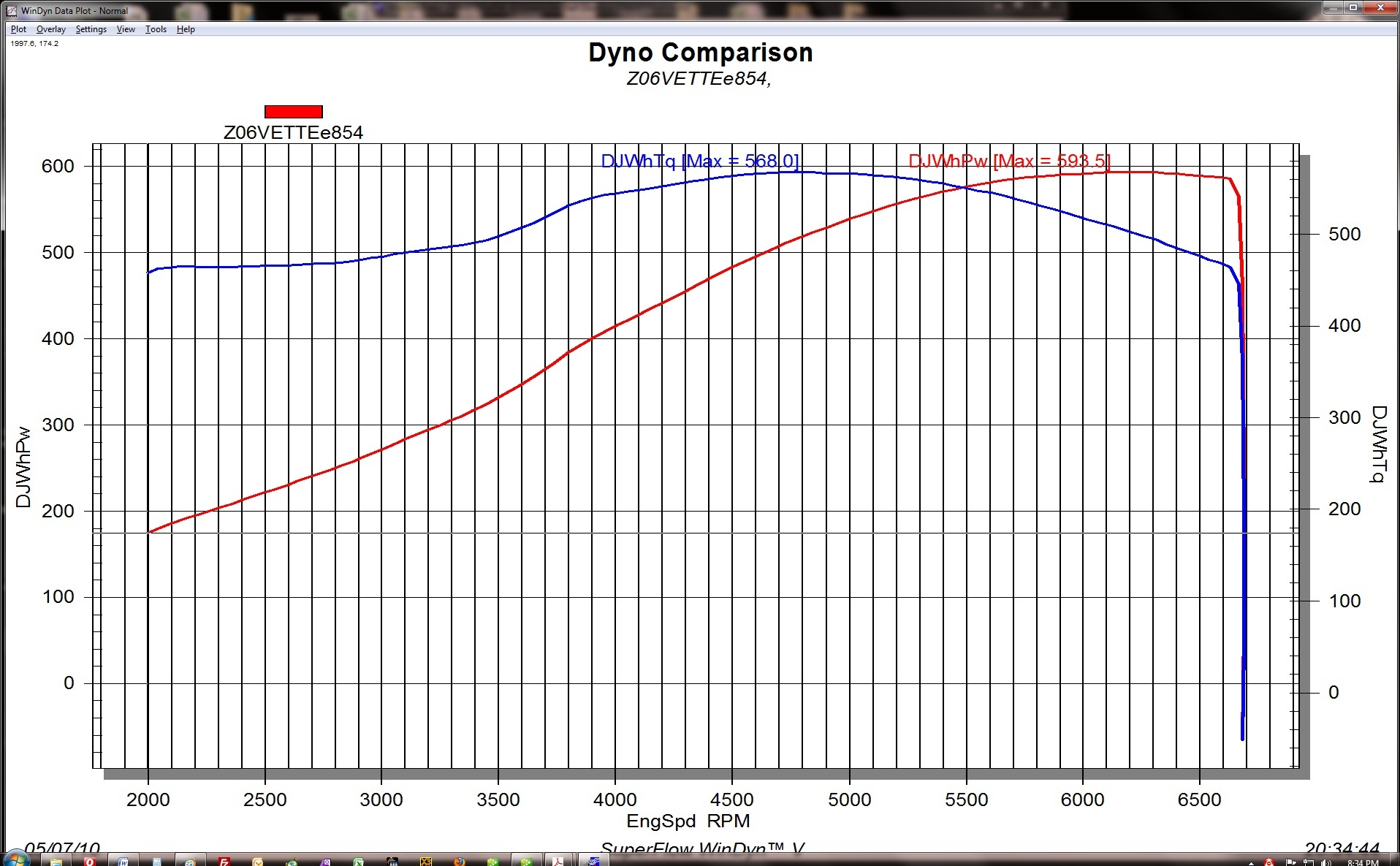


It has the torque curve of a positive displacement blower. Now why do you need to wind this motor out to 11000? RPM is just one more way to skin this cat.


Last edited by LSxJunkie; 09-10-2024 at 10:11 PM.
LSxJunkie is offline   Reply With Quote
Old 11-24-2012, 11:39 PM   #53
serialk11r
Senior Member
 
Join Date: Mar 2011
Drives: '06 AM V8V Coupe
Location: United States of America
Posts: 5,279
Thanks: 285
Thanked 1,075 Times in 759 Posts
Mentioned: 13 Post(s)
Tagged: 1 Thread(s)
Garage
Quote:
Originally Posted by blu_ View Post
You guys are still overcomplicating the argument IMO. There is no question GM pushrod engines make great power based on total physical size and weight of the engine. This works very well for performance based applications. All engine designs have strengths and weaknesses.
Yea, this is sorta the point I suppose. High displacement is great for performance because it lends itself to efficient production of power. For maximum possible performance (like a racing engine) I suspect DOHC can be considered inherently "better" in some way since it cuts the mass that must be controlled by springs.

For a street car I strongly dislike the massive displacement thing because these V8s are great when you're going 70-80mph with a very long cruising gear, but otherwise you're just wasting all that extra displacement (and fuel).

Additionally, variable lift systems are easier to implement in DOHC engines but most manufacturers don't even have those.
@LSxJunkie well cam phasing being standard on all engines these days makes the situation a little better for big cams, but I think the exhaust cam needs to be compromised on a little to give good streetability (too big of an exhaust cam just bleeds away too much energy by opening early). I suppose at the end of the day it all just depends on what you're looking for.
serialk11r is offline   Reply With Quote
Old 11-25-2012, 01:17 AM   #54
LSxJunkie
Senior Member
 
LSxJunkie's Avatar
 
Join Date: Dec 2011
Drives: Car
Location: Here
Posts: 326
Thanks: 283
Thanked 403 Times in 214 Posts
Mentioned: 8 Post(s)
Tagged: 0 Thread(s)
Quote:
Originally Posted by serialk11r View Post
Yea, this is sorta the point I suppose. High displacement is great for performance because it lends itself to efficient production of power. For maximum possible performance (like a racing engine) I suspect DOHC can be considered inherently "better" in some way since it cuts the mass that must be controlled by springs.

For a street car I strongly dislike the massive displacement thing because these V8s are great when you're going 70-80mph with a very long cruising gear, but otherwise you're just wasting all that extra displacement (and fuel).

Additionally, variable lift systems are easier to implement in DOHC engines but most manufacturers don't even have those.
@LSxJunkie well cam phasing being standard on all engines these days makes the situation a little better for big cams, but I think the exhaust cam needs to be compromised on a little to give good streetability (too big of an exhaust cam just bleeds away too much energy by opening early). I suppose at the end of the day it all just depends on what you're looking for.
Perhaps I'm just a creature of excess. One of my best friends has a Novi 1500 on an LS3 C6. 8lbs of boost, completely stock motor with longtubes and cats. Makes 550whp and blows the tires off at 50mph rolling into the throttle. Which is an absolute riot.
LSxJunkie is offline   Reply With Quote
Old 11-25-2012, 09:45 AM   #55
ZDan
Senior Member
 
ZDan's Avatar
 
Join Date: May 2011
Drives: '23 BRZ
Location: Providence, RI
Posts: 4,672
Thanks: 1,439
Thanked 4,012 Times in 2,098 Posts
Mentioned: 85 Post(s)
Tagged: 0 Thread(s)
Quote:
Originally Posted by Dimman View Post
I thought the DOHC ZR1 might have offered the best apples to apples, but the only things I know come from Wiki, and even there it's not apples-apples since Lotus had them recast the block in aluminum to use completely different bore and stroke ...
Well, there can really be no "apples to apples" but if there WERE, for ME it would be two engines, both designed for the same purpose (legal high performance street car), of the same physical size and weight, one a v8 DOHC with 4 valves per cylinder and the other a V8 cam-in-block OHV 2 valves per cylinder.

The DOHC would necessarily have much less displacement than the OHV engine.

Quote:
But using the example anyways, according to Wiki, the 1993 version made 405 hp and GM didn't match that with OHV tech until 2002 with the uprated Z06.
Of *course* a DOHC multivalve engine of the same displacement will have MUCH greater power potential than an OHV engine of the same displacement! That's never been disputed. The problem is that the DOHC multivalve engine will be significantly bigger and heavier.

The 90s ZR-1 with its 5.7 liter all-aluminum DOHC LT5 weighed a good 230 lb. more than its 5.7 liter iron-block LT1 Corvette brethren, just over 3500 lb. vs. just under 3300. The 405hp C5 Z06, in contrast, weighed about 100 lb. *less* than standard C5s, with published as-tested weights as low as ~3150 lb.

For me, weight matters, a LOT. Which is why My LS2 is in a ~2800 lb. RX-7 and not a 3300+ lb. C6 Corvette

Quote:
So I think the balance only comes from DOHC motors not being made to large displacements.
I've said it many times before and I'll say it again: Of *course* a DOHC 4-valve will have MUCH greater power potential vs. an OHV engine of the same displacement! But it will be HUGE in comparison, and significantly heavier as well, with all the additional mass up high.

Quote:
If someone made a modern DOHC ZR1 type engine out of a 7.0L SBC, we would be expecting no LESS than an emissions-friendly 700 hp (what, only 100hp/L? yawn...), with a broader powerband. For a small weight and packaging penalty.
The packaging penalty is not "small", it's HUGE. And the weight penalty is significant. Scale it down so that there is NO size or weight penalty, and the performance advantage disappears completely or becomes a DISadvantage.

Quote:
Yes it would be more expensive, and too much car for me but whatever...
Yup, there's also the price penalty.
And if you want to tweak for more power, you get to swap out 4 cams instead of just one.

The 6-liter LS2 in my RX-7 fits in the space formerly occupied by a 1.3 rotary. It has minor mods: L92 heads (same as LS3 heads but with solid valves), LS3 intake, mild cam (222/230 .597" lift), valve springs. It makes on the order of 525-540hp, did 184.8mph in the Texas Mile, and delivers 25-29mpg on the highway. Built for daily-driver usage, with power steering and A/C and cats (passed RI emissions, limit of 2.25 gpm HC), the car gained ~50 lb. with the transplant (2780 lb. => 2830 lb.).

I don't think there's a DOHC engine out there that competes with GM's LS engines as far as power potential vs. size/weight. Those are the parameters that most interest me. Great fuel mileage (for 500+ hp, anyway!) is a nice bonus

Last edited by ZDan; 11-25-2012 at 10:18 AM.
ZDan is offline   Reply With Quote
Old 11-25-2012, 10:14 AM   #56
BRZranger
Senior Member
 
Join Date: May 2012
Drives: BRZ
Location: Everett, WA
Posts: 736
Thanks: 996
Thanked 268 Times in 180 Posts
Mentioned: 15 Post(s)
Tagged: 0 Thread(s)
Anyone notice the irony?

@7thgear arguing for Japanese engineering

vs

@LSxJunkie arguing for Chevy engineering?

*user pics didn't upload-fail
BRZranger is offline   Reply With Quote
 
Reply


Posting Rules
You may not post new threads
You may not post replies
You may not post attachments
You may not edit your posts

BB code is On
Smilies are On
[IMG] code is On
HTML code is Off

Forum Jump

Similar Threads
Thread Thread Starter Forum Replies Last Post
100 hp/l NA engines einzlr Other Vehicles & General Automotive Discussions 95 11-15-2012 08:55 PM
What other engines fit our transmissions 1strwdcar Engine, Exhaust, Transmission 36 08-02-2012 05:45 PM
So you think you know engines? Ryephile Other Vehicles & General Automotive Discussions 43 02-04-2012 04:49 AM
different engines for different domestic markets?! Abflug Scion FR-S / Toyota 86 GT86 General Forum 20 10-02-2011 09:04 PM
Subaru engines' weights Allch Chcar Other Vehicles & General Automotive Discussions 19 04-30-2011 01:10 AM


All times are GMT -4. The time now is 07:29 AM.


Powered by vBulletin® Version 3.8.11
Copyright ©2000 - 2026, vBulletin Solutions Inc.
User Alert System provided by Advanced User Tagging v3.3.0 (Lite) - vBulletin Mods & Addons Copyright © 2026 DragonByte Technologies Ltd.

Garage vBulletin Plugins by Drive Thru Online, Inc.