Whoa, whoa... you guys realize there are millions of cars with aluminum exhaust components including turbo engines?
Quote:
Originally Posted by Dimman

I think that axle-back could be ok for a couple years, but life will get shorter the closer to the motor. But there could also be more stress and fatigue issues with a hybrid stainless/aluminum systems from different expansion rates and galvanic corrosion.
|
This is a theory that makes sense at first glance, but when you look at real vehicles on the road today it turns out that you've got it in reverse. There are basically zero axle-back exhausts on street cars, but
millions of vehicles with aluminum exhaust manifolds. Most of them are cast into the head.
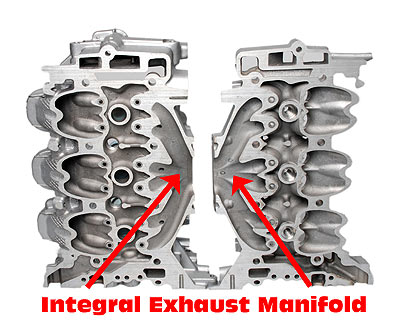
I have four examples for you, two non-turbo and two turbo.
First is the Chrysler Pentastar V6 engine you find in all sorts of longitudinal configurations, like on the V6 Challenger.
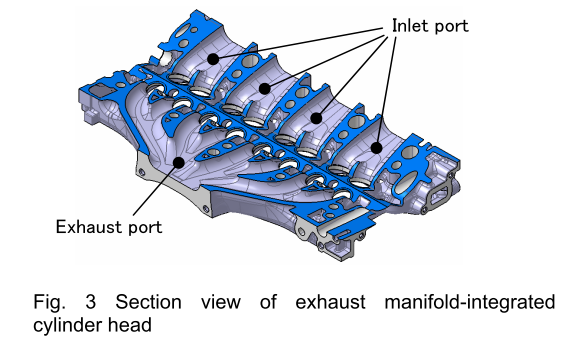
next is the Honda R18 engine used in a gazillion Civics
third is the new EA888 1.8T VW engine for European markets that I have discussed in the past. This engine also features port + direct injection like the FA20:
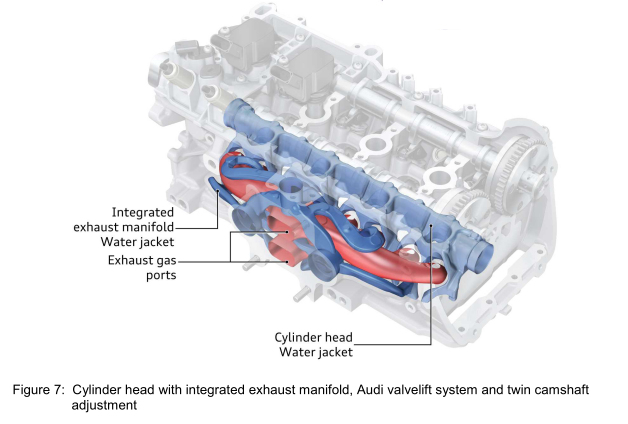
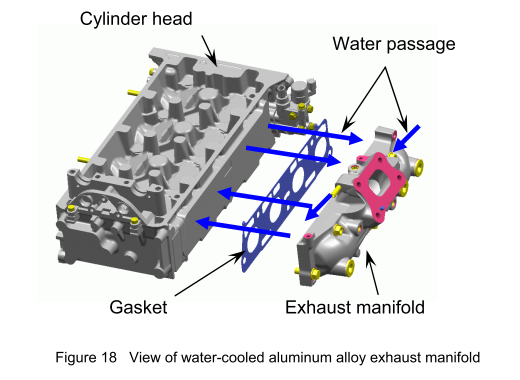
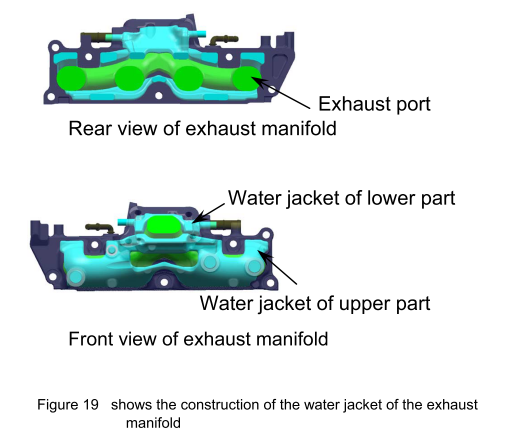
note that this manifold is aluminum and water-cooled. It's also cast into the head. The last example is the Honda K23A1 engine found in the outgoing RDX models. It's aluminum and water cooled, but it is not cast into the cylinder head:
Quote:
Originally Posted by serialk11r
Aluminum is more expensive than mild steel, and is less durable at temperature, that's why they don't use it in street cars.
But what's a reasonable length of time? A street car is run mostly at part load where exhaust temperatures are low.
|
Again, this seems to make sense on the surface except for the fact that exhaust temperatures have gotten very high over recent years. Engines run much leaner during transients to keep CO emissions down, as measured on the US06 test cycle. And you don't see gazillions of aluminum exhaust manifolds cracking.
The most common manifold design for modern emissions standards is probably the dual-wall stainless steel type, but aluminum exhaust manifolds are becoming increasingly more common. As for the rest of the vehicle, well I don't design catalysts but I'm sure cost is a big issue and I imagine there are a lot of problems making aluminum shells for catalysts.
Just because small companies with low production volumes haven't made it work doesn't mean there are insurmountable technical challenges.