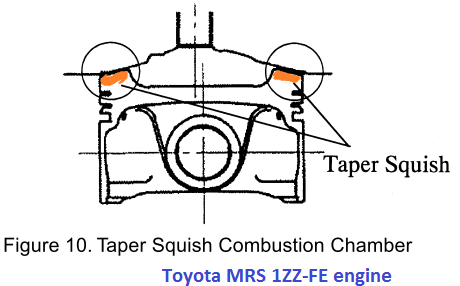
Well as far as squish zones go, below are squish zones on some well-known port injected engines from tdifferent angles. Here's the taper squish zones on a 1ZZ engine:
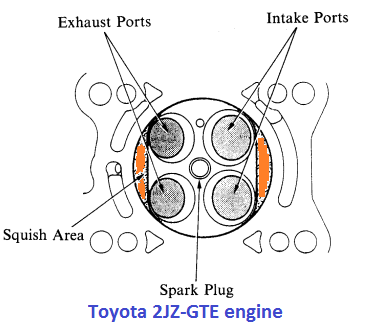
Here are squish zones on a 2JZ:
Here are squish zones on a Subaru EJ255 boxer engine:

and here is the squish zone (which is very knock prone) on a wankel rotary engine:
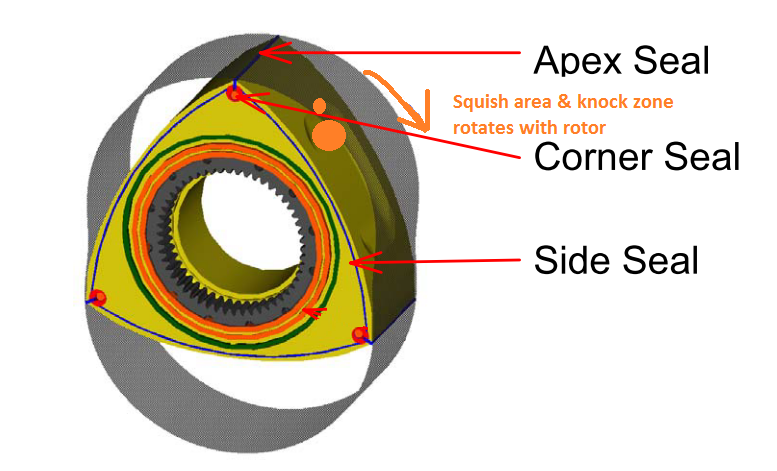
If you have a different combustion chamber shape (wedge for example, on a GM pushrod V8) then the squish flows will be different. I don't know too many specific details about squish flows on GDI engines.
Quote:
Originally Posted by Dimman

With the DI systems and charge motion, we are basically also less dependent on intake velocity because we are adding kinetic energy from the high pressure pump too, correct?
What are some of the pressures and velocities of DI fuel spray?
|
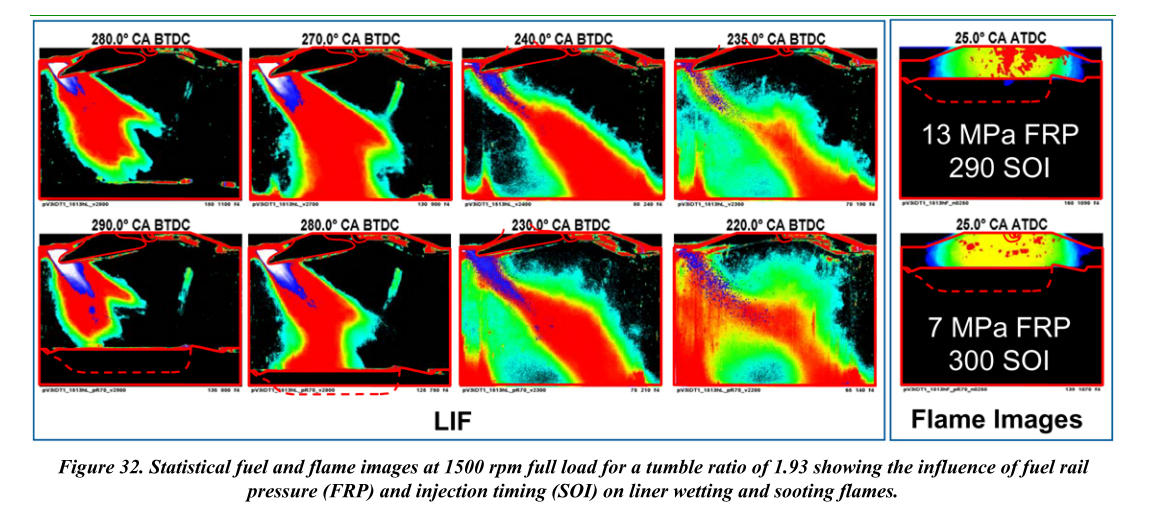
Lots of time and money are spent to answer those questions. These things are figured out during the development of combustion systems often by guys who have a PhD. The nominal high pressure fuel system pressure varies with the injection system and load, where higher load has higher fuel pressures. They typically vary between 120-200 bar, so do the math. There are fuel pressure specs in the 2GR paper in the sticky. Generally speaking you use higher pressure under heavier loads for better atomization and hopefully knock resistance, while at lower loads you want lower fuel pressure to reduce the amount of energy used by the high pressure fuel pump.
The spray does induce additional kinetic energy into the system. Expensive computer models and optical engines (transparent single-cylinder with high speed photography) are used to study these effects. Maybe I've posted something like this before, but here are some visualizations of spray patterns based on fuel pressure and start of injection timing on a prototype flex fuel Ecoboost engine.