as @
moto-mike is saying, in the end you have to do what's practical. How is the dyno and the knock reading responding to whatever AFR you are reading on your given sensor? The more instrumentation you can compare, the better.
While I'm thinking about it, here is another comment on the cam phasing and what is actually happening in the cylinder on a turbo DI engine:
For those of you who have tuned a boosted EJ and played around with cam timing, more boost, whatever, you expect to see a certain AFR. You have to remember that
the port injected fuel gets thrown out the exhaust valve during overlap & open valve injection, but for DI it doesn't! That's raw unburned fuel that can affect readings.
Nobody has come up with a RAM value from the FA20 ECU or a calculated parameter to determine the end of injection timing for the FA20's PFI system. If the end of injection occurs during an open intake valve & overlap, you've got all that unburnt fuel possibly reacting in the exhaust manifold or otherwise skewing the wideband as I said.
This is why if you have an engine dyno you would look at your CO2%, CO, and O2%, and HC ppm. In full stoich part load, CO2% is very very close to wideband AFR, and can be a good indicator of in-cylinder AFR during scavenging too. O2% is related to scavenging pass-through, and can be associated with reactions occuring in the exhaust stream that change the mixture. CO is probably the simplest metric for enrichment. Before wideband o2 sensors existed, all you went by was the CO%. HC ppm can correlate with unburned fuel passing through the exhaust valve during PFI scavenging.
So that's the PFI skewing AFR thing. Meanwhile, the DI start of injection event is timed past the scavenging crank angle window. So that fuel isn't thrown into the exhaust and isn't skewing the reading--this is a major reason why DI turbo engines spool better than port injected engines. They are tuned from the factory for more scavenging because fuel pass-through isn't an issue.
And as a further side note, if the injection system is sophisticated enough there can be multiple injection events for knock relief. The FA20 doesn't seem to do this, but many other DI engines can. Here is among the most sophisticated on the market, the M133 2.0 engine by AMG/Daimler using Piezo A-cone injector:
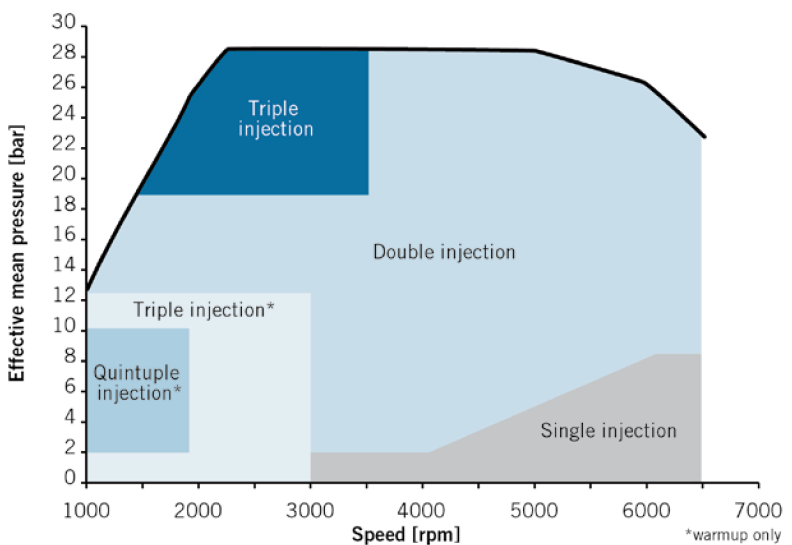
So you've got different things going on actually inside the cylinder depending whether it's PFI, DI, or PFI + DI due to injection and valve timing.