Quote:
Originally Posted by fstlane

My BRZ with 2500 miles on it has behaved this way since day one. Any quick shift regardless of the rpm will result in a brief period of detonation. I have also used the knock detector plug in for the Torque app which confirms what my ears hear.
|
I don't know the exact formula your Torque app uses, but the only way it could work is by taking some kind of "before and after" comparison or some kind of statistical analysis of spark timing. It can't read the knock sensor over the universal CAN bus. So you're still at the mercy what the knock sensor is responding to. The knock sensor can be responding to driveline noise, or it could in some cases be a little extra sensitive to combustion noise depending on how the engineer set the background learning signal processor and the knock judgment threshold.
Quote:
Originally Posted by jamesm
'on the edge of knock' and 'knocking' are not the same thing. if you're engine is knocking, something is wrong.
|
I know what you're thinking. "It's either knocking or it's not. If it's knocking, that's bad, and no engine should be knocking on a regular basis because it will cause damage." Wellll...
Ask trained engineers or engine technicians observing the same engine whether the engine is "knocking too much" and you'll get a different answer. There are two different ways of judging knock. There's a cylinder pressure trace method, and there's an audible microphone method. Notice that I didn't include a knock sensor in that list. The knock sensor reading, as processed by the ECU, is a reflection of some judgment call made during development in terms of sensor placement, calibration of the noise learning, and judgment of the "real knock" threshold.
Cylinder pressure, actual microphone, or knock sensor?
First, somebody decided where to put the knock sensor, which was a series of compromises in and of itself. Then during calibration of the knock system, somebody was physically listening to the engine or looking at the cylinder pressure trace. There are two schools of thought on knock judgment. The "microphone guys" swear that it's the best way to judge knock, and that with proper training it can detect real knock before a cylinder pressure trace ever could. The cylinder pressure guys say the same damn thing, claiming it's more representative than a microphone could ever be.
So, you get two guys listening to an engine and they will have their own opinions on how much noise is too much, unless they were trained by the same guy. And their judgments would then be reflected in the knock sensor feedback system on the ECU, which ultimately affects you the driver. But what about the cylinder pressure trace? Combustion pressure couldn't lie, could it?
Let's look at my cartoonish representation of a typical pressure trace at high load and MBT timing (minimum spark advance for best torque). X axis is time/crank angle, Y axis is combustion chamber pressure measured by pressure transducer.
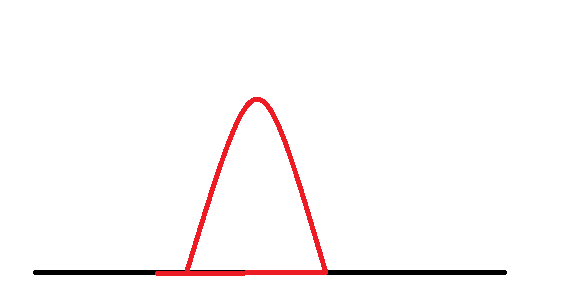
so that's MBT. Usually you have 50% burn by 6-10 degrees ATDC firing, and peak pressure (shown above) maybe 15-20 degrees ATDC. Now here's a retarded combustion phasing under full load. It's retarded because at a given rpm, we retard ignition timing with increased load to mitigate knock. In this example, peak pressure is around say 30 degrees ATDC.
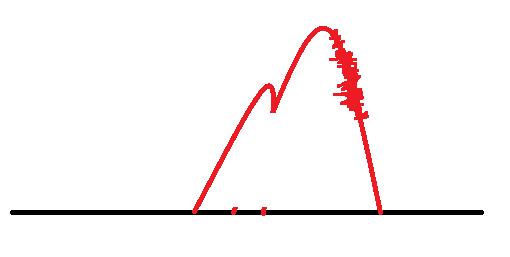
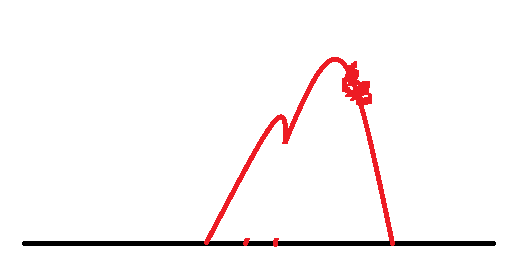
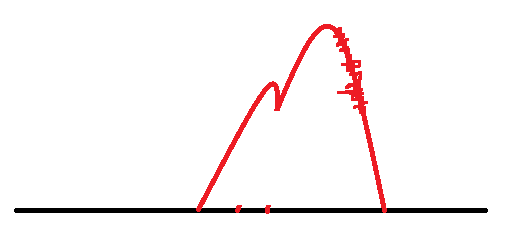
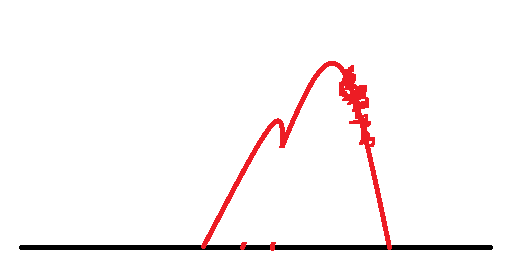
All of these made different levels of power and fuel economy, and often the uglier pressure traces perform better (except for when they don't). So which one is knocking "too much" ? But why not pull timing more so the pressure trace is less noisy? Well if you decide to do that you'd lose output and heat up the exhaust, requiring you to richen the mixture to keep temps down.
Remember, the knock sensor on your car can't read cylinder pressure and it doesn't have a human being sitting there with a microphone. It's just an approximation of that process. Setting an OEM knock control system is very difficult and except for extreme cases, there is no universal consensus on how much knock is too much. It's all somebody's judgment call, magnified by production tolerances and other factors.