


|
||||||
| Other Vehicles & General Automotive Discussions Discuss all other cars and automotive news here. |
 |
|
|
Thread Tools | Search this Thread |
 09-29-2011, 05:57 AM
|
#43 |
|
Supra Owner

Join Date: Sep 2010
Drives: 1995 Toyota Supra UK Spec
Location: New Zealand
Posts: 440
Thanks: 0
Thanked 6 Times in 3 Posts
Mentioned: 0 Post(s)
Tagged: 0 Thread(s)
|
^ This man speaks the truth... at least from what I can tell from what I've learnt in 1st year Engineering XD
I would still need a lot more practice/study to put my full faith in it, but from what I remember it all sounds pretty much right  Either way, I stil love seeing these things pan out, it's all about learning for me! 
__________________
 |

|

|
|
09-29-2011, 12:01 PM
|
#44 |
|
Kuruma Otaku
Join Date: Dec 2009
Drives: Mk3 Supra with Semi-built 7MGTE
Location: Greater Vancouver (New West)
Posts: 6,854
Thanks: 2,398
Thanked 2,265 Times in 1,234 Posts
Mentioned: 78 Post(s)
Tagged: 2 Thread(s)
|
The stiffness issue is largely solved by shape, going to larger diameter tube.
As for the welds, like I said in the vid, it was fusion welded with only half penetration, which would be done in an exhaust type situation. Plus not purging it to see what types of corrosion effects would happen, as low temp Ti is very corrosion resistant (about the same as 304 SS, I believe) but at high temps it reacts with oxygen and nitrogen. Basically it was an experiment for the welder. What we learned, is that with our current abilities, we can fabricate a titanium exhaust system without difficulties (excepting the cost...). As for the corrosion resistance of 7075, if it is anodized it is hardly an issue. It is 2024 that is the high-strength alloy that is more sensitive to corrosion. If I can find Grade 5/Ti 6AL 4V tubing, we will be doing some more serious testing, in terms of weld strength, but don't think it will be an issue. Annealed tensile strength is in the 145 kpsi range, with 180ish heat-treated. With proper purging and shielding the weld should be quite strong.
__________________
 Because titanium. |
|
|
|
|
09-29-2011, 02:16 PM
|
#45 |
|
Kuruma Otaku
Join Date: Dec 2009
Drives: Mk3 Supra with Semi-built 7MGTE
Location: Greater Vancouver (New West)
Posts: 6,854
Thanks: 2,398
Thanked 2,265 Times in 1,234 Posts
Mentioned: 78 Post(s)
Tagged: 2 Thread(s)
|
Old Greg: You feel there would be no benefit from titanium? Since we can match or increase the stock links' stiffness through an increase of diameter with thin wall material, wouldn't the far lower density alone out perform a steel version? Part of the issue is minimum practical thickness of pieces from a manufacturing point of view. If you recommend, for example, your .065" minimum thickness, wouldn't a Ti piece with an increased diameter still weigh less than the much denser steel piece?
On the F1 example, I believe this skipping of Ti is due not to mechanical limits, but due to aero requirements needing a smaller cross-section of the wishbone, and that aero is far more important than semi-sprung weight. PS: The rod-ends are just place holders as the 7075-T6 ones weren't in stock...
__________________
Because titanium. |
|
|
|
|
09-29-2011, 03:51 PM
|
#46 | |
|
Rocket Surgeon
Join Date: Apr 2011
Drives: PSM GGA OMG
Location: FL
Posts: 1,312
Thanks: 10
Thanked 141 Times in 84 Posts
Mentioned: 2 Post(s)
Tagged: 1 Thread(s)
|
Quote:
The stiffness of your link will be proportional to area*E, and since E is proportional to density, stiffness will be proportional to area*density (ie. weight). Lower weight means lower stiffness, regardless of what you make it out of. Conversely, equally stiff steel and titanium links will weigh the same amount. Seriously, you'll save a lot more weight by not using rod ends (aluminum or otherwise) in the second link than you ever would by using Ti. |
|
|
|
|
|
09-29-2011, 04:22 PM
|
#47 | |
|
Kuruma Otaku
Join Date: Dec 2009
Drives: Mk3 Supra with Semi-built 7MGTE
Location: Greater Vancouver (New West)
Posts: 6,854
Thanks: 2,398
Thanked 2,265 Times in 1,234 Posts
Mentioned: 78 Post(s)
Tagged: 2 Thread(s)
|
Quote:
So why wouldn't the unlimited budget F1 guys go to tiny low-drag tungsten for their control arms? There is obviously more to it than just the metal's density. More research time for me... The rod-end dilemma is more about manufacturing time. I would prefer only one rod-end with a threaded adjuster on one side with a fixed bearing on the other side, but it is far faster to just thread the opposite ends. And on the DOM note, why do you suggest heat-treating for rally-cross? DOM (when referred to just as DOM anyways) is just mild steel and I can't think of any suitable processes that would make it better suited for rally-cross. DOM is the manufacturing process of cold-Drawing tubing Over a Mandrel. It is more consistent and accurate, but no more suitable for heat-treatment than ordinary mild steel.
__________________
Because titanium. |
|
|
|
|
|
09-29-2011, 05:12 PM
|
#48 | ||
|
hashiryu
Join Date: Nov 2009
Drives: Mk4 Supra
Location: Probably mucking around in an engine bay
Posts: 2,567
Thanks: 18
Thanked 37 Times in 20 Posts
Mentioned: 0 Post(s)
Tagged: 0 Thread(s)
|
Quote:
Something tells me that tensile strength of the material is not being considered **goes to dig for Uni note books**
__________________
Welcome to FT86club.com
Quote:
|
||
|
|
|
|
09-29-2011, 06:27 PM
|
#49 |
|
Kuruma Otaku
Join Date: Dec 2009
Drives: Mk3 Supra with Semi-built 7MGTE
Location: Greater Vancouver (New West)
Posts: 6,854
Thanks: 2,398
Thanked 2,265 Times in 1,234 Posts
Mentioned: 78 Post(s)
Tagged: 2 Thread(s)
|
Also, with the primary focus on compression and tension stiffness, are we looking at this from an ideal physics model viewpoint, or a real-world application viewpoint?
And is this issue strictly for lower lateral control arms? The Legacy is simply a starting test point, and eventually I will be doing them for a Mk3 Supra. In the Supra's case they can break toe-control links (a straight semi-trailing arm, similar to the bent one on the Subaru's) on hard, high-power, slick tire launches. Plus they can snap off the anti-roll bar mounting brackets when higher rate bars are used, which is what the emphasis on the ARB mounting is about.
__________________
Because titanium. |
|
|
|
|
09-29-2011, 07:16 PM
|
#50 | |||||
|
Rocket Surgeon
Join Date: Apr 2011
Drives: PSM GGA OMG
Location: FL
Posts: 1,312
Thanks: 10
Thanked 141 Times in 84 Posts
Mentioned: 2 Post(s)
Tagged: 1 Thread(s)
|
Quote:
Quote:
Quote:
Quote:
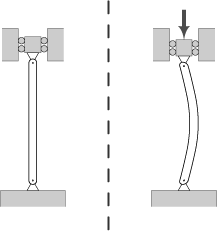 At low loads, the ratio of force to displacement is pretty linear. As you get closer to the point of buckling failure that ratio becomes exponential. So increasing Buckling strength increases stiffness at very high loads, but at low loads (where your links will be) it doesn't make much difference. For reference, a 20" long piece of 5/8th's 0.035" steel tube has a buckling strength of ~2000 lbs. Quote:
|
|||||
|
|
|
|
09-29-2011, 07:52 PM
|
#51 | |
|
Rocket Surgeon
Join Date: Apr 2011
Drives: PSM GGA OMG
Location: FL
Posts: 1,312
Thanks: 10
Thanked 141 Times in 84 Posts
Mentioned: 2 Post(s)
Tagged: 1 Thread(s)
|
Quote:
The stuff I've been saying about compression stiffness and buckling strength is directly applicable to Subaru style lateral links, as well as toe links and tie rods (and any other two force members). The science can be applied to other stuff, but it's a bit different. Got any pics of broken Supra parts? If the toe rods are bending in the middle, all you need to do is increase E*I... basically, use larger diameter tube. The other option is to use higher offset wheels, but I doubt that would go over well.
|
|
|
|
|
|
09-29-2011, 09:00 PM
|
#52 |
|
Kuruma Otaku
Join Date: Dec 2009
Drives: Mk3 Supra with Semi-built 7MGTE
Location: Greater Vancouver (New West)
Posts: 6,854
Thanks: 2,398
Thanked 2,265 Times in 1,234 Posts
Mentioned: 78 Post(s)
Tagged: 2 Thread(s)
|
I still just see bending force in that pic, regardless of where the force comes from it's compressing one side and in tension on the other. I'll have to go over this with one of the engineers I work with when they have time...
Back to the stuff I am more familiar with, there is little point to heat-treating mild steel, DOM or not. Due to the low carbon content you don't get a suitable strength increase. It will be marginally stronger and harder, but more brittle. Now when you are talking brittle when the material thickness is only .065" and subject to impacts from rocks, you are asking for trouble. If you are talking about case-hardening it through pack carburizing, cyaniding etc... but it will almost through-harden the whole rod with the thin wall and that kind of defeats the cost purpose using regular DOM in the first place. Just start with a stronger material. Now if we are talking about DOM 4140 (or 4130, 4340 etc...), yes heat-treating is suitable. Remember DOM is just the manufacturing process and has nothing to do with the heat-treat suitability of the metal. For the machining, it takes me literally less than 5 minutes to thread those. Probably closer to 3. If I wanted to make a piece with a spherical bearing, I would have more setup time and tooling changes, as well as worrying about tighter tolerances for fitting (how tight of a press fit) and snap-ring grooves. (Drilling out the titanium and parting off 3 pieces takes less than 10 minutes.) My interest is in what a total time cost would be. ie: would it be worth it to make a limited run once fully tested and proven... The anti-roll bar 'L' bit is a headache and a half. It's completely done on a lathe in the pic to get the nice stress-riser free radii, and then will require all the spherical bearing nuissance stuff listed above. I was looking into heat-treating facilities, so I could make them out of TIG welded 4140 and get them properly stress-relieved or process-annealed. Then I got distracted by the titanium.
__________________
Because titanium. |
|
|
|
|
09-29-2011, 09:50 PM
|
#53 | |
|
Rocket Surgeon
Join Date: Apr 2011
Drives: PSM GGA OMG
Location: FL
Posts: 1,312
Thanks: 10
Thanked 141 Times in 84 Posts
Mentioned: 2 Post(s)
Tagged: 1 Thread(s)
|
Quote:
|
|
|
|
|
|
09-30-2011, 11:54 AM
|
#54 |
|
Kuruma Otaku
Join Date: Dec 2009
Drives: Mk3 Supra with Semi-built 7MGTE
Location: Greater Vancouver (New West)
Posts: 6,854
Thanks: 2,398
Thanked 2,265 Times in 1,234 Posts
Mentioned: 78 Post(s)
Tagged: 2 Thread(s)
|
I haven't had a chance to go over it more completely with an engineer, but I did some reading last night.
I have a better understanding of why the 'E' is important for suspension. Since the goal with things like spherical bearings is to reduce flex. This would be to keep the roll centers from moving around unpredictably. Having 'stretchy' control arms will act like squishy rubber bushings, and also shift the centers around. But to a much lesser degree. I'm still having trouble wrapping my head around how much is pure tension or compression force. If the suspension loads were just creating flexural stress on the arms, then making them larger diameter will make them functionally stiffer and more precise. Once I fully understand why the tension/compression loading is so important, I'll be back on track to continue, I think... However I do have to disagree with your explanation regarding density's effect on E (Young's Modulus). This is just going from some given amounts in my metallurgy textbook... Aluminum's E: 10.0 X 10^6 psi Aluminum's density: 170 lbs/ft^3 Titanium's E: 15.2 x 10^6 psi (the Ti 6Al 4V I've got a hard-on for. General is listed as 16.0 x 10^6 psi) Titanium's density: 280 lbs/ft^3 Steel's E: 30.0 x 10^6 psi Steel's density: 490 lbs/ft^3 So looks like it's increasing nicely with density here, but... Wrought Iron's E: 28.0 x 10^6 psi Wrought Iron's density: 490 lbs/ft^3 Copper's E: 17.0`x 10^6 psi Copper's density: 555 lbs/ft^3 Pure Tin's E: 6.0 x 10^6 psi Pure Tin's density: 455 lbs/ft^3 Inconel 600's E: 30.0 x 10^6 psi Inconel 600's density: 527 lbs/ft^3 14k gold's E: 11.5 x 10^6 psi 14k gold's density: ~1200 lbs/ft^3 But getting back to my hypothetical F1 tungsten arms: Tungsten's E: 59.0 x 10^6 psi Tungsten's density: 1180 lbs/ft^3 (Tungsten is a pretty impressive metal overall, given it also has a 220000 psi tensile strength, melts at 6100 degrees F, and hardly expands when it gets hot. Too bad it's so heavy, and would be a headache to work with I'm sure...) So there is more to it than simply density. So given that E = stress/strain the tensile strength of the material (from calculating stress) does seem to be taken into account. Still doesn't work out too favourably for Ti, given that it ends up with about half the E of steel. But all this leads to is a small length change under load, right? So the trade off will be to reduce semi-sprung weight, or more accurately control roll centers and camber change? I'm thinking that the semi-sprung weight benefit will outweigh the small potential precision loss with tension and compression loading (at least until maybe I better understand that loading). Some of that missing precision can be taken back with chassis bracing to reduce that flexing as a variable, so the end result can be basically keeping the same precision, but moving mass (with possibly a net reduction) from being semi-sprung to unsprung, which is ultimately beneficial. Alternatively, could I make some larger diameter, thin .035" wall high-strength Ti arms and slip over a few layers of biaxial carbon sock in epoxy to increase the E of the arms? Also what kind of testing procedures should be used? Load the stock ones in tension (how much?) and record the elongation, then compare mine to that baseline? Then to failure and compare load? Repeat with them loaded in flexure? (Destructive is ok for any 4140 or aluminum parts, titanium bits later when I can afford it.) Once I have a finished design, I will probably have to find a firm that can con$ult on this. Edit: Part in red is wrong. Stress is simply based on the load and area. However this leads to the following questions: If we know the material's E and the stress applied to it (load x A), we can calculate the length change under load and see how that affects the roll centers. ie: Stress of 18000 psi over a 12" long piece of steel will stretch (18000/(30 X 10^6)) x 12 = .0072" Then we can look at the suspension geometry and re-calculate roll centers to have a look at how much the roll center shifts. But seeing that it is stress and therefore area that directly affects E, I see now why there is little change in weight between steel and aluminum (actually a tiny bit heavier than steel in the stiffness comparison) for the same stiffness. BUT... the aluminum part will be much stronger for the same weight. Titanium will end up being heavier for the same stiffness, but ridiculously stronger. I'm getting closer, I think... Now to wrap my head around the emphasis on compression and tension loading, as opposed to bending.
__________________
Because titanium. Last edited by Dimman; 09-30-2011 at 02:15 PM. Reason: Edit: |
|
|
|
|
09-30-2011, 09:11 PM
|
#55 | ||||||
|
Rocket Surgeon
Join Date: Apr 2011
Drives: PSM GGA OMG
Location: FL
Posts: 1,312
Thanks: 10
Thanked 141 Times in 84 Posts
Mentioned: 2 Post(s)
Tagged: 1 Thread(s)
|
Quote:
Quote:
Quote:
Oh and if you want that Ti6Al4V tube, try supraalloys.com Quote:
All you need to do is figure out the internal and external dimensions of the stock links. From that you can calculate area and I, and you already have E for steel. Quote:
Quote:
And just to make sure, you do realize that the increased strength is coming from the need for larger tubes (and the corresponding increase in I, and therefore buckling strength), not from the higher Area * Yield Strength, right? You aren't going to fail these things in tension, and if you do, whatever caused them to fail is probably going to put you in the hospital or worse. |
||||||
|
|
|
|
09-30-2011, 09:31 PM
|
#56 | |
|
Kuruma Otaku
Join Date: Dec 2009
Drives: Mk3 Supra with Semi-built 7MGTE
Location: Greater Vancouver (New West)
Posts: 6,854
Thanks: 2,398
Thanked 2,265 Times in 1,234 Posts
Mentioned: 78 Post(s)
Tagged: 2 Thread(s)
|
Quote:
When you say 'buckling' I don't have a clear picture of what that is. I'm imagining it's compression/flexural and picturing a strength that is resisting stress (load/area). I haven't got too far into Poisson's Ratio, if that's a relevant bit that I'm missing. On a side note stock steel Subaru lateral arms will bend on a 40 km/h (guesstimate, slow speed but ass end was swinging around) curb impact. So does the wheel.
__________________
Because titanium. |
|
|
|
|
|
|
|
|
|
|


