


 11-18-2011, 07:24 PM
|
#379 |
|
Hot Dog

Join Date: Apr 2011
Drives: quicker than arghx7
Location: Metro Detroit
Posts: 1,316
Thanks: 103
Thanked 173 Times in 83 Posts
Mentioned: 6 Post(s)
Tagged: 0 Thread(s)
|
It's possible Formula 1 are currently using multi-wall tubing in conjunction with merging the exhaust valve ports in the first few inches of the primary tubing, then what appears to be a step another several inches later...however it's possibly a Helmholtz resonator using the multiple-walls as tuning forks. It's also possible that it's a simple step-primary and the delta versus straight diameter primaries nets a marginal gain solely at crazy high RPM [i.e. not relevant for road cars]. Any gain in F1, however, is worth the cost.
For us, it's rather academic and not terribly practical. Having Burns hash out the design with their software is likely going to get us much further than the OEM setup, and further than the usual hack aftermarket offerings.
__________________
"Wisdom is a not a function of age, but a function of experience."
Just Say No to unqualified aftermarket products. |

|

|
|
11-18-2011, 08:48 PM
|
#380 | |
|
Kuruma Otaku
Join Date: Dec 2009
Drives: Mk3 Supra with Semi-built 7MGTE
Location: Greater Vancouver (New West)
Posts: 6,854
Thanks: 2,398
Thanked 2,265 Times in 1,234 Posts
Mentioned: 78 Post(s)
Tagged: 2 Thread(s)
|
Quote:
__________________
 Because titanium. |
|
|
|
|
|
11-18-2011, 11:55 PM
|
#381 |
|
Senior Member

Join Date: Oct 2010
Drives: 04 PSM WRX Wagon
Location: Irvine, CA
Posts: 385
Thanks: 0
Thanked 4 Times in 3 Posts
Mentioned: 0 Post(s)
Tagged: 0 Thread(s)
|
__________________
|
|
|
|
|
11-23-2011, 09:17 PM
|
#382 |
|
Kuruma Otaku
Join Date: Dec 2009
Drives: Mk3 Supra with Semi-built 7MGTE
Location: Greater Vancouver (New West)
Posts: 6,854
Thanks: 2,398
Thanked 2,265 Times in 1,234 Posts
Mentioned: 78 Post(s)
Tagged: 2 Thread(s)
|
Ryephile:
I noticed in the Engineering thread that you are an acoustical engineer. Is it possible for you to explain the acoustical tuning aspect of intake runners/plenums? And possibly the same with the exhaust headers/collectors and their pressure waves? Relating this to Burns' products, their collectors can sometimes referred to a 'venturi merge collectors'. (depending on whether the end tube stays the same diameter or expands) Looking at them, this makes sense, the runners merge, and smoothly neck down, before the combined tube gradually expands out.  Inertia-wise you can 'see' the venturi, and since the low pressure area is where the runners meet, it makes sense that if they are matched to appropriate firing order, the next runner's exhaust gets the benefit of less pressure in its tube. Like a carb, the first rush of exhaust is the air, and the next connected rush is the 'fuel' and gets a pull from the venturi. And back and forth (2-1) or round and around (3-1, 4-1, etc...). But what do the high (speed of sound) speed exhaust pressure waves do when they hit the gradual area change of the collector, instead of one where the just end inside a cone? Is it any different?
__________________
Because titanium. |
|
|
|
|
11-23-2011, 09:54 PM
|
#383 |
|
Hot Dog
Join Date: Apr 2011
Drives: quicker than arghx7
Location: Metro Detroit
Posts: 1,316
Thanks: 103
Thanked 173 Times in 83 Posts
Mentioned: 6 Post(s)
Tagged: 0 Thread(s)
|
In all honesty, it's much more complicated than simple acoustic tuning like a Helmholtz resonator or reflex port. I also don't practice nearly as much acoustics as I should to keep fresh, so I'm pretty rusty with execution without the crutch of my software programs.
 With an intake manifold it's reasonably corollary, as the cylinder suction combined with the transient of the valve timing can create standing waves within the intake port and improve mass air flow [and thus VE]. This is basically why high RPM engines use short intake runners and low RPM engines use long intake runners, to set a resonance at a frequency corresponding to the operational RPM range the engine designers choose. Going further, it's why you see complicated active intake port geometries [BMW did an active intake manifold on one of their V8's, though I can't recall which one off the top of my head]. With exhaust tuning, the acoustics are one aspect, but actual particle exhaustion is critical as well. With a traditional loudspeaker bass-reflex port, the air particles are suspended within the port. This resonance is counter productive to particle flow in engines. Thankfully, the positive displacement nature of engines force the particles out the exhaust pipe. The trick now is to set up a complicated series of resonances between the primary and secondary tunings along with not ruining the particle flow with overly abrupt transitions [i.e. crappy collector, sharp bends, or old school restrictive cats]. To try to answer your question, a poor collector is similar to simply dumping all 4 primaries into free space; you get no benefit of the negative wave pulling the next cylinder wave. A terrible collector will actually inhibit pressure wave complimentary interaction and will likely impact particle flow in practice as a result. A properly merged collector will manage the cross section and perceived volume such that each primary slowly expands [relatively speaking] so it doesn't stall and negate it's intended function as a scavenger. If you can envision intake and exhaust flow as an AC circuit [RPM acoustics] with a DC bias [MAF], you're pretty close to the right headspace. I hope that comes across how it sounds in my head! If you haven't read it yet, Burns' explanation is a good abstract.
__________________
"Wisdom is a not a function of age, but a function of experience."
Just Say No to unqualified aftermarket products. Last edited by Ryephile; 11-23-2011 at 09:57 PM. Reason: added Burns link |
|
|
|
|
11-23-2011, 10:12 PM
|
#384 | |
|
Kuruma Otaku
Join Date: Dec 2009
Drives: Mk3 Supra with Semi-built 7MGTE
Location: Greater Vancouver (New West)
Posts: 6,854
Thanks: 2,398
Thanked 2,265 Times in 1,234 Posts
Mentioned: 78 Post(s)
Tagged: 2 Thread(s)
|
Thanks, don't know how I missed that page, but most of my time there is comparing the bend prices.
Best part was this: Quote:
__________________
Because titanium. |
|
|
|
|
|
11-23-2011, 10:22 PM
|
#385 |
|
Hot Dog
Join Date: Apr 2011
Drives: quicker than arghx7
Location: Metro Detroit
Posts: 1,316
Thanks: 103
Thanked 173 Times in 83 Posts
Mentioned: 6 Post(s)
Tagged: 0 Thread(s)
|
It's a pretty good book [I have it in my bookcase] and worth getting if nothing more than to be an educated consumer.
__________________
"Wisdom is a not a function of age, but a function of experience."
Just Say No to unqualified aftermarket products. |
|
|
|
|
11-24-2011, 01:49 PM
|
#386 |
|
Senior Member
Join Date: Nov 2011
Drives: car
Location: cold
Posts: 599
Thanks: 72
Thanked 611 Times in 185 Posts
Mentioned: 33 Post(s)
Tagged: 0 Thread(s)
|
One of the things that really makes intake and exhaust manifolds complicated are variable cam phasers (VVT). Here's a case-in-point, the 2.4L direct injected nonturbo engine on the Hyundai Sonata. This engine has variable cam timing on both intake and exhaust, as well as a variable intake runner system:
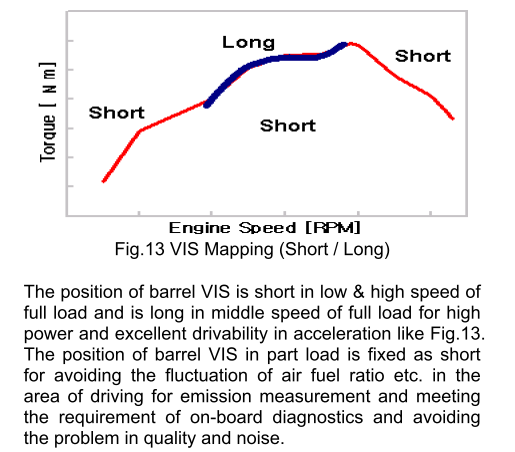 As counter-intuitive as it may seem, it actually runs short intake manifold runners at low speed and longer runners only in the mid range. Here is a cam timing map for that engine using isobars: 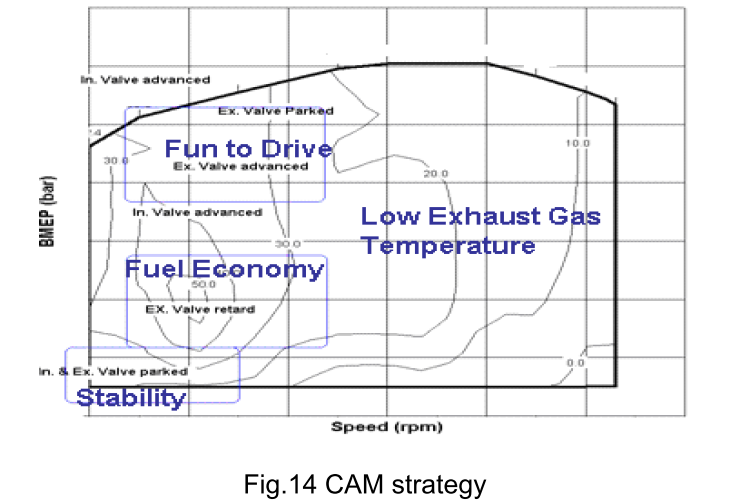
|
|
|
|
|
11-24-2011, 02:16 PM
|
#387 | |
|
Kuruma Otaku
Join Date: Dec 2009
Drives: Mk3 Supra with Semi-built 7MGTE
Location: Greater Vancouver (New West)
Posts: 6,854
Thanks: 2,398
Thanked 2,265 Times in 1,234 Posts
Mentioned: 78 Post(s)
Tagged: 2 Thread(s)
|
Quote:
It likely has to do with which wave reflection they were tuning for. On a short runner it may be possible to get a positive wave on an early reflection at low rpm, but probably at the expense of corresponding negative wave a little later in the power band. What the cam phasing can do is change when the valves open/close/overlap related to when the good and bad pressure waves come back. With a longer runner but unable to change cam phasing, maybe to get the low/mid rpm positive wave boost, the later negative reflections will only come back at an rpm higher than the motor runs. So with cam-phasing this can be tuned around now. Fat power bands are becoming the norm now, which is why I don't believe the brochure torque number is a peak one. An example is the LFA with two stage intake induction. It makes 90% of peak torque from 3700 rpm to probably its redline. (At the minimum a bit past its 8700 rpm power peak.)
__________________
Because titanium. |
|
|
|
|
|
11-26-2011, 10:05 PM
|
#388 | |
|
Hot Dog
Join Date: Apr 2011
Drives: quicker than arghx7
Location: Metro Detroit
Posts: 1,316
Thanks: 103
Thanked 173 Times in 83 Posts
Mentioned: 6 Post(s)
Tagged: 0 Thread(s)
|
From The Toyota UK Press release:
Quote:
__________________
"Wisdom is a not a function of age, but a function of experience."
Just Say No to unqualified aftermarket products. |
|
|
|
|
|
11-26-2011, 11:50 PM
|
#389 | |
|
Site Moderator

Join Date: Dec 2010
Drives: Stuff
Location: Florida
Posts: 10,317
Thanks: 955
Thanked 5,965 Times in 2,689 Posts
Mentioned: 262 Post(s)
Tagged: 8 Thread(s)
|
Quote:
__________________
-Dave
Track cars: 2013 Scion FRS, 1998 Acura Integra Type-R, 1993 Honda Civic Hatchback DD: 2005 Acura TSX Tow: 2022 F-450 Toys: 2001 Chevrolet Corvette Z06, 1993 Toyota MR2 Turbo, 1994 Toyota MR2 Turbo, 1991 Mitsubishi Galant VR-4 Parts: 2015 Subaru BRZ Limited, 2005 Acura TSX Projects: 2013 Subaru BRZ Limited track car build FS: 2004 GMC Sierra 2500 LT CCSB 8.1/Allison with 99k miles |
|
|
|
|
|
11-27-2011, 03:42 PM
|
#390 |
|
Senior Member
Join Date: May 2011
Drives: Toyota
Location: Germany
Posts: 1,202
Thanks: 134
Thanked 138 Times in 90 Posts
Mentioned: 5 Post(s)
Tagged: 0 Thread(s)
|
For engine/performance comparision:
Renault Clio RS III Cup NA 2.0l I4 201 PS @ 7.100 RPM 215 Nm @ 5.400 RPM (engine is not quadrat, it has long stroke, that is why more torque) Redline @ 7.500 RPM Curb Weight: 1230 kg 0-100 km/h: 6,9 sec V-max: 224 km/h Price: 24.000 € |
|
|
|
|
11-28-2011, 12:12 AM
|
#392 | |
|
ლ(ಠ益ಠ)ლ

Join Date: Apr 2010
Drives: E36 5.7 V8
Location: Bronx, NYC
Posts: 1,573
Thanks: 194
Thanked 198 Times in 112 Posts
Mentioned: 3 Post(s)
Tagged: 0 Thread(s)
|
Quote:
__________________
I wish I was cool enough to have an FR-S
 |
|
|
|
|
|
|
|
|
|
|
 Similar Threads
|
||||
| Thread | Thread Starter | Forum | Replies | Last Post |
| Joke Thread | VenomRush | Off-Topic Lounge [WARNING: NO POLITICS] | 27 | 07-09-2011 01:44 AM |
| The Music Thread | aliphian | Off-Topic Lounge [WARNING: NO POLITICS] | 13 | 03-28-2011 12:35 PM |
| engine swap thread | aspera | Engine Swaps | 231 | 03-15-2011 06:10 PM |
| FT-86 to debut new GPS-track day technology for use on track and GT5! | Hachiroku | Scion FR-S / Toyota 86 GT86 General Forum | 17 | 01-30-2010 12:30 PM |
| Official MMA Thread | zigzagz94 | Off-Topic Lounge [WARNING: NO POLITICS] | 11 | 12-15-2009 11:59 PM |





 spyda
spyda