While we look forward to RobiSpec's analysis, I'll provide some brain food.
There are multiple systems interacting in a car suspension, with different natural frequencies and damping characteristics. The lowest decade (1-10Hz) is responsible for almost all system dynamics, but all of them should be mentioned. The system looka like dis:
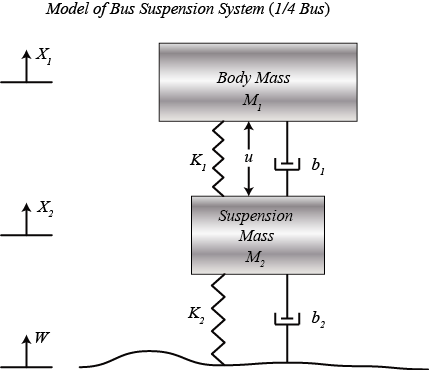
1) Upper system (fix x_2 and w):
Sprung weight + suspension spring. This motion is damped by the suspension damper. These are very low frequencies (0.5-5 Hz).
f_nat1 = constant * sqrt(spring rate / sprung mass)
b_1 = damper constant / sqrt(spring rate / sprung mass)
2) Middle system (fix x_1 and w):
Unsprung weight + suspension + tires. This motion is damped by both the suspension damper and tire damping. These are generally much higher frequencies.
f_nat2 = constant * sqrt([spring rate + tire rate] / unsprung mass)
b_2 = damper constant / sqrt([spring rate + tire rate] / unsprung mass)
3) Lower system (fix x_1 and x_2)
If we assume that all of the car's weight is sent to the ground, the parts involved are the sprung weight + unsprung weight + tires. This motion is damped by the tire, which is generally a very low damping factor (tires bounce).
f_nat3 = constant * sqrt(tire rate / [sprung mass + unsprung mass])
b_3 = tire damping constant / sqrt(tire rate / [sprung mass + unsprung mass])
Due to the low damping capabilities of tires, it's best to let the dampers handle vibration control. For tire dynamics to minimally affect suspension dynamics, a decade of frequency separation should be sufficient.
F_tire > 10 * F_susp
sqrt(tire rate / unsprung mass) > 10 * sqrt(spring rate / sprung mass)
If both values are more than one,
tire rate / unsprung mass > 100 * spring rate / sprung mass
tire rate / spring rate > 100 * unsprung mass / sprung mass
for our example:
6500 / 131 > 100 * 83 / 618
49.6 > 13.43 --> sufficiently separated
I guess I should amend the above statement. Thanks for pointing it out!
Continuing this thought:
If we calculate the max spring rate that can be used without being affected by tire dynamics (at stock pressures):
max front wheel rate = 484 lbs/in
max front spring rate = 526 lbs/in
max rear wheel rate = 422 lbs/in
max rear spring rate is = 548 lbs/in
At autox pressures, max spring rates would be 809 (front) and 843 (rear). In metric, that's 14.2k and 14.8k. Interesting, not that anyone would want to run them that stiff anyways.