Quote:
Originally Posted by SkullWorks

also compression helps to spool a turbo,
|
Ehhh there's a lot that influences a turbo's spool. All things held equal, raising compression actually decreases exhaust enthalpy (exhaust potential energy) but when you change compression you tend to change other things at the same time. Usually the combustion phasing and gas exchange change at the same time.
Quote:
I have read the articles about effective compression ratio...I disagree with the math because it tends to make people feel good about bad things...
a 75:1 motor wont ever exceed 100% VE but a turbo motor that is **:1 compression will achieve greater than 100% VE...that's why we all like Forced Induction more power same displacement.
|
I just want to let you guys know that
dynamic or "effective" compression ratio is effectively a made-up term by car forum people who don't have access to combustion analysis tools. In real combustion engineering you look at the peak combustion chamber pressure and the amount of work done during the process (net/brake mean effective pressure).
I've never seen or heard any engine dyno technician or combustion engineer ever discuss "dynamic compression ratio" except in the context of Miller/Atkinson cycle processes.
Quote:
Originally Posted by d1ck
\Note: Given two engines with everything equal except compression ratio they will have identical fuel consumption at a given rpm and MAP. The difference will be that the high compression engine will be producing more torque than the lower compression engine. Because fuel has a finite amount of energy which can be extracted through combustion, a higher compression engine will produce less waste heat (Coolant & Exhaust) and will actually result in an engine which takes slightly longer to spool a turbo. This is because you are getting the same volume of exhaust, but it is slightly cooler. A turbo relies on mass flow rate and heat to spool.
\
|
Yes, but I think you meant at a given rpm and Brake Mean Effective Pressure (BMEP). MAP, Manifold Absolute Pressure, might be related or it might not. With modern de-throttling strategies, MAP is not necessarily proportional to load like in the old days.
Quote:
Originally Posted by Coheed
Cams and pressures! NA cams work amazingly well when the operating pressures of the engine are similar to NA environments. Get intake pressures and exhaust pressures to be similar to how an NA engine operates and you can get great scavenging and improve VE over 100% to a pretty large extent!
|
Yes, volumetric efficiency can be greater than 100% on an n/a engine using the right valve timing and resonance tuning. If you have high exhaust pressure inside the cylinder due to overlap, when the intake valve opens the air will actually rush backward and send a wave of compression to the next intake valve. If you have very low exhaust pressure inside the cylinder, the intake charge will help push out residual gases.
Quote:
|
High compression also works well when VE is low. They intentionally lower VE on the Prius engine and run 13.5:1 compression for better mileage. The lower VE prevents detonation, even though 13.5:1 is way high for pump 85 octane.
|
The Prius uses late intake valve closing Atkinson cycle. It controls engine load using valve timing instead of a throttle valve. It also means that the compression ratio is lower than the expansion ratio.
They control knock with cooled EGR:
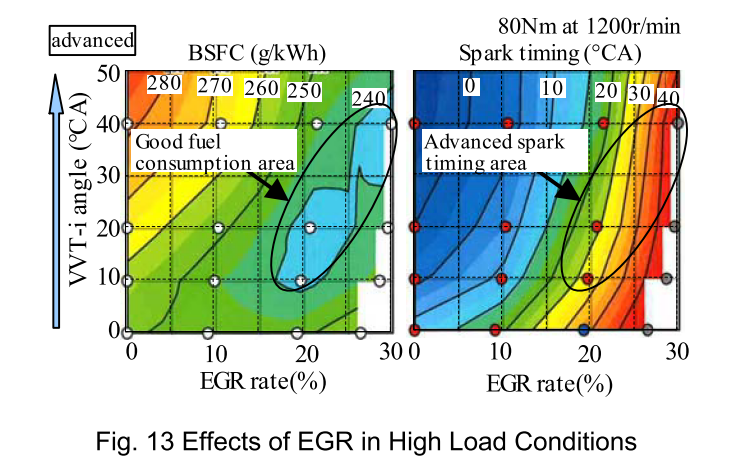
higher cooled EGR flow rates allow more advanced spark timing.