 12-15-2021, 01:19 AM
|
#439
|
|
Because compromise ®
Join Date: Jan 2012
Drives: Red Herring
Location: australia
Posts: 7,819
Thanks: 4,050
Thanked 9,556 Times in 4,196 Posts
Mentioned: 60 Post(s)
Tagged: 0 Thread(s)
|
Arctic Report Card: Update for 2021
Highlights
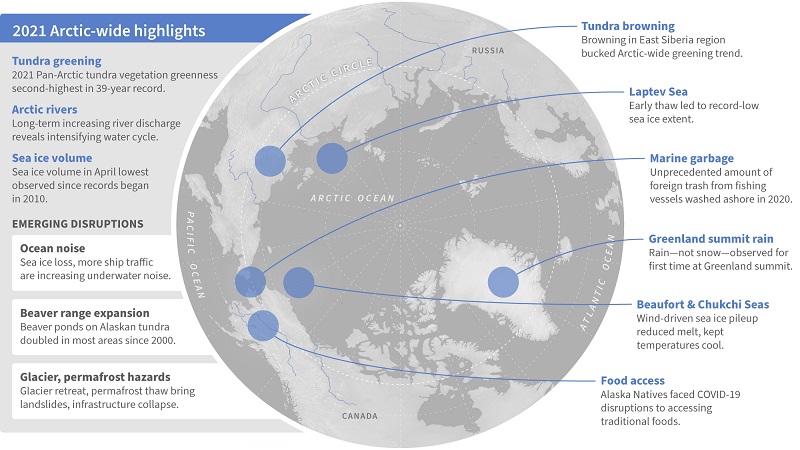
- The average surface air temperature over the Arctic for this past year (October 2020-September 2021) was the 7th warmest on record. This is the 8th consecutive year since 2014 that surface air temperatures were at least 1°C above the long-term average.
- The Arctic continues to warm more than twice as fast as the rest of the globe.
In the oceans
- The substantial decline in Arctic sea ice extent since 1979 is one of the most iconic indicators of climate change. Summer 2021 saw the second-lowest amount of older, multi-year ice since 1985, and the post-winter sea ice volume in April 2021 was the lowest since records began in 2010.
- Although there is considerable interannual variability in spatial sea surface temperature patterns, August mean SSTs show statistically significant warming trends for 1982-2021 in most regions of the Arctic Ocean that are ice-free in August.
- Seven of the nine Arctic regions observed showed higher ocean primary productivity in 2021 than the long-term average (2003-20). All regions continue to exhibit positive trends over the 2003-21 period, with the strongest trends in the Eurasian Arctic and the Barents Sea.
- Recent work on ocean acidification has shown that the Arctic Ocean is acidifying faster than the global ocean, but with high spatial variability. A growing body of research indicates that acidification in the Arctic Ocean could have implications for the Arctic ecosystem, including influences on algae, zooplankton, and fish.
On the land
- Terrestrial snow cover in the Eurasian Arctic in June 2021 was the 3rd lowest since records began in 1967. In the North American Arctic, snow cover has been below average for 15 consecutive years.
- The Greenland Ice Sheet experienced three extreme melt episodes in late July and August. On August 14, 2021, rainfall was directly observed at the 10,500-foot Summit Station for the first time ever.
- Exceptionally high midsummer productivity was observed in 2021 across the tundra. Satellites provide unequivocal evidence of widespread tundra greening, but extreme events and other drivers of local-scale "browning" have also become more frequent, highlighting regional disruption as an increasing component of Arctic change.
- Beavers are colonizing the Arctic tundra of western Alaska, transforming lowland tundra ecosystems and degrading permafrost by increasing the amount of unfrozen surface water on the landscape in winter.
- The long-term observations for Eurasian and North American Arctic river discharges demonstrate an upward trend, providing evidence for the intensification of the Arctic hydrologic cycle. In 2020, the combined discharge of the eight largest Arctic rivers was ~12% greater than the average over the 1981-2010 reference period.
- Retreating glaciers and thawing permafrost are causing local to regional-scale hazards that threaten lives and livelihoods, infrastructure, sustainable development, and national security. There is an urgent need for broad-scale hazard identification and assessment across the Arctic.
__________________
My car is completely stock except for all the mods.
|

|

|