Quote:
Originally Posted by Irace86.2.0

What you’re proposing would require a lot of customization and cost for little gain, which is why I mentioned manufacturers. They care more about 3 mpg loss or gain in fuel economy (hypothetical) or the warranty of a supercharger or managing excess heat, while keeping costs and packaging manageable. Most people would rather add more cooling capacity and call it a day or switch to a turbo system than retrofit a custom exhaust manifold, custom half a turbo with output shaft, gear and belt and everything else. I get the idea of using wasted exhaust gasses to help spin a belt, so the parasitic energy from the supercharger is balanced out, but your setup is so close to a turbocharged setup that dual charging seems easier and cheaper to do for the lay person, and it would probably outperform your setup in other aspects. For instance, that same exhaust energy could generate boost and thus horsepower probably more efficiently than it could assisting with driving a belt.
Also the point was to mention inherent benefits and drawbacks to each system. I wasn’t quantifying the impact of any of these things.
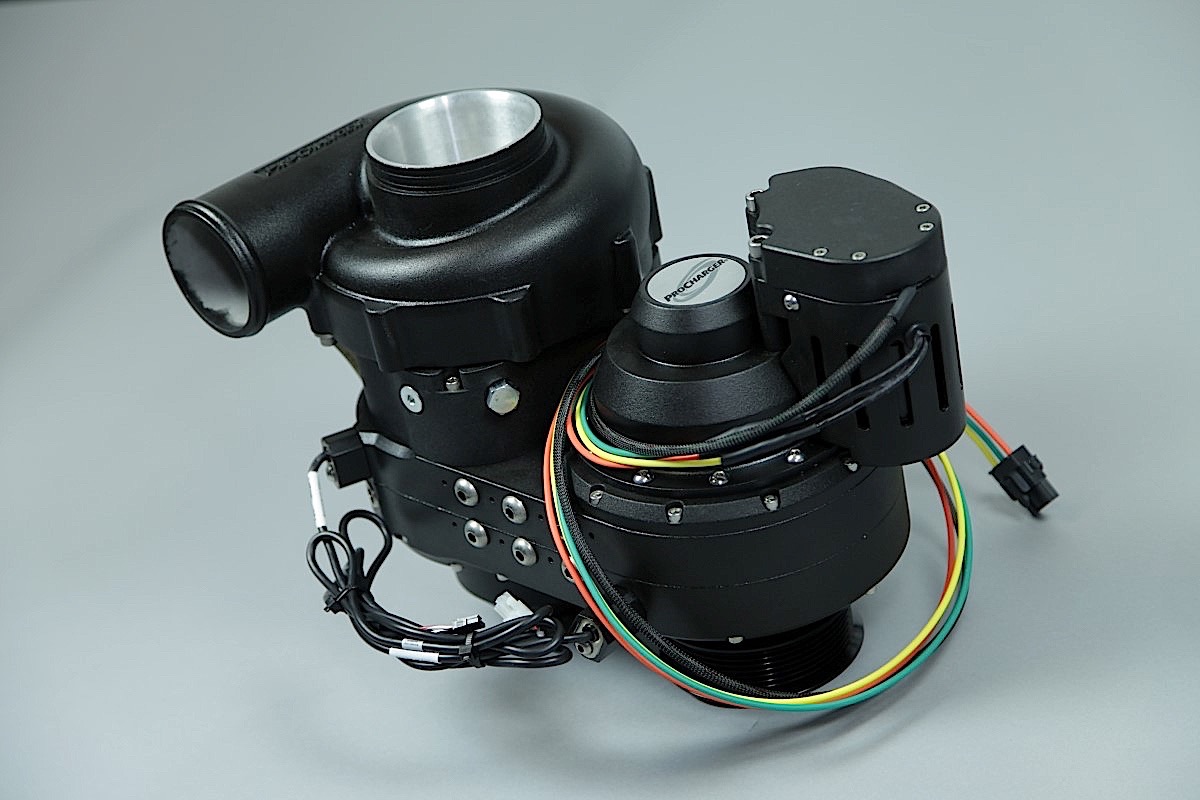
The cheapest supercharger solution would be to buy a variable pulley supercharger like in the video above and build custom brackets since no one is offering an off-the-shelf kit for the 86. I posted a video from Torotrak, but Procharger also has a CVT-like supercharger:
https://www.enginelabs.com/news/insi...ng-technology/
Just FYI, many other manufacturers are using BAS setups like Audi. Obviously, such systems could be custom added to any vehicle, but these are more for OEMs, which again, is what I assumed you were referring to in a hypothetical situation; I didn’t think you were thinking someone would actually build something one-off for their setup in a cost-beneficial way. |
Although the variable pulley supercharger is an interesting design, seeing the technology already being used in vehicle transmissions with somewhat iffy reliability results, (I'm thinking Jatco CVT's in Nissan vehicles) I would have serious doubts about the overall reliability of that particular technology within the Procharger over an extended period of time. But time will surely tell once they are out on the market. Maybe they'll be more reliable than the Edelbrock kits, maybe they'll be worse.

I can almost guarantee you that they won't be as reliable as our Harrop kits. One thing for certain is that they WILL cost even more than their standard supercharger as the rep stated in the video you provided.
Another thing I see about the variable pulley supercharger, is that whenever boost is needed, and wherever in the RPM band, parasitic draw on the engine will still always exist. Low demand for boost, like in a standard fixed pulley supercharger, will mean a low draw, and high demand for boost will mean a high draw. What I'm proposing would reduce the draw on the engine completely (ideally) at high demand. This would have the added benefit of less strain on the engine internals.
You are correct in pointing out the higher cost, which I pointed out already, but the two combined technologies I'm proposing are already tried and true and have been for decades. There is already an understanding of both out in the field of how they work and what things to expect to have to deal with when using them, with the exception of mounting a drive pulley to the gearbox instead of a compressor, but I would think that would simplify the build somewhat. And with the higher cost will come higher reliability, not only of the engine, but the bolt-ons as well.
I seriously think my idea would be much more reliable in the long term than any type of electronically-controlled variable pulley drive system, as long at it is designed properly. I doubt those rollers or electronic actuators inside the Procharger will hold up to years of even just normal wear and tear.
The good thing is, the standard Procharger supercharger is a tried, tested and reliable design, and its gearbox would be a good candidate to modify in the set up that I'm describing. The desired final supercharger drive shaft speed could be as simple as experimenting with different combinations of gearbox, pulley size, belt size and possibly overrunning clutch pulley size. It will certainly take time in developing, but what good product doesn't?