Quote:
Originally Posted by rvoll

Really? I can make a "sports car" out of a truck frame, but it won't be a really good sports car. That's the issue. The front is designed to hold AWD differentials
|
Wrong. Subaru 101: the front diff is in the transmission, also referred to as a transaxle, a term you've surely come across in your background in product development and design in a number of industries. This makes it ridiculously easy to convert a Subaru to RWD. Just take the front halfshafts out and replace the front diff with a spool. Subaru did a bit more of a thorough job by getting a new transmission for the BRZ.
Subaru AWD tranny:
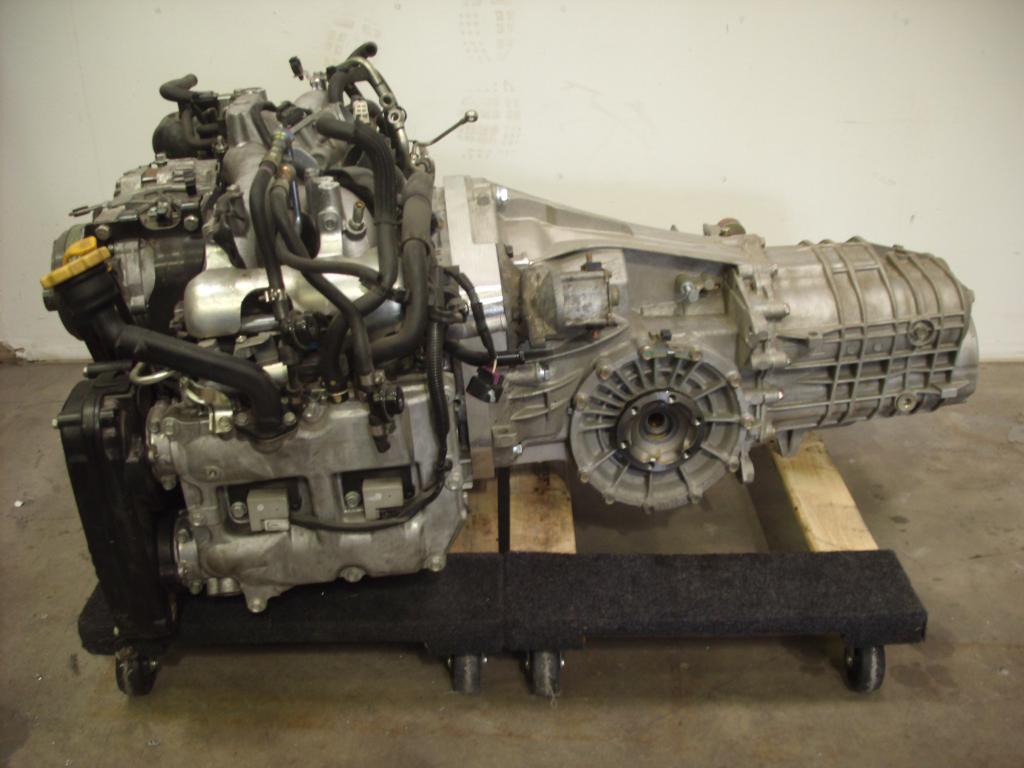
BRZ tranny:

Quote:
Originally Posted by rvoll
and thus the proportions are not amenable to a good, light, RWD sports car design.
|
Wrong again. The BRZ is already based off the Impreza, like all modern Subarus are. Just like 20 years ago they were all based on the Legacy. You think it's coincidence that the front wheels are so far back for a RWD car? Or that it's quite front heavy with 55% over the front axle? Why didn't they increase the rear overhang to get it to 50-50? That's a trick BMW loves. Why is the engine so far forward? Why do we have a random 'overpipe' where the uppipe/downpipe on a wrx go? The chassis and engine design was supposed to be clean slate right? Guess what? There's still an Impreza under all that metal.
Quote:
Originally Posted by rvoll
In addition, the ratios of width to height, which are a part of the platform, would not be good for a low car. Rather than looking at what is there, look at what components of that design would be good for a sports car. The assumption you obviously make that the platform could be "cut down" with a reworked front end degrades the idea that this is THE platform for all of the cars. If the assumption you make is true, then there is no real platform at all, just a bottom frame.
|
This is
exactly what global platforms are for:
Scaling.
The platform has all the basic features a car's chassis needs: Subframe interface points, a floor pan, bulkheads and firewalls, suspension pickup points, etc. The dimensions between them are variable, as the real engineering is figuring out how these subcomponents fit together. Once you figure out a solid way of putting the chassis together, you can change dimensions to suit your applications.
VW uses the
MQB platform from the Polo to the Atlas, the latter being pretty much twice the size as the former. It also underpins 3/4 of everything VW/Audi/SEAT/Skoda make, including the low slung TT and massive SUVs. The
Nissan FM platform underpins the 350Z/370Z and Skyline, the Infiniti FX SUVs, a bunch of RWD sedans, eventually the R35 GTR, and a
GODDAMN FWD MINIVAN Yes, the 370Z shares its platform with a FWD minivan.
Quote:
Originally Posted by rvoll
This is the difference between an automotive engineer and a mechanical engineer.
|
Mechanical Engineer can be
any industry. It merely denotes an area of expertise, in my case Mechanical design, Static and dynamic analysis, scalable architecture design, and design for manufacturing, among others. Regardless, the governing principles are the same. Stress, strain, CTE, mass, inertia, vibrations and dynamics, it all applies accross industries. A good engineer can hop between them and excel in multiple fields.
Quote:
Originally Posted by rvoll
My background was in product development and design in a number of industries. So I'd like you look again at the design, taking into account that the platform will be designed for AWD (and not RWD)
|
Irrelevant, see first paragraph.
Quote:
Originally Posted by rvoll
and tell me how you could make a good sports car from it.
|
Idem.
Also Subaru already did:

Quote:
Originally Posted by rvoll
If you have a CAD program, take the ratios of width and height and place a car body on it and you'll see it will be far too tall to be a low sports car. What you'll get, at a minimum, are the proportions of an Impreza or WRX which are about 58" tall. Our BRZ's are about 51" tall. Think about it....
|
Again, refer to my previous paragraph about platform sharing. This is nothing new. The whole point of scalable platforms are the fact that they're, what? Scalable? naaaaaaaaaaaaaaaah.