I just wanted to add this info as it seems to be a massively overlooked effect of MAF scaling as many look to MAF scaling as a 1 step fix.
Below we'll use an exaggerated example situation that the engine is being held at 0.9 load and 2600 RPM.
Here's the fuel and ignition maps on the
original MAF scale.
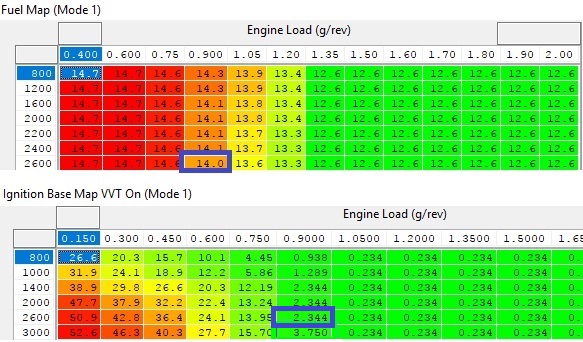
We can see that the fueling target is 14.0:1 and the base timing is 2.35 degrees advance. Now lets say that the fueling error works out to be around -15% (AFR too rich) and you adjust the MAF scale to that effect. Due to the MAF re-scale the engine load calculations will also end up having the same reduction, so now at the same situation your load is now around 0.75
MAF Scale Reduced 15%
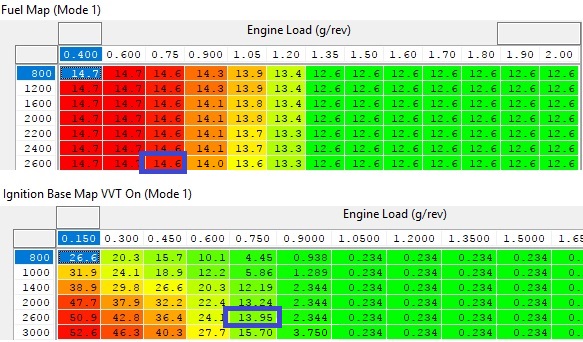
This correlates to the same MAF voltage so the same actual airflow as above however you are now targeting 14.6:1 and base timing advance of 13.95 degrees. That means despite the same conditions in the cylinder you are now targeting a
leaner AFR and nearly 11.5 degrees more advanced timing. Now lets swing the MAF up 15% the other way as if the fuel error was lean.
MAF Scale Increased 15%
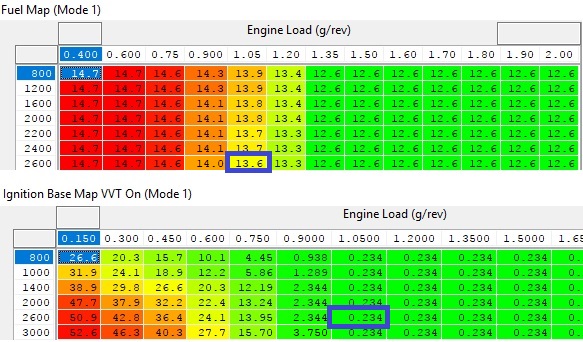
Targets of 13.6:1 AFR and base timing advance of 0.23 degrees.
Now I know that my example is a little extreme and if you're not changing intake you wont get error like that, however I have just rescaled an intake where the original is around 15% out under WOT conditions. Even in my 1st example that a -5% change in MAF scale from the original would result in 4 degrees of extra advance. For those having a working tune that then starts to pull timing after a MAF re-scale then this could well be the cause.
All this needs to be taken into account when you play with your MAF and is one of the reasons that when you want to correct your OL MAF scale, if you've got all your load dependent settings (timing, cams, load limits, injection control etc) set then changing your MAF scale might not be the solution that you want to do.