Quote:
Originally Posted by justatroll

Actually you have it mostly right.
Horsepower measured by a Dyno is really measured at a lot of discrete points of constant RPM in the "curve" as the RPMs are raised.
When you look at "dyno pull results" (like this one from Vans 914 build
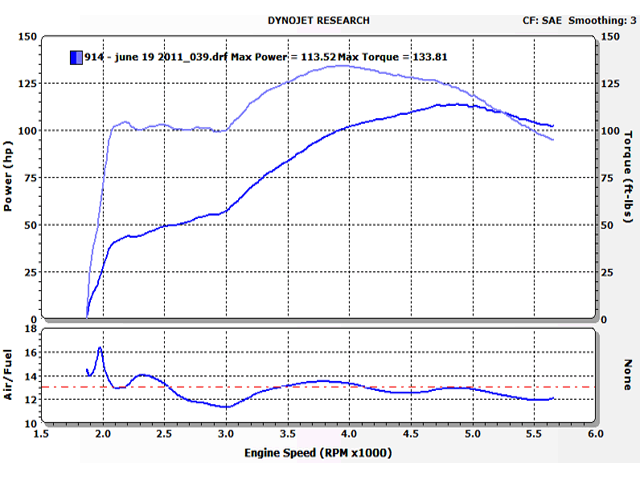
It looks like a constantly changing RPM and most people believe that you want to try to do the "pull" as fast as possible and that a faster pull means more HP.
That is not the case, in fact, the SAE requirements for dynamometer measurements are that the dyno is supposed to pause at each discrete measurement point for a specified duration before measuring torque & RPM.
In practice, dyno pulls are done in a dynamic sweep that seems to be one continuous pull, when they are really performing hundreds of discrete measurements.
The most accurate dyno measurements are done as slowly as possible.
What I am getting at is that each discrete measurement of torque is supposed to be done at constant RPM.
So how does the rotational inertia of the flywheel and crank affect the torque measurement at constant RPM (NOT accelerating)?
Answer: It doesn't.
So now lets hear where you got YOUR engineering degree.
my point again - it is NOT possible to get more horsepower by reducing rotating mass.
Will the car accelerate faster with a lighter rotating assembly - YES but NOT because the engine produces more HP. PERIOD
|
Actually, I have a couple. BS Nuclear Engineering from Univ of MI '81 and MS in Environmental Engineering from Univ of WA '97.
If what you are saying is that it is not possible get "additional" HP from the engine by reducing the mass of rotating assemblies, I completely agree.
However, if you were able to lower the mass of your rotating assemblies in the engine and drive train, you would free up power that was previously being used to accelerate the higher rotational mass. The power that is now freed up is available to provide linear acceleration for your car.
The simple way to say it is, lowering the rotational mass of the engine and drive train will result in faster linear acceleration, all else being equal.
I would also note that because a chassis dyno measures wheel horsepower, none of the parasitic losses in the engine and drive train (friction and losses to accelerate rotational mass) will show up on the dyno results. If you are able to reduce the rotational mass of the engine and drive train, you will get a higher HP reading on the chassis dyno. Less power used to accelerate rotating mass means more is available to spin the dyno drum.
Cheers!