 11-09-2016, 05:33 PM
|
#41
|
|
Senior Member
Join Date: Dec 2015
Drives: Full race 4cyl boxer
Location: CO, USA
Posts: 587
Thanks: 310
Thanked 510 Times in 269 Posts
Mentioned: 20 Post(s)
Tagged: 1 Thread(s)
|
Quote:
Originally Posted by DSLeach

Actually, less rotating mass (crank, flywheel, clutch, drive shaft, wheels, tires) or moving the mass inwards towards the center of rotation will free up HP parasitic losses. Here is a thought experiment for you.
Take one straight shaft and put a heavy truck wheel/tire on it. Lets say it is 300 lbs. Stand that axle straight up on with the wheel/tire on the top. Now imagine using your hands to spin that axle with the wheel/tire on the top. Its going to pretty hard because of the mass you are attempting to accelerate.
Try the same thought experiment with a little 12" trailer wheel/tire combination on the axle. Spinning that little wheel/tire combo is a lot easier because the mass is lower and because that small mass is concentrated closer to the center of rotation.
Remember the force required to accelerate a mass is governed by the equation F=ma. As the mass you are accelerating increases, so does the required force. This equation also applies to to rotational mass. Its just simple physics.
By the way, where did you get your engineering degree?
If you want some further education on the effective of rotating mass, there is a pretty good discussion of it in the suspension forum.
Cheers!
|
Actually you have it mostly right.
Horsepower measured by a Dyno is really measured at a lot of discrete points of constant RPM in the "curve" as the RPMs are raised.
When you look at "dyno pull results" (like this one from Vans 914 build
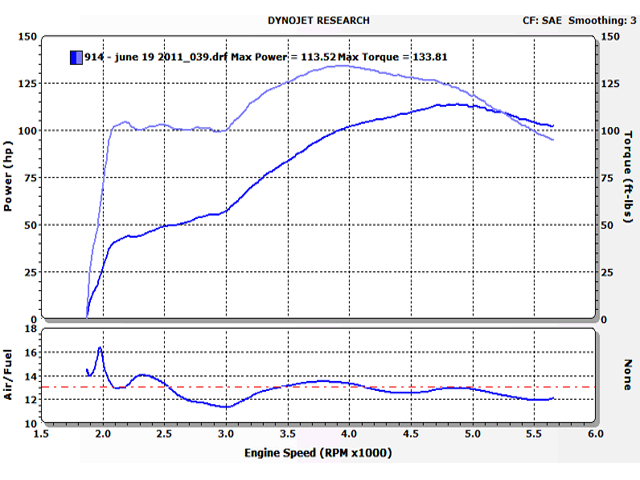
It looks like a constantly changing RPM and most people believe that you want to try to do the "pull" as fast as possible and that a faster pull means more HP.
That is not the case, in fact, the SAE requirements for dynamometer measurements are that the dyno is supposed to pause at each discrete measurement point for a specified duration before measuring torque & RPM.
In practice, dyno pulls are done in a dynamic sweep that seems to be one continuous pull, when they are really performing hundreds of discrete measurements.
The most accurate dyno measurements are done as slowly as possible.
What I am getting at is that each discrete measurement of torque is supposed to be done at constant RPM.
So how does the rotational inertia of the flywheel and crank affect the torque measurement at constant RPM (NOT accelerating)?
Answer: It doesn't.
So now lets hear where you got YOUR engineering degree.
my point again - it is NOT possible to get more horsepower by reducing rotating mass.
Will the car accelerate faster with a lighter rotating assembly - YES but NOT because the engine produces more HP. PERIOD
__________________
Arguing with an engineer is like wrestling with a Pig in the mud. You are never going to win and after a couple of hours you realize that he likes it.
|

|

|