So, as everyone knows, I had to stop testing for the time being. I also had to sell the speakers used in the test rig. I knew I couldn't possibly finish all the brand comparison's in time, but I still wanted to test a few last things. Being that it would not be fair for me to pick and choose which brands to test, I instead testing install methods. 25% vs 100%, stacked double layers vs opposed side double layers, multiple small pieces vs one large piece. I needed to use a product that I still had enough of to do multiple tests, the only product with enough material for that was SDS Tiles and SDS Sheet. I know, SDS Sheet was not included in the product comparison test, but I had no other material in quantities large enough to use for the purpose of this testing.
Just to clear the air, I was extremely stressed out on the day I did this, so I screwed up on this run of testing, and closed out REW without saving the files. Therefore, I only have the individual frequency response plots and waterfall plots saved. Rton20s helped me out by overlaying the plots so the comparisons are easier, although the plot names are jumbled. That is entirely my fault. The other thing you'll notice is I tested at a much higher level. Aside from that, all testing was done as normal, at 77 degrees, with all noise sources as quiet as possible. Never realized how long my fridge runs for until I had to wait for it to stop.
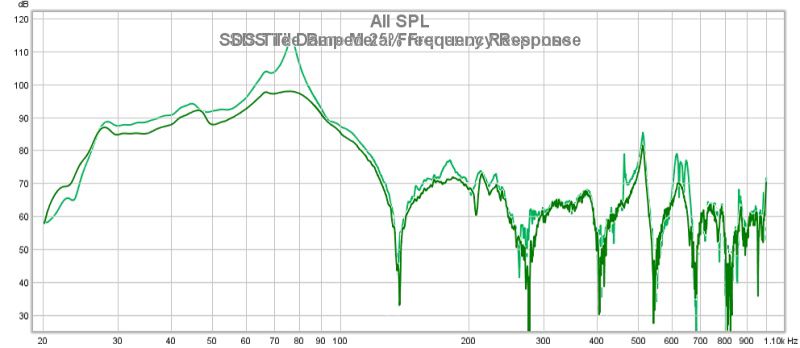
Lets start with 25% vs 100%. I tested this with SDS CLD Sheet. It is advertised as a corrosion preventative treatment for camper vans, and is recommended to be used at 100% coverage. It is the same butyl as CLD Tiles, but thinner with a thinner constraining layer.
Bare Metal Frequency Response - Peak Amplitude 114.2db
28% Damped Frequency Response - Peak Amplitude 103.0db
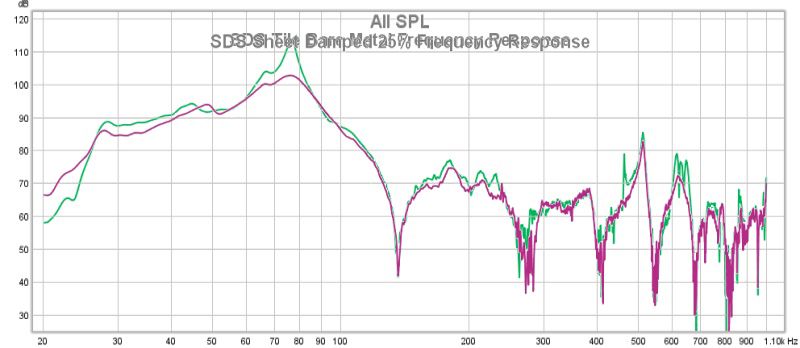
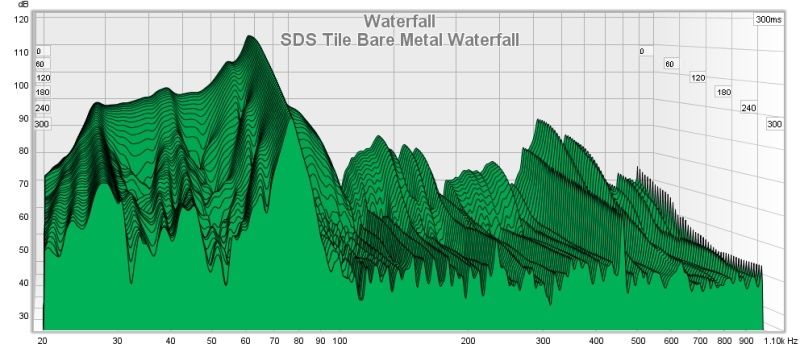
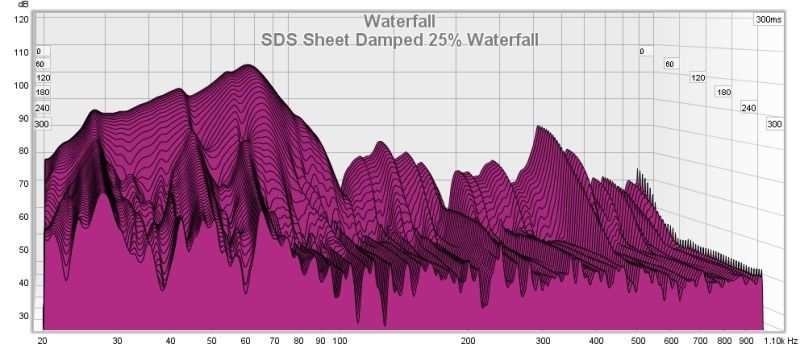
Bare Metal Frequency Response - Peak Amplitude 114.2
100% Damped Frequency Response - Peak Amplitude 98.0db
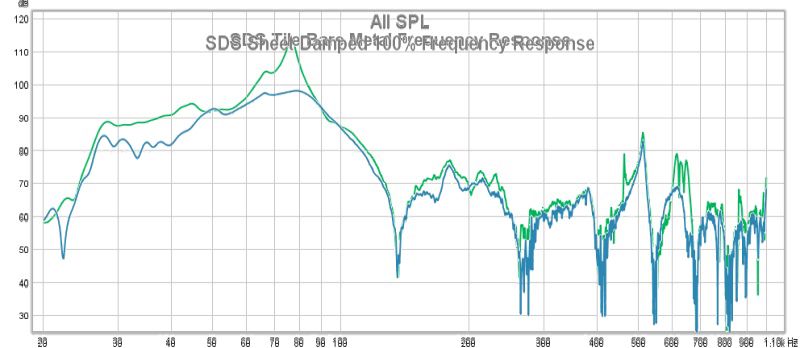
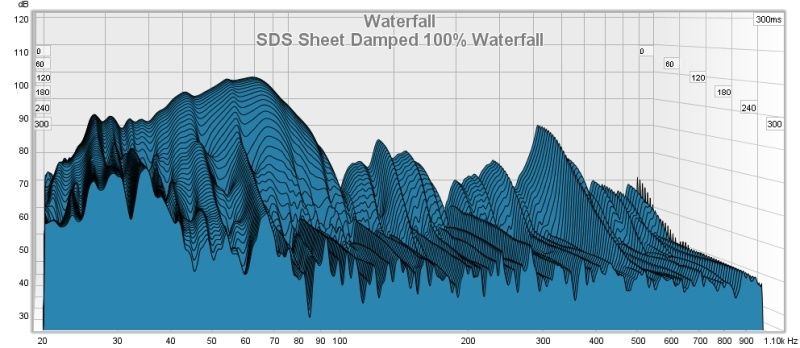
So there is a 11.2db drop in peak amplitude with 28% coverage. There is a 16.2db drop with 100% coverage. So, to treat 1 square foot, you would spend $0.85 for the first 11.2db, and $2.20 for an additional 5db.
As an aside, I would now put CLD Sheets just above Dynamat Xtreme for those wanting the lightest weight effective damper out there. I know this isn't a direct comparison, however, the performance is as good, and it is lighter.
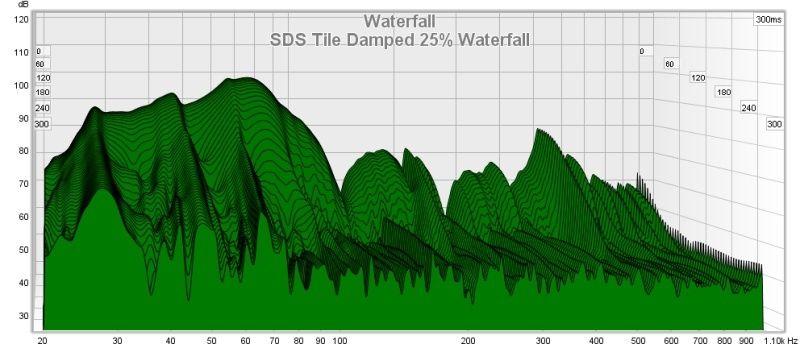
Moving on. SDS Tiles, 28% vs 56%. This test used a single 28% coverage piece vs two 28% pieces double layered on each other.
Bare Metal Frequency Response - Peak Amplitude 114.2db
28% Damped Frequency Response - Peak Amplitude 98.5db
Bare Metal Frequency Response - Peak Amplitude 114.2db
56% Double Layer Damped Frequency Response - Peak Amplitude 96.8db
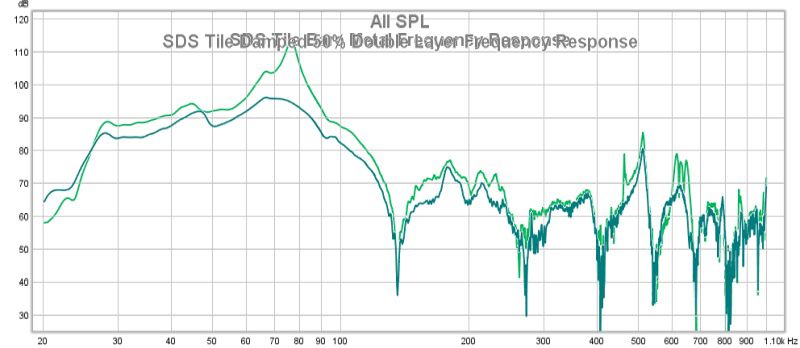
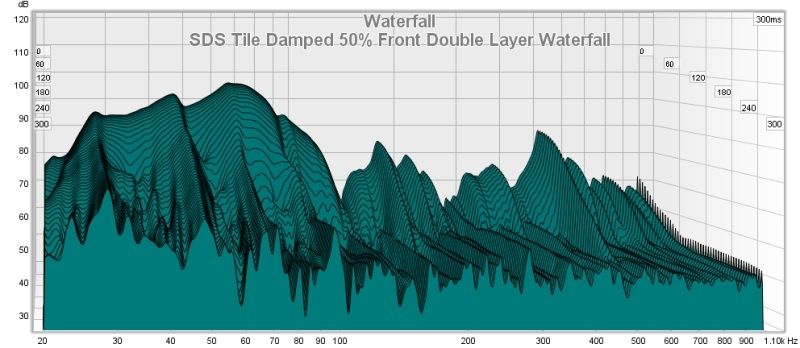
So, 28% coverage with CLD Tile gave a 15.7db reduction in peak amplitude, vs 17.4db for 56% coverage using two 28% coverage layers. Your first 15.7db will cost you $1.78, while that additional 1.7db will cost you another $1.78.
Moving on. I have long held a belief that if you are intent on double layering, that put one layer on each side of the metal would be better than putting two layers on one side. Well, I was wrong. This tested that theory, using 28% coverage on each side of the panel In fact, the results are damn near identical.
Bare Metal Frequency Response - Peak Amplitude 114.2db
56% One layer per side damped Freq Resp - Peak Amplitude 96.8db
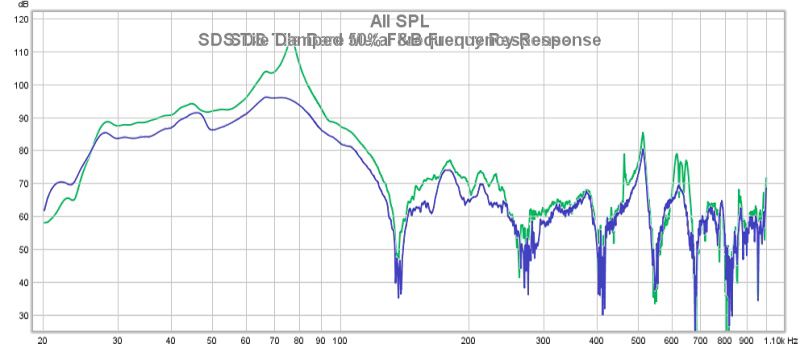
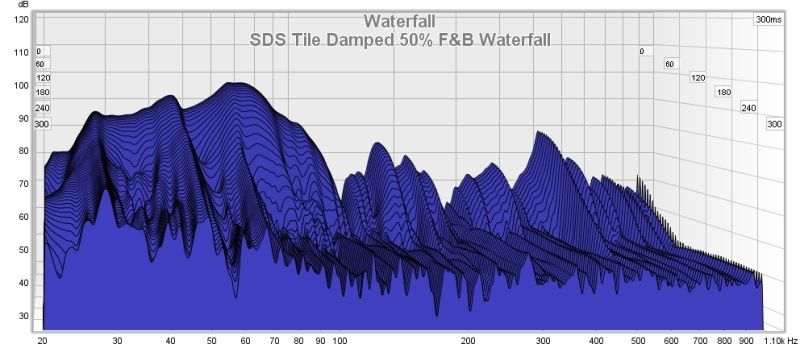
And here is an overlay showing 28% coverage, vs both forms of 56% coverage.
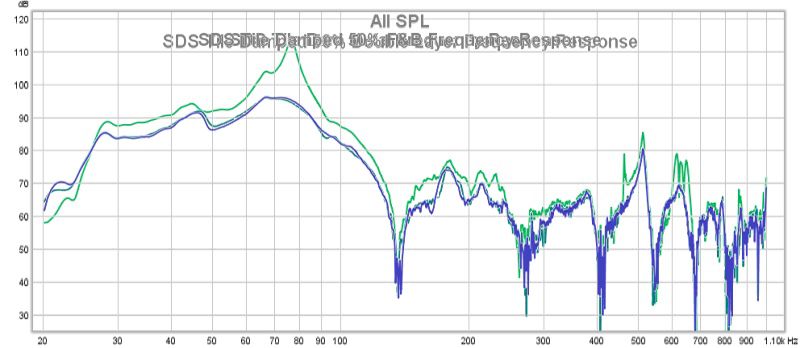
As with double coverage, you would get your first 15.7db for $1.78 and your additional 1.7db for another $1.78.
I also ran a test just to see what would happen. I ran a 28% vs 120% test using CLD Tiles. The 20% was layered on top of the first layer. My test rig panel measured 10"x10", and CLD tiles are 6"x10", so I put one dead down the center, and cut one in half, covering each uncovered edge.
Bare Metal Frequency Response - Peak Amplitude 114.2db
120% Damped Frequency Response - Peak Amplitude 95.1db*
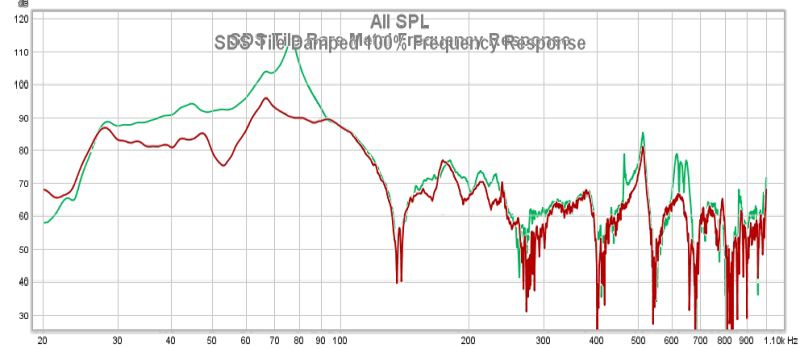
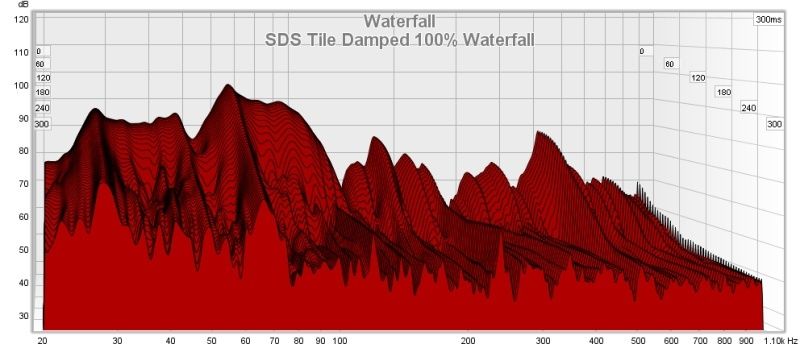
And for fun, 0% coverage vs 28% coverage vs 120% coverage.
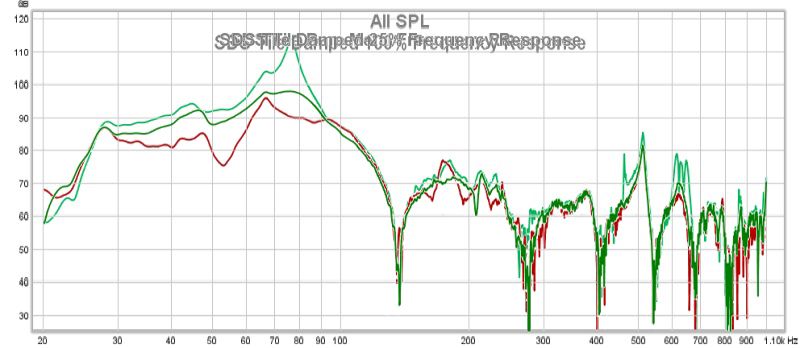
So in this case, your first 15.7db comes at a cost of $1.78, while an additional 3.4db comes at an additional $10.94.
*Now, there is a catch. If you look at the 120% graph, you'll notice the original peak is actually down more like 24.2db, and there is a new peak lower in frequency. That peak has always been there, but it was always secondary to the largest peak. I have a hunch that secondary peak may be due to the speakers themselves, as you can see that peak in every other test I've done, and it never changes very much, which you can tell by looking at the waterfall plots. None of the products can stop that particular peak from ringing. Even so, if we ignore that peak, you would still be getting the first 15.7db for $1.78, and the next 8.5db for $10.94.
On to the last test. I've had a hunch for a while that using one large piece of material was more effective than using a bunch of small pieces. This test proved that theory correct. In fact, it actually blew me away on how much of a difference it makes. If you cut your pieces too small and use a lot of them, instead of fewer large pieces, CLD actually stops working as a CLD, and works more like a mass loading product. To test this, I cut up a 28% coverage piece into 4 equal pieces, and placed them around the center of the panel.
Bare Metal Frequency Response - Peak Amplitude 114.2
28% Damped Multi Piece Freq Resp - Peak Amplitude 108.4db
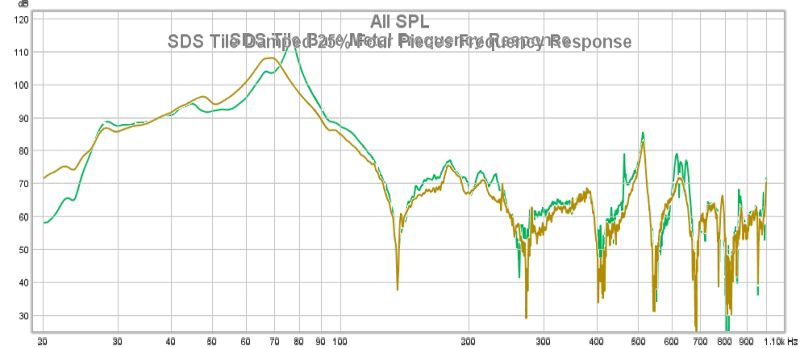
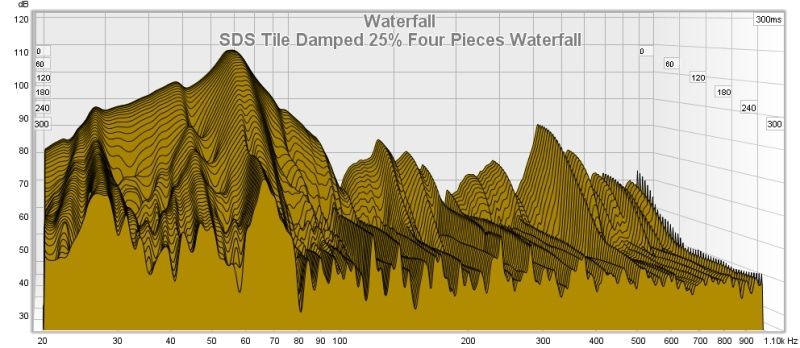
And here is 0% coverage, 28% coverage, and 28% coverage split into 4 pieces.
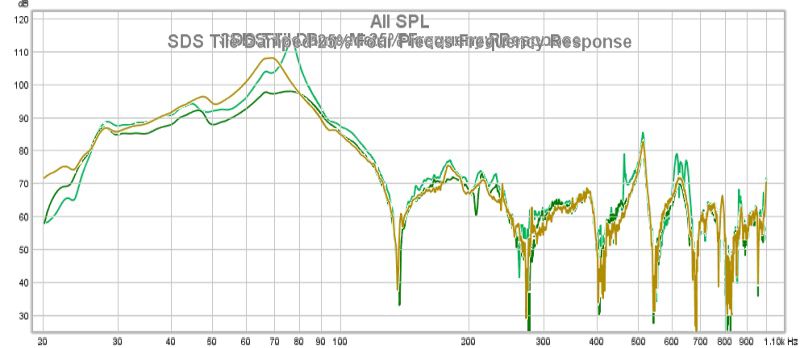
As you can see, you go from a 15.7db reduction in peak amplitude with a single piece of CLD Tile, to a 5.8db reduction if you cut that same size piece into 4 pieces. It also rings for much longer, and maintains its high Q frequency response. Bottom line, don't cut your cld pieces if the panel you are treating is 75% larger than the piece of cld you are using.
That's it guys. Speakers are out and for sale. At some point, I will start again, with a new rig and better results. Hopefully sooner rather than later.