Quote:
Originally Posted by twag4

Clean bass comes from well engineered sub woofer, not big sub woofer. See Phil jones pure sound. On his bass guitar amps he uses 5" woofers arranged in parallels. I promise you, they move more air and are way louder than anything else out there. Also, because of the smaller size of the drivers, they are extremely responsive and accurate. They will make you poop your pants. I am a musician, a bass player. I have played bass (guitar) out of many amps and speaker cabinets, and these things are legitimately the most unbelievable bass amps out there. 12, 15, and 18 inch woofers are lazy and slow. 4 good ten inch of offers move more air than 18" woofers. The smaller ones will hit all the lows too. Oem audio has done a good job with this system. I am a bass guy, I got their robust setting, and it is very good. Don't get me wrong, the big systems and big speakers can sound great, but most wash everything else out. Oem covers the tonal spectrum very well.
|
My buddy is a bass player and we've talked about those amps/cabs. It couldn't do what it does without the pure amount of drivers it uses.
The bottom line is, distortion is caused by excursion. Its true that a well designed speaker will have more excursion before distortion becomes audible, but its also true that a larger cone won't need to move as much for the same output/frequency, which will lower distortion.
Speed, when referring to sound, is about a speakers ability to handle transients. This comes strictly down to motor strength vs cone mass vs suspension stiffness. If a larger speaker sounds "slower or lazy", that's because it needs more motor strength.
Poor tuning will also cause a subwoofer to sound slow or lazy. Being out of phase with the midbass will cause this. Having the level slighty high will also cause this.
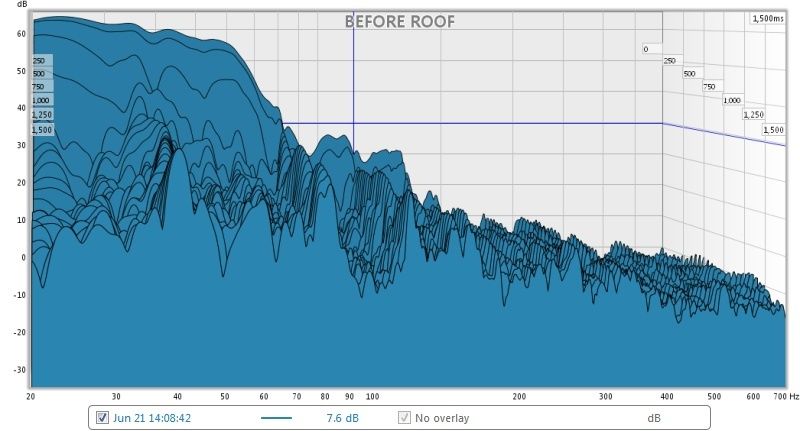
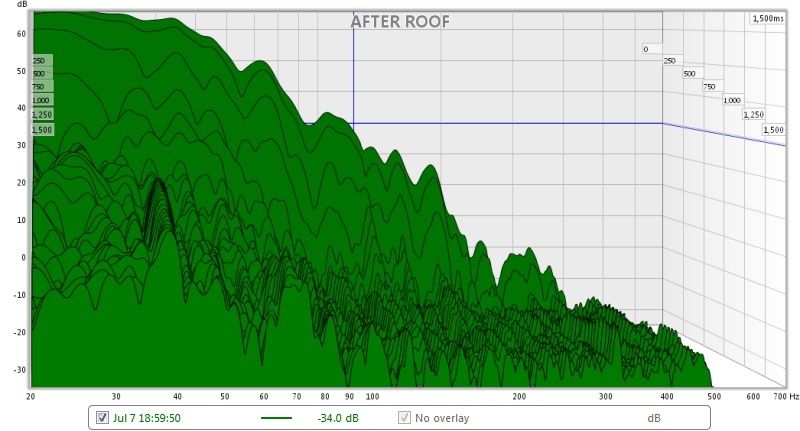
Another thing that can case this, as well as poor decay, is poor sound deadening. This causes the metal panels to continue to ring for as much as a second after the initial impulse. That causes smearing.
This is the decay plot of a car that has been fully deadened except for the roof. Notice how frequencies continue to resonate as long as 1.5 seconds.
This is the same car, with the roof deadened. Notice how much quicker the initial impulse decays, leading to a much more accurate bass sound.
There is another catch. For every octave lower you go, you need 4x as much displacement. That means, for instance, if your maxing those 5's in that cab out at 80hz, you would need 4 times as many to get to 40hz. And 16 times as many to get to 20hz. Since subwoofers need to play to 20hz, that means you either need a LOT of excursion, or a LOT of cone area.
But, there is a counter to that. With the interior dimensions of a car, you have a lot of room gain. An FRS probably probably starts to enter into cabin gain around 100hz, based on its size. Below that frequency, you will gain roughly 12db per octave as you go down.
I compete in extreme class in car audio sound quality competitions. I also judge them when I'm not competing. The absolute best bass I've ever heard in a car has always come from 12" or larger drivers. None of them have been slow or lazy. All of them have been barely loafing along, and "disappeared".