Quote:
Originally Posted by Turdinator

First of all, great post. Thank you for your input. I am trying to get my head around all the info here and the other threads linked earlier. One thing I was curious about is, what exactly does "better combustion stability" mean?
|
You'd think an engine makes some amount of torque but that's constantly jumping up and down. It's usually worst at cold start, when pulling spark to reduce knock, and part load where it's being choked down with internal EGR for fuel economy. The ugly zigzags you see on a dynojet sheet are sometimes noise but there really are torque fluctuations. If they're bad enough you'll get hesitations, surging, and misfires.
If one were to manually control an engine on an engine dyno, holding speed with loading, one might see all sorts of fluctuations in torque and combustion pressure. Then one's software could calculate an instability % which corresponds to these fluctuations in torque or combustion pressure. It might look like this, with the bigger changes corresponding to same change in some parameter you are tuning...
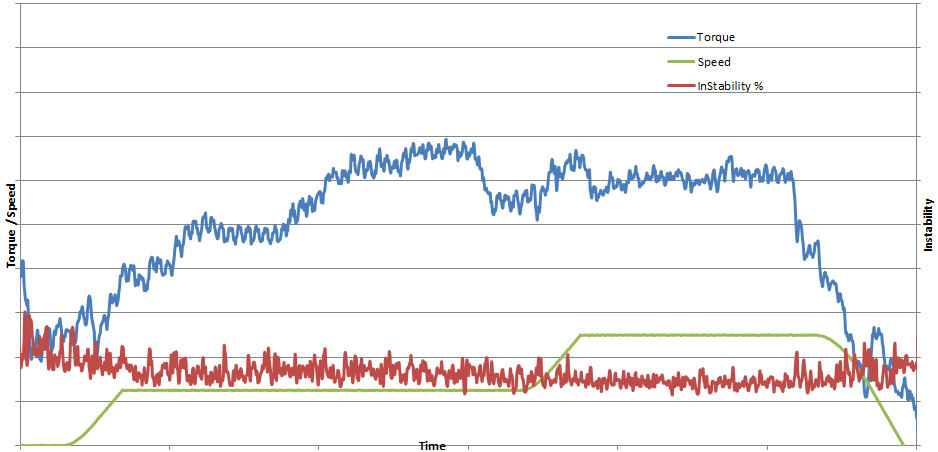
so is the torque really say 100 lb/ft or is it 100 +/- 5% , or 10%? Is it bad enough that a driver could feel it, or even bad enough that you start getting misfire?
The thing that's relevant to the debate is this: DI can cause poor combustion stability if it's not mixing correctly. However, it relieves knock, and that means more advanced spark and with the right heads probably faster combustion speed.
More advanced combustion due to knock relief improves combustion stability. That's a + for DI.
Poorer mixing due to injection timing and mixing time hurts combustion stability. That's a - for DI.
More retarded combustion due to spark retard for knock hurts combustion stability. That's a - for PFI.
Better mixing due to vaporizing the fuel in the intake port and having more time improves combustion stability. That's a + for PFI.
Quote:
Originally Posted by wparsons
@ jamesm (banned, don't wait for a reply) stated he was able to find an extra ~10whp in the most knock prone areas just by increasing the DI %age on 91/94 octane. On e85 it isn't as big of a difference (or a difference at all) because of how knock resistant e85 is. |
I can't even keep up with this forum and who's in and or who's out. It's like a middle school clique sometimes.
For E85 it's going to depend on if/how boosted the engine is and how retarded the spark/combustion was on normal E10.