Inline engines, especially I4's basically have a bunch of rotational energy creating a torque roughly about the crankshaft when revved, this was very evident in early motorcycles where the engine is longitudinally mounted and when revved the bike would basically try it's darndest to lay down on it's side.
Everybody on board with that concept? Cool.
With transverse engines the torque makes the motor want to fall towards the front or to the back, sure beefy motor mounts could do the trick but why not add a third support?
So some engineers came up with a 'torque damper' shown below:
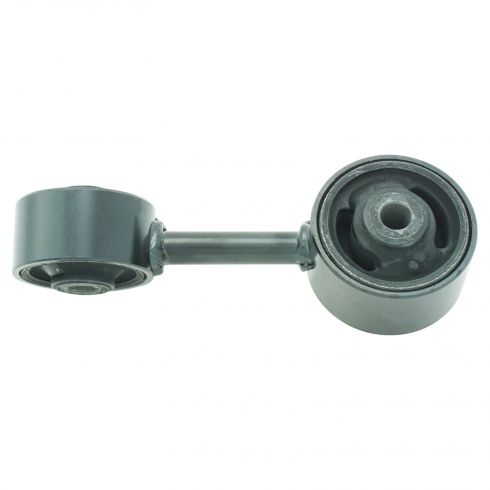
Here we can see it in the engine bay of a Camry, it's on the left side just below and to the right of the strut tower:

So, why doesn't the FRS have one? Because a flat four engine simply does not generate that kind of force, it's 'balanced' so they say.
Enjoy OP:
http://www.autozine.org/technical_sc...ech_index.html
Specifically:
http://www.autozine.org/technical_sc...ne/smooth1.htm
Edit: I don't think I've ever seen one on a longitudinally mounted engine, I hypothesize this is because with a transverse engine, the distance between the axis where this torque acts is far removed from the driveshafts, if it were allowed to apply that force unmetered it would create a large stress on the driveshaft/hub interface whereas with a longitudinally mounted RWD the distance between the axis about which the motor rotates and the driveshaft to the differential is much smaller so the stresses are negligible and the torque damper is unneeded. This would also feed into the wheel hop idea the OP mentions.