The age old question of looks versus handling. It's a question (and debate in most cases) that has plagued the aftermarket community for years. There are so many schools of thought on handling and performance versus looks and styling. Words such as stance and fitment are so overused that it makes most of us cringe. The majority of us love a well put together car and in that 'well put together car', there is usually some sort of suspension tweaking or altering that has been performed.
Before we get ahead of ourselves, we'd like to set something straight on our end. This thread is not meant to push products or sell anything. That is the antithesis of what we're after. We're trying to put to rest the rumors, misconceptions and false truths about air suspension. We also are trying to give a bit of 'insider information' about the progression and evolution that air suspension systems have made over the last decade.
While at one point, we would agree that air suspension was more about looks than anything else, that's hardly the case these days. The amount of research, design, technology, etc. that goes into (some) air suspensions is beyond that of your normal coilover suspension. And air suspensions handle as well as, if not better than coilovers. Yes, we said it.
Not long ago, we had the pleasure of spending time with AirLift Company. We took a full tour of their facility as well as spent time going over their 550 AWHP STI which is currently riding on their new Performance air ride system.
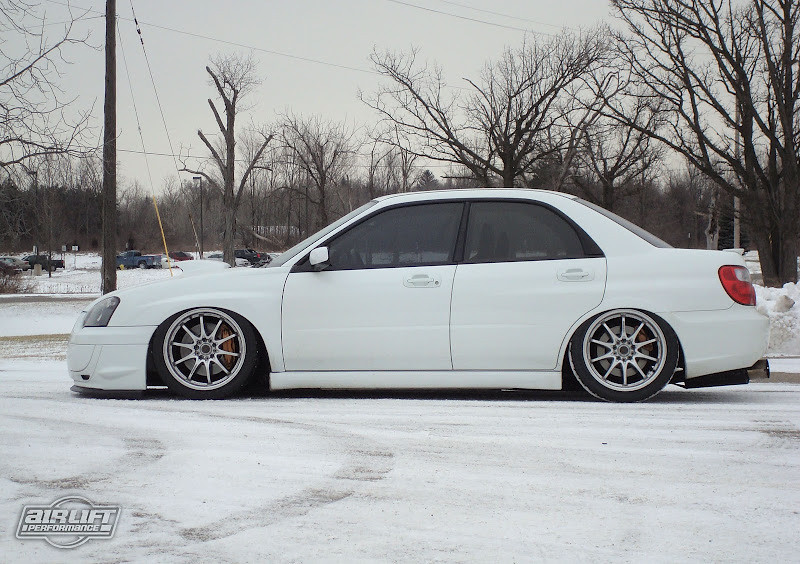
AirLift's 05 STI is sporting 9.5" wheels wrapped in 265/35/18 tires with zero stretching. The car was previously on RaceComp KW V3's.

RC KW V3's weighing in at 14.605lbs

AirLift Performance Front Struts weighing in at 11.865lbs
That's a total of 2.74lbs per front corner!

RC KW V3 rears weighing in at 14.450lbs
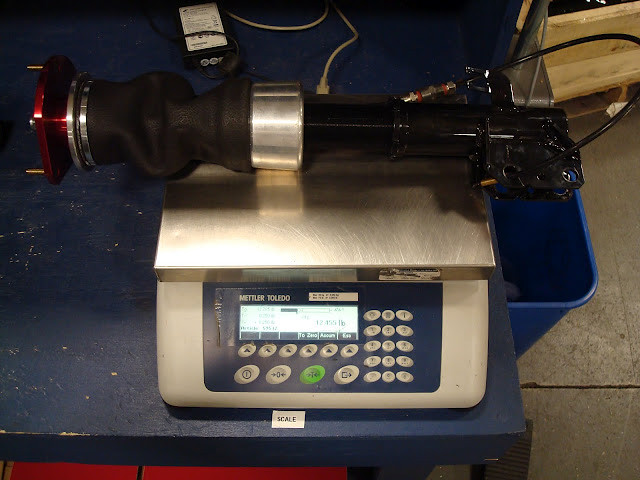
AirLift Performance Rear Struts weighing in at 12.455lbs
Total weight savings of 1.995lbs per rear corner.
Total combined weight savings: 9.47lbs
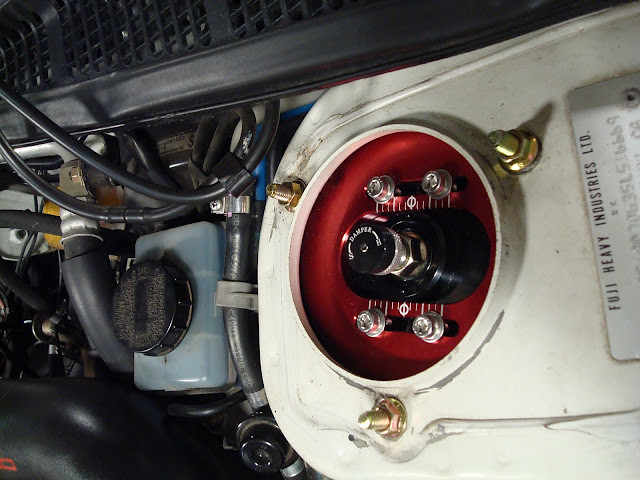
Front Camber plates [included with each strut]
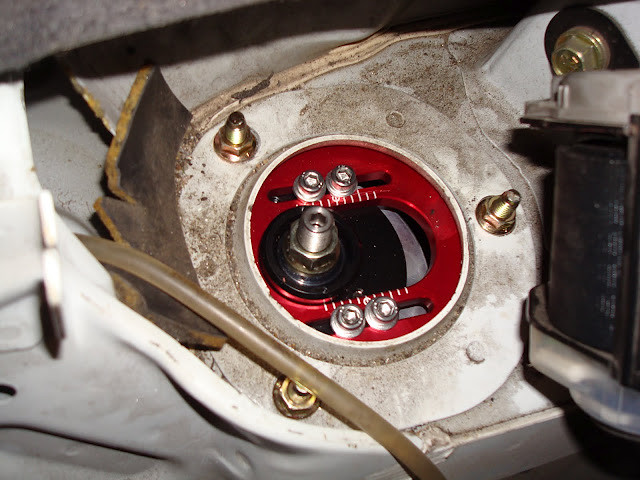
Making excellent use of the rear camber plates!
The AirLift Performance Series Struts are built on Custom BC Racing Coilovers. Each set of Performance Series Struts for the Subaru GC/GD platform is both height adjustable via the fully threaded body but is also height adjustable via the air spring.
The struts are 30 way dampening adjustable via the adjustment knob on top of each of the struts (the rears have remote adjusters for convenience). Realistically, you could have your car Cadillac plush during the week and canyon carving stiff on the weekends. Another plus of the AirLift struts is that they are not assembled using normal coil spring rates. The struts are revalved specifically for the use of an air spring. This is because air springs do not function like regular metal coil springs. Things such as spring rate, deflection, etc. are much different and must be compensated for when building an air suspension.
Media / Videos
[ame="https://www.youtube.com/watch?v=_uppK8z0lDg"]Air Suspension vs. Coilovers - YouTube[/ame]
[ame="https://www.youtube.com/watch?v=9Fl7PuPmcoA"]Air Lift Performance Track testing - YouTube[/ame]
Let's bring some math into the mix:
Calculating the spring rate of an air bag is much harder than calculating the spring rate of a typical metal coil spring. Spring rate is defined as the amount weight (typically in lbs) needed to compress a spring one inch. Typically spring rates are calculated using the equation:
k = Gd^4/8nD^3
in this equation:
k = spring constant, pounds of load per inch of deflection
G = modulus of rigidity
n = number of active spring coils
D = wire diameter or coil diameter - measured in inches
Because we cannot plug in raw numerical values for air springs, it becomes increasingly harder to figure out the exact spring rate. Furthermore in the world of air springs, both pressure and volume need to be taken into consideration when trying to calculate spring rate - again, it's not as easy as it would be with a set of coil springs.
There are a two things that are certain more often than not and they are: larger bags will lift more weight but have a lower spring rate and smaller bags will not be able to support as much load but will have a higher spring rate. Spring rate with regard to air ride is definitely a function of bag pressure and volume. Another variable that has to be taken into consideration is the material used in bag construction. The thicker the material, the more weight the bag will support and the less pressure it will need to lift the vehicle. It's very tough to calculate the exact spring rate of air springs because there are (in a sense) too many unknowns. Without breaking out paper and an abacus, you could always set your car at maximum height and consistently add weight until the vehicle drops one inch and do the same at ride height. This will show you that spring rate will vary dependent upon pressure and not just volume. It's a pretty 'raw' method of figuring out the spring rate, but it should give you a general idea of the spring rate of your air springs.
We welcome any questions, comments, responses, etc. We realize that air suspension is not everybody's cup of tea and we're not here to turn atheists into believers. We're just trying to create a good discussion and help people further their knowledge outside of proverbial box.
If you'd rather speak to someone directly regarding these suspensions, feel free to contact us:
E:
info@openroadtuning.com
P: 610.572.2898