Quote:
Originally Posted by nelsmar

@ arghx7 Thanks for the detailed post. I have always wondered how much of a pressure difference there was on spark timing. Do you have a reference for those photos? I would love to read more.  |
Here's something to check out. It's from a Ford study of using dual fuel pump gas + E85 capability in an 3.5L Ecoboost engine with PFI and DI.
Ford Ecoboost E85 Study
Here are some more relevant charts.
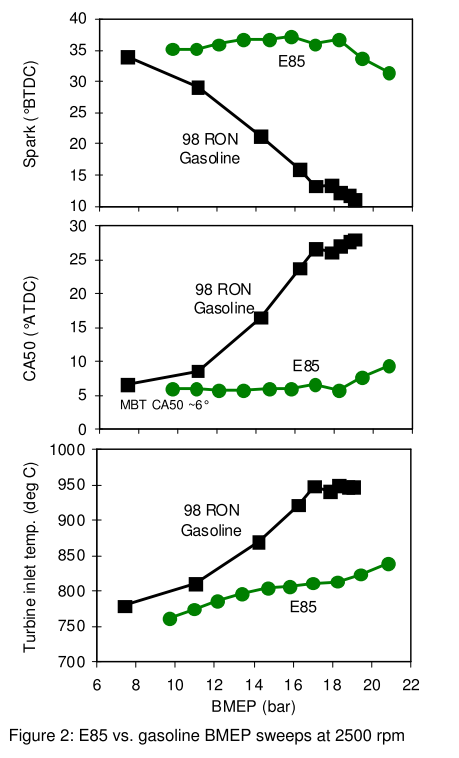
For purposes of this discussion, BMEP can be converted to torque. 10 bar BMEP is 260 lb ft and 20 bar is 520 lb ft. CA50 is location of 50% burn. MBT is typically 6-10 degrees after top dead center. Add roughly 5 degrees for location of peak pressure (CA50 of 10 = peak pressure at roughly 15 degrees ATDC firing).
Example: near 20 bar BMEP on this engine, so 520 lb/ft of torque at a fixed 2500rpm. With pump gas only, sprayed through port injectors, we run -10 BTDC degrees spark (10 degrees ATDC). With E85 direct injection we can run 30 degrees spark.
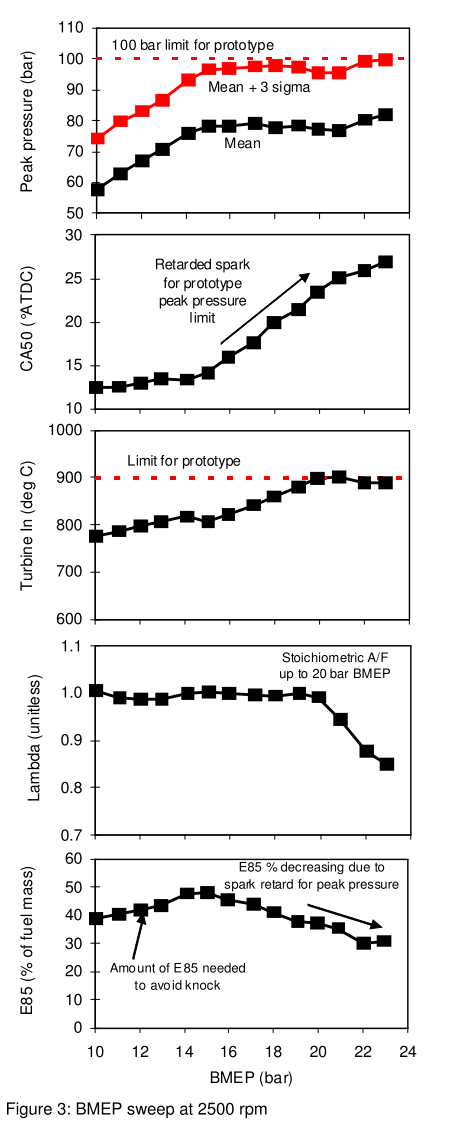
The second chart is kind of complicated and hard to explain without reading the attached paper. Basically, they were dialing in spark, AFR, and E85 blend % to #1 not overheat the turbo and #2 not exceed 100bar peak pressure in order to protect parts in the engine. But you can see that
they limited peak pressure to 100bar even when the engine wasn't knocking in order to prevent damage. They pulled timing even when they technically didn't have to, which then fed into the E85 blend ratio and Lambda so that the turbo didn't overheat. It's also a little complicated because you can go by average peak pressure across cylinders, average peak pressure over some number of cycles on a single cylinder, or peak pressure on a single cycle for a single cylinder.