Quote:
Originally Posted by cf6mech

I had bearing failure on E85 with no detonation with a very sound tune on a built motor running close to 400whp Using Amsoil 10W 40. I'm now equipped with Accelerated Performance Pauter rods with ACL bearings and at 300whp @ 10 psi with no issues.
|
One thing people don't realize is that when you run E85 or race fuel cylinder pressures can go way up with enough spark advance. I know that sounds strange--say you have 300whp (or 300wtq) on E85, versus similar output on pump. The E85 is much less likely to knock, so it should be better for the bearings, right? Well, sort of.
Peak cylinder pressures is highly sensitive to spark advance, or rather the phasing of peak combustion pressure. Allow me to illustrate.
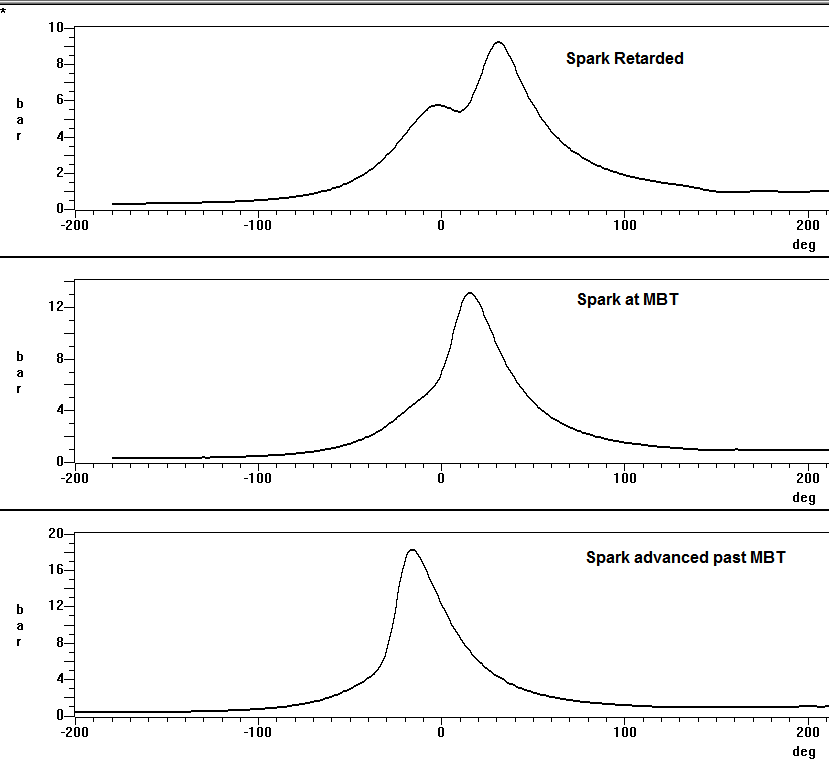
Here you can see a 300 engine cycle average pressure trace on this particular direct injected engine at an idle condition where knock is not really going to happen. This is all at constant torque, so other things were adjusted to make up for the effect of changing spark advance.
The top pressure trace has peak pressure occurring around 40 degrees ATDC firing. Spark is very late, after TDC. Now look at the Y axis. Peak pressure is about 9 bar.
Now look at the middle trace. Peak pressure is around 15-20 degrees ATDC, which at this speed and load is roughly MBT (minimum spark advance for best torque). Peak pressure is at 12.5 bar. Do the math--that's about 50% more cylinder pressure from retarded spark vs MBT, but engine output in the case is the same.
Finally, check out the bottom trace. This spark is way past MBT, something like 30 degrees BTDC. Peak pressure is about 15 degrees BTDC, way too early. Peak pressure is now about 19 bar. From the two extremes of unnecessarily retarded combustion to overly advanced combustion we double the cylinder pressure. Let's look at it with a pressure-volume diagram, (x axis volume, y axis pressure)
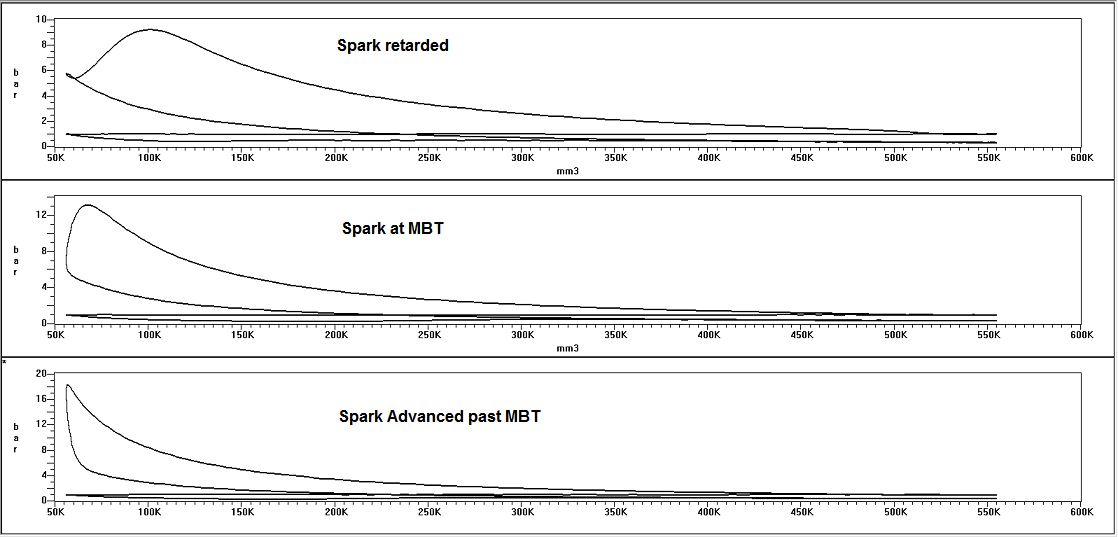
This relationship between non-knocking spark advance and peak cylinder pressure also exists at high loads. So what does that tell us? When we make our engine output relying on using knock resistant fuel and spark advance, it greatly increases cylinder pressure. What do you think that does to bearings? I'll say that again:
Fully taking advantage of knock-resistant fueling with spark advance can be very stressful on the engine due to high cylinder pressures, and it's not knock causing the stress.
This engine was never designed for high loads (lots of airflow crammed in there at a given rpm) and high cylinder pressures. Think about it when you put E85 in there, boost it, and have a low knocking tendency fueling (race fuel, E85, maybe water/meth).