Quote:
Originally Posted by brn12345

Ok so if the Arghx7 logic on LSPI is correct then I will go one step further and say that the fuel itself is a cause. To test I have access to VP Motorsport 103 (helps that I race circuit in Honda's) which ill fill up with for 2 tanks and observe by logging and hearing (wish I had unicorn ears) and will report back.
|
In my experience, race fuel basically eliminates LSPI. It's mostly a pump fuel phenomenon. Ethanol is a different beast--in some ways it has its own unique tendencies.
Quote:
Originally Posted by Td-d
There's another part of the puzzle which is not being picked up - transient conditions are not only managed with respect to spark, but also with respect to fueling. There are a set of tables that manage transient fueling - the so-called Tau tables (google it for some context). These tables either enrich or lean out the mixture based on a rapid transitions in engine load.
|
I'd have to look closely at what the tables supposedly due, but that is mostly a port injection phenomenon. In the days of the original AE86, the fuel injectors just kinda sprayed and as long as there was no major hesitation it was all good. So on modern port injection engines, you have what's called a wall film model.
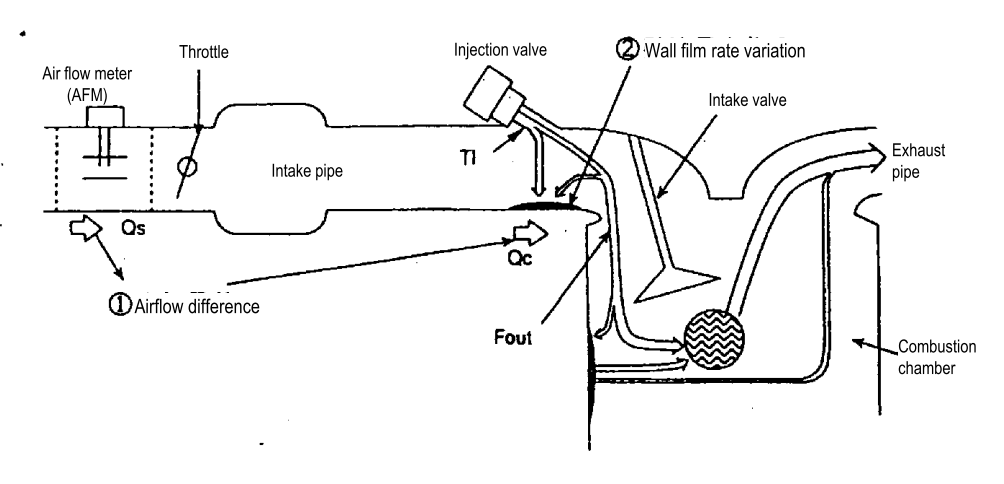
The wall film model calculates the steady-state size of the fuel "puddle" in the port. It figures out how much is sticking to the port and how much is flowing into the engine as the valve opens. Then it will adjust the main injection time to help maintain that puddle. In the event of rapid opening of the throttle, you might have additional injections. They can happen when the fuel is sprayed through an open intake valve and could potentially induce knock with the right temperature distribution.
On the direct injection side, transients can involve two injections per cycle. Sometimes it's two in the intake stroke, sometimes it's split between intake and compression stroke. It tends to help with knock There's no indication that this engine uses multiple direct injections. Keep in mind that with direct injection you don't have to worry about maintaining the fuel film on the back of the valve. However transients aren't fully understood to the point where we can say how exactly port and direct injection might be blended on this particular implementation of port + DI.
There's no easy way to know what's going on without acquisition of cylinder pressure, injector waveform, spark waveform, and individual crank angle degrees. You can certainly play around with tables and see if it helps though--but understanding the "why" is going to be murky. If changing a couple cells in some map makes it go away perhaps at the expense of some negligible fuel economy hit, that would be great.