Quote:
Originally Posted by jamesm

i just don't understand it all well enough to know for sure if they're there for a reason other than those you stated. i agree it probably is fine, i'd just want to understand the whole picture more before making that call.
|
I've given this explanation in other threads. Here's how enrichment delay timers really started. When the vehicle is being certified for fuel economy and emissions for the US market, it has to be driven on the US06 cycle:
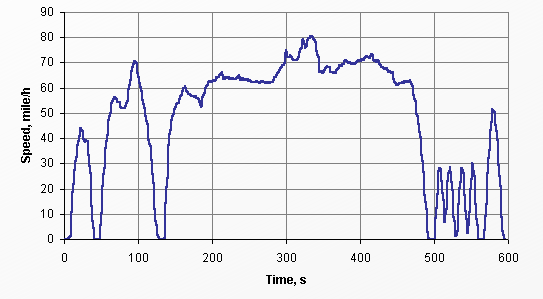
The cycle above is driven two times. The first time is a warm-up run, and the second one takes measurements of C02 (to calculate fuel economy), plus emissions. The most important thing here besides fuel economy is CO emissions. CO emissions are directly related to enrichment. So if I'm at Lambda=1 or 14.7:1 AFR on pure gasoline, my CO at the tailpipe is almost 0. The catalytic converter takes care of it.
If I have to work the engine hard though, the AFR will enrich first to keep the catalyst temperature down. It may also need to do so to protect for knock but usually the spark timing is ok for that. See that big acceleration at about 130 seconds? That and a few other spots are where the mixture is most likely to enrich to keep cat temps down. This applies especially to an engine with a poor low end torque or bad power-to-weight ratio (4 cylinder trucks for example).
The enrichment/open loop delay timers were developed and tuned so that the vehicle can get through these accelerations without adding more fuel than necessary. The timer counts up and might only add extra fuel for a small period of time. That helps fuel economy and CO emissions. Some cars stay in closed loop at heavy loads, but still have an enrichment delay timer. Subaru engine management is not particularly sophisticated though.
What can happen during development is that the vehicle is tuned a certain way by the driveability guys at the OEM. Then as it becomes time to certify the vehicle for emissions, the emissions guys lengthen the delay timer to meet a CO and/or fuel economy target. The cat temp and knock sensor readings are supposed to be in spec for durability. Sometimes what can happen though, and I think the '08 Subarus are a good example, is that the car gets pushed out to production meeting emissions but having a hesitation. The engineers weren't given enough time and resources to get the balance right, and you get pissed off customers. It's cheaper to tune the vehicle with a long closed loop delay than to redesign the engine with new parts that can satisfy fuel economy, performance, and emissions.