Quote:
Originally Posted by mid_life_crisis

I find myself wondering about gearboxes, but I don't see anything capable of spinning at the rpm we need as being reliable or affordable. If you were to try simply offsetting the motor and using a couple of gears to increase the speed, I worry that the side load forces would make the turbine unstable. Could this be overcome by using three smaller motors as the points of a triangle with the turbine shaft in the center? The appropriate sized gears would ramp up the turbine rpm and the three driving gears might support the driven gear of the turbine and help keep it stable while three smaller motors added together could supply the necessary power to spin the thing.
Going further, a plate at each end of the assembly sandwiching the three motors could support a center shaft with a high rpm bearing at each end, allowing you to build it with the drive shaft diameter of your choice in the center. The output speed of the drive shaft would be established by the ratio of the gears. The design is simple and should be fairly rugged.
|
I believe this is the design I was describing in post #270 and is my current plan. Ive been researching bearings, shaft sizes, and gears that will fit and am getting a solid idea of what I want to do. Ill probably start some 3d modeling soon.
More or less I'm not spending too much time on the controller I was speaking of because I'm curious how well the unichip is going to work.
Quote:
Originally Posted by mid_life_crisis
What keeps popping up in my mind when I think of this is a bank of relays wired up so that three identical batteries are wired in parallel and connected to the alternator's charging circuit. When you hit the activation switch, the relays switch and the batteries are in series connected to the electrocharger. You could wire in a voltage sensor that could trip a master relay in the event that one of the other relays ever stuck and the charging system would have seen more than one battery's worth of voltage.
It isn't exactly a new idea but it could work and you don't lose energy converting voltages.
|
So, basically you got the same idea Ive been thinking of and conveniently drew up last night:
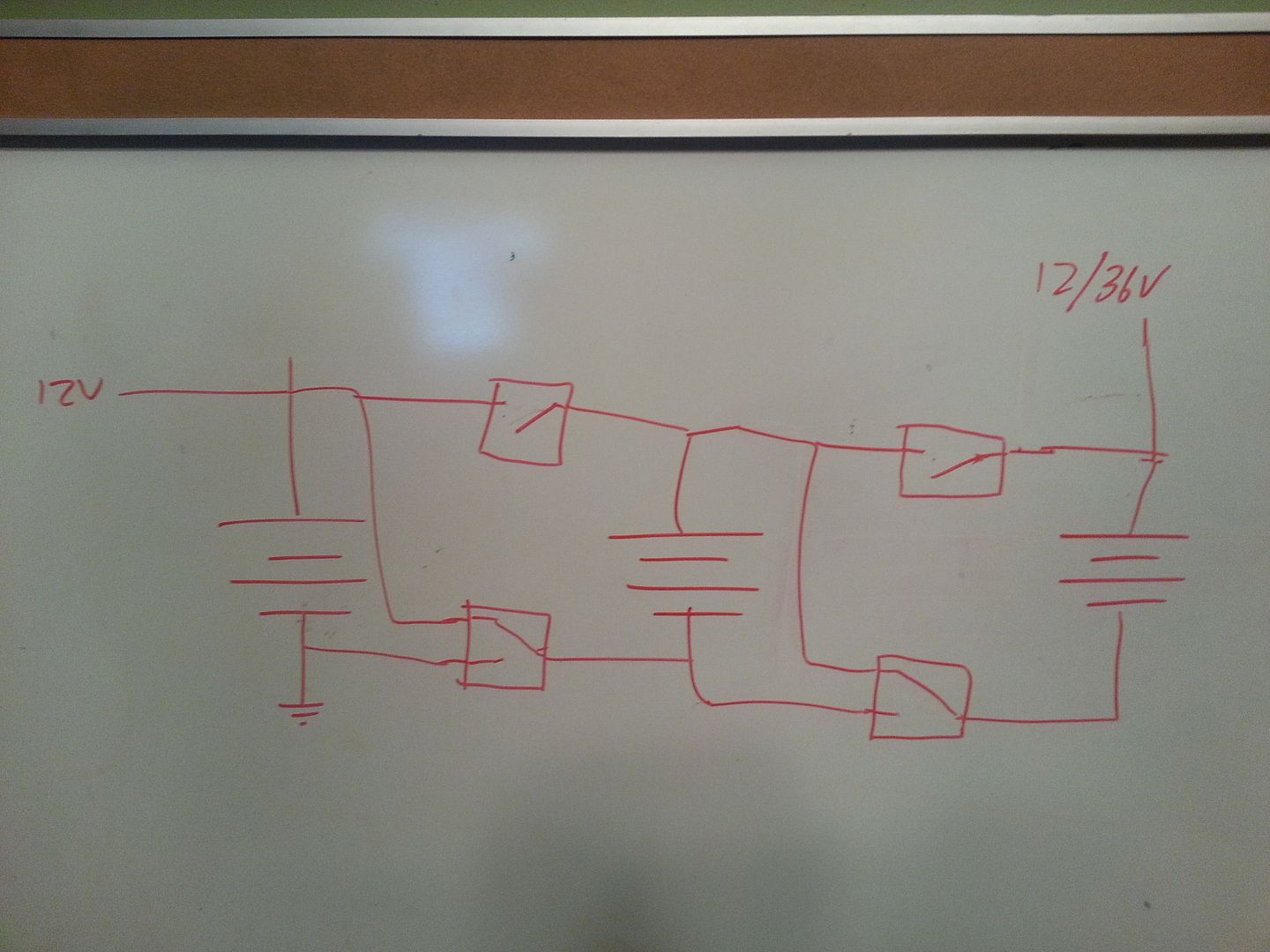
Obviously this isn't a full plan and would have failsafes/fuses etc, but seems like a solid idea.
Ive been doing a bit of looking as far as suitable relays go, but this idea works well for me because I will just put it in the trunk and then it will be perfect for stereo duties as well. If I use some xs power d925's Ill only be adding 20-30 lbs of battery weight but will have significantly more capabilities.